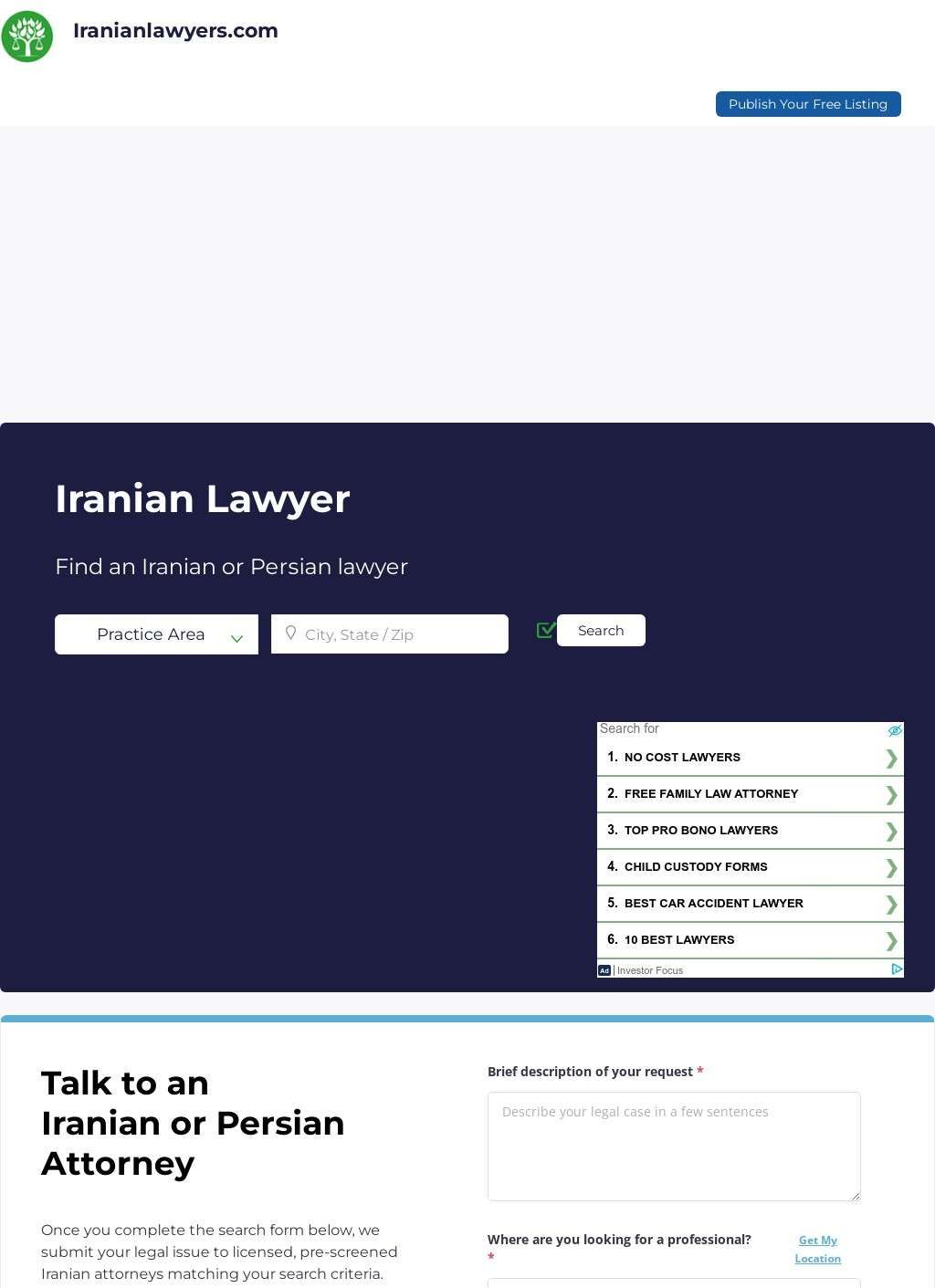
Iranian Lawyers is an online directory and attorney-matching service built specifically for Iranian and Farsi-speaking lawyers, with coverage spanning the United States, Canada, Australia, and Iran. The premise is narrow on purpose: someone who needs a lawyer who speaks Farsi, or who understands the cultural and legal context an Iranian client might carry into a case, can search by country and city and reach a practitioner without wading through general legal portals where that match would be pure luck. That is a real need, and the site is organized around answering it instead of looking impressive.
Practice areas by city
The breadth of practice areas is the first thing that registers as genuine. The site lists bankruptcy, business law, criminal defense, family law, immigration, personal injury, real estate, and tax law, then claims more than fifty additional specialties on top of those. That kind of spread only makes sense for a matching platform like Iranian Lawyers, because no single firm would advertise that range. It tells you the goal is to be a switchboard between people and attorneys, with the directory sorted so a user can drill down by where they live. Featured location pages exist for Los Angeles, New York, Chicago, Toronto, and Sydney, which lines up with where the Iranian diaspora actually clusters, so the geographic choices are not arbitrary.
On Iranian Lawyers, individual attorney profiles are published rather than hidden behind a contact wall, and the brief points to concrete examples: a labor and employment attorney in Los Angeles, and a business and litigation attorney in Ontario. Published profiles help a prospective client read about a specific person before sending an inquiry, and they show that the listings are populated by working practitioners, with no empty placeholder categories waiting to be filled.
Verifying attorney licenses
The vetting claim is where Iranian Lawyers tries to separate itself from a plain link dump. According to the About page, professional licenses are reviewed manually when a lawyer submits a listing, and then verified again every year. If that process runs the way it is described, it addresses the obvious weakness of any open directory, which is that anyone can claim to be anything. Annual re-verification is a stronger promise than a one-time check at signup, because licenses lapse and statuses change. The policy would be stronger with some documentation behind it, since the site states the standard without showing how a given review was carried out, but as a stated standard it goes further than many comparable sites bother to put in writing.
Referral pricing model
Listings for lawyers are free to submit, which is the usual way Iranian Lawyers builds its inventory quickly. The revenue side sits in a separate paid tier on the pricing page, where attorneys can buy qualified referrals. The terms there read reasonably for a working lawyer: each referral is sold exclusively once instead of being blasted to a dozen firms at the same time, there is no long-term contract, and no monthly minimum to hit. That structure favors solo practitioners and small firms who want to test the channel without locking themselves in, and it is a more honest setup than the pay-per-lead mills that resell the same inquiry repeatedly.
Iranian Lawyers also advertises HIPAA-level data security. That phrasing is a little loose, since HIPAA governs health information and a legal directory is not a covered entity in the usual sense, so it reads as a general statement of intent about handling sensitive submissions carefully, not a precise compliance claim. People reaching out about immigration trouble or a criminal matter are sharing genuinely private details, so taking security seriously is the right instinct even if the label is borrowed from the wrong field.
Contacting attorneys online
Reaching the company itself is handled entirely through the web. There is no phone number and no physical address published, which is worth flagging plainly: a visitor who wants to speak to a human before submitting anything will not find that option up front. Inquiries go through a web form, and the site commits to a reply within two business days, so at least there is a stated expectation instead of silence. A contact page is referenced elsewhere on the site, and once a user is matched, an in-site messaging system lets them contact attorneys directly, which keeps the conversation inside the platform.
For the attorneys being listed, that messaging channel is the point, and the lack of a public phone line is less of a concern. For an ordinary person in distress, though, the absence of a number to call is a friction point. The two-day window also implies this is not a place to turn for an emergency. Someone facing an arraignment tomorrow needs a phone, not a form, and the design here clearly assumes a more deliberate, plan-ahead kind of search.
Outside sources are nearly silent on Iranian Lawyers. A search did not surface notable third-party reviews or ratings tied to this exact domain. Making that search harder, several similarly named directories exist (iranianlawyer.com, iranianlawyer.info, iranianlawyer.org), and the testimonials that turn up belong to those competitors, not to this site. Anyone evaluating Iranian Lawyers should be careful not to credit it with praise that was actually written about a near-identical name, an easy mistake given how close the domains are.
That naming overlap is a real liability, not a cosmetic one. It muddies the trail of evidence a cautious person would normally follow, and it means Iranian Lawyers is leaning almost entirely on its own stated standards rather than on a body of public feedback. The manual vetting and annual re-verification have to do that work on their own, precisely because there is no external chorus to confirm or contradict them.
Weighed up, Iranian Lawyers is a sensibly built niche tool that does the one job it sets out to do: connect Farsi-speaking clients with vetted attorneys across four countries, sorted in a way that makes the search quick. The free listings, the exclusively-sold referral model, and the written verification policy are all points in its favor.
The caveats are equally real, though, and they keep my verdict measured: no phone, no public address, a security claim borrowed from an unrelated regulation, and an almost empty independent track record clouded further by copycat domains. For the specific person who needs an Iranian or Farsi-speaking lawyer and is willing to vet the individual attorney on their own, it is a useful starting point. As a platform you can trust on reputation alone, it has not yet earned that, and the gap is worth knowing before you rely on it.