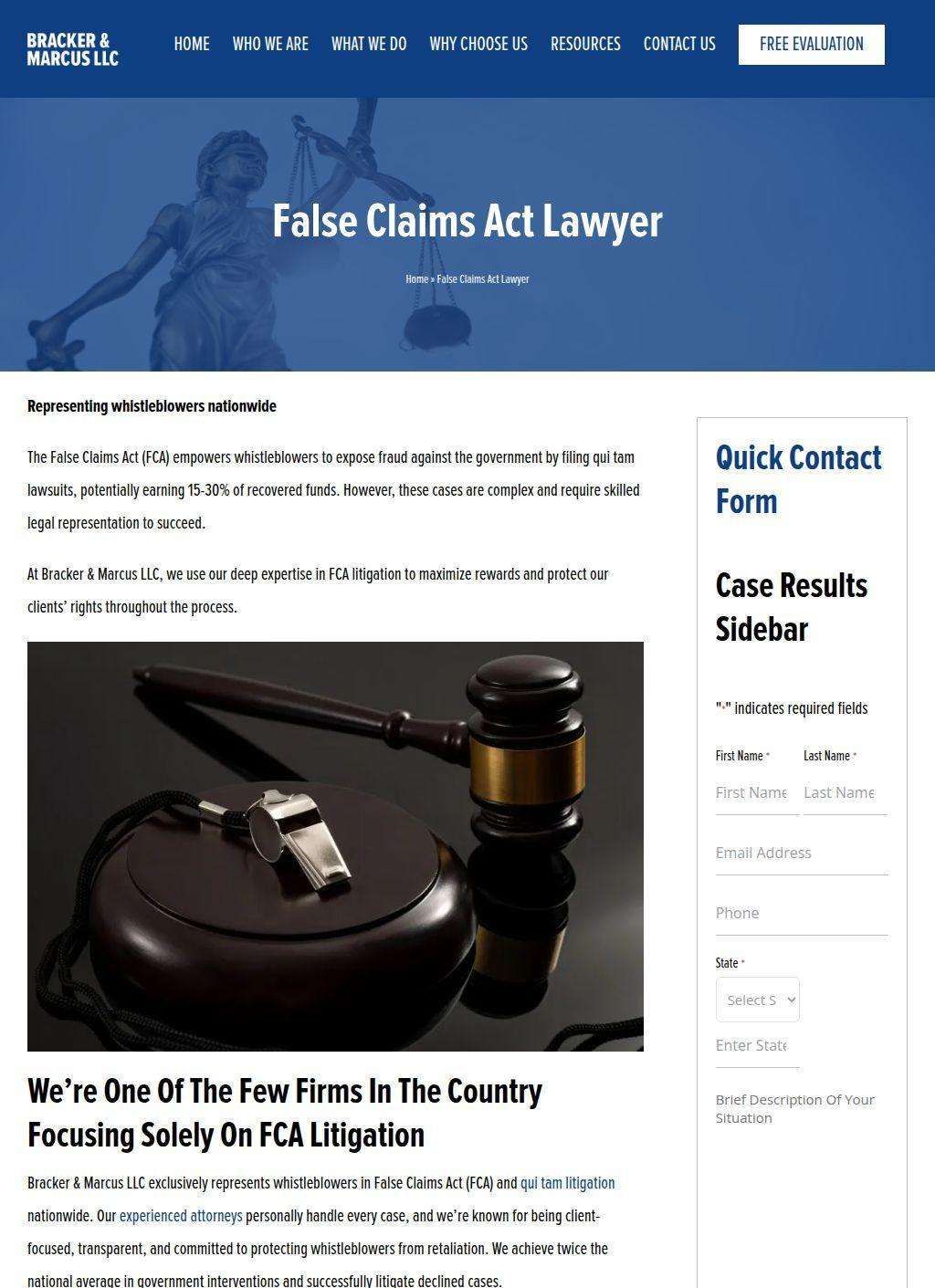
Bracker and Marcus LLC runs its whistleblower practice under the flat public name False Claims Act Lawyer, and it takes only one side of these disputes: the person reporting the fraud, never the company or agency being sued. Fees come out of a recovery if there is one, and the firm fronts the legal costs while the case runs, so a client who steps forward is not paying the meter month to month.
That single loyalty shapes the rest of the site. The work at False Claims Act Lawyer is qui tam and False Claims Act litigation, handled nationwide, for people who have watched public money get siphoned out of a government program and decided to report it.
The team is small and named in full. Julie K. Bracker and Jason Marcus are the partners. Graham Rusk and Sara T. Ballew are associates, Nathan M. Peak holds the counsel title, and Sheri Lang runs the office. A visitor can see exactly who would touch the file.
The site is laid out the way you would expect from a focused practice. Tabs cover Who We Are, What We Do, Why Choose Us, the case results, testimonials, and a Resources area holding a blog, an FAQ, and media coverage. City-specific pages sit alongside those, so a New York or Washington whistleblower lands on copy aimed at their location, and a Free Evaluation link threads through the whole thing.
The economics deserve a closer look, since they are the reason a whistleblower case gets filed at all. Reporting fraud usually means going up against a hospital system or a large contractor with a deep legal budget, and few individuals can fund that kind of fight on their own. By working purely on contingency and carrying the costs upfront, False Claims Act Lawyer takes the money question out of the decision, which is the practical wall most would-be whistleblowers never get over.
How the practice picks its fights
False Claims Act Lawyer does not spread itself across unrelated areas of law. Everything on the site points back to whistleblower and qui tam claims, sorted into the specific ways people defraud the government and the money that flows through it.
The fraud categories it takes on
The list at False Claims Act Lawyer runs long: healthcare fraud, government fraud, cybersecurity fraud, tariffs and customs fraud, PPP fraud, financial fraud, education fraud, federal grant fraud, mortgage fraud, and retaliation aimed at whistleblowers who come forward. Healthcare and government billing sit at the center of the practice, which tracks the reality that most large qui tam recoveries involve Medicare, Medicaid, or federal contracts.
Breaking the work out this way helps a reader place their own situation. Someone sitting on evidence of PPP abuse or falsified customs paperwork can open a page on False Claims Act Lawyer that speaks to that exact scenario instead of wading through one generic fraud pitch. The retaliation page matters too, since coming forward and then getting pushed out is a common ending for these stories.
The settlements on the results page
Three cases carry the credibility here, and they are specific enough to check. False Claims Act Lawyer points to a $23,963,100 settlement with B and H Health Care Services over unqualified home health aides billed to Medicaid, a $320 million resolution involving Taylor Bean and Whitaker Mortgage and Home America Mortgage over falsified borrower eligibility data, and a $117 million settlement with Universal Health Services over fraudulent psychiatric billing.
Those are specific numbers attached to named defendants, not a vague claim of success. False Claims Act Lawyer also states that its cases draw government intervention at twice the national average and that its attorneys lecture at whistleblower law seminars. The intervention figure is the one to press on, because government intervention is the strongest early signal a qui tam case has legs, and the site is the only source quoting it.
Taken together, those three results describe a practice comfortable with large, complex frauds across home health care, mortgage lending, and psychiatric billing, and willing to publish the defendant names and dollar figures that let a reader check them. For a whistleblower weighing whether a firm can carry a case of real size, that specificity does more work than any adjective could.
The testimonials tab
False Claims Act Lawyer publishes client testimonials with five-star ratings on its own pages. Those are selected and hosted by the firm, so they tell you how satisfied clients describe the experience and nothing about what a neutral platform would show.
Contact is easy. False Claims Act Lawyer puts a phone number at the top of every page, and the main navigation carries both a Contact Us link and a Free Evaluation link, which fits a practice that lives on intake calls from people weighing whether to come forward. A separate FindLaw profile lists an Atlanta office on Lenox Road, so the physical footprint checks out through a third party.
Here is where False Claims Act Lawyer gets harder to vouch for. A search for outside reviews of False Claims Act Lawyer turns up its own testimonials, competitor pages, and ranking directories, but no Google, Yelp, Trustpilot, or Better Business Bureau rating specific to it. A whistleblower is being asked to trust this firm with a career-defining, sometimes career-ending decision, and the absence of any independent verdict is the thing a careful reader is left staring at.

Business address
Bracker & Marcus LLC
3355 Lenox Road, Ste. 660,
Atlanta,
GA
30326
United States
Contact details
Phone: 770-988-5035