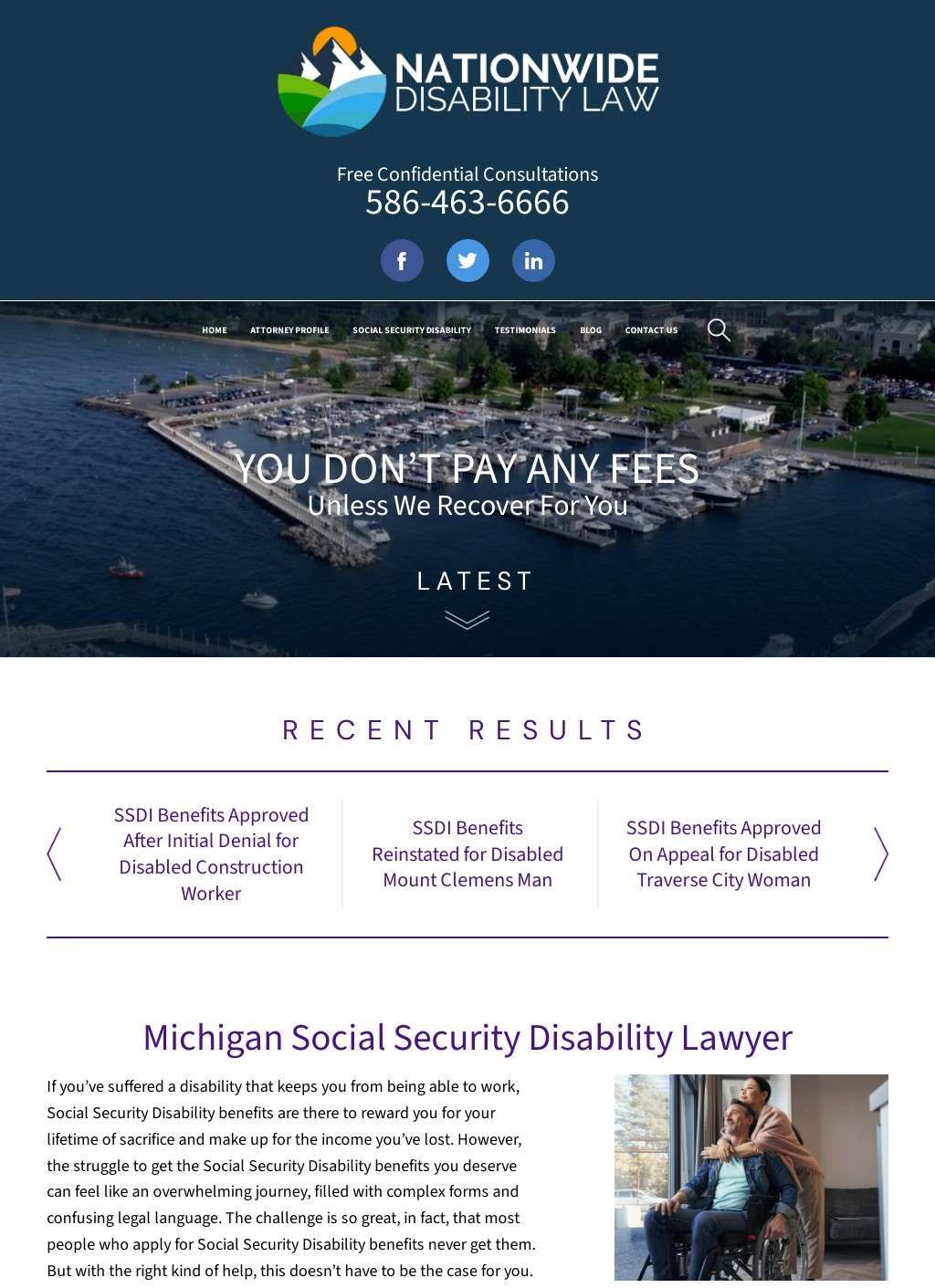
You have a denial letter and a deadline. The Social Security Administration has rejected your initial application, or the VA has turned down your claim, or a private long-term disability carrier has cut off your benefits. At that point, the attorney who appears at the administrative hearing matters more than anything on the firm's website. Michigan Social Security Disability Lawyer documents that Christopher Pozios personally attends those hearings, a structural commitment many disability practices sidestep by placing junior staff in the hearing room while the named partner handles intake and marketing.
Three disability claim types
The practice divides into three procedural lanes that share a common origin: an institutional decision-maker said no, and the claimant needs to push back through a defined appeals track. The first is federal disability benefits, SSDI and SSI at every stage from initial application through reconsideration and Administrative Law Judge appeals. The second is veterans disability: VA supplemental claims, higher-level reviews, and Board of Veterans' Appeals cases.
Offices and national reach
The third is private long-term disability insurance disputes when a carrier has denied or terminated benefits. Michigan Social Security Disability Lawyer operates under the trade name Nationwide Disability Law, headquartered in Mount Clemens, Michigan, with additional offices in Traverse City, New York City, and Naples. The firm takes clients across all 50 states, a scope the name does not communicate and one that raises a practical question: whether remote representation at ALJ hearings in distant states comes with any coordination costs or procedural disadvantages that purely local counsel would avoid. Each of these three claim types runs on the same contingency model, meaning Michigan Social Security Disability Lawyer carries the financial exposure until a case resolves.
How the contingency fee works
Every case runs on contingency, no fee unless benefits are recovered. For claimants who are typically out of work and exhausting savings by the time they begin seeking legal help, that removes the single most predictable access barrier. Contingency is standard in SSDI work, but the combination of contingency, a multi-office structure, national reach, and a named attorney personally attending hearings is a less common arrangement. Michigan Social Security Disability Lawyer builds its entire practice structure around that combination and makes it explicit in its marketing rather than burying it in site copy.
Resources on the firm's website
The site covers all 50 states with individual disability law pages. An eligibility guide and FAQ address practical questions: payment amounts, waiting periods, documentation the Social Security Administration requires. The blog updates regularly. For a first-time claimant, arriving at an initial conversation already understanding the procedural stages ahead reduces the orientation time considerably. The homepage lists a local Mount Clemens number, a toll-free line, a full street address with suite number, and an online intake form. For a practice whose clients are often managing health conditions severe enough to have stopped them working, that directness is appropriate.
Reviews and ratings across platforms
A Yelp listing exists for the Mount Clemens office under Michigan Social Security Disability Lawyer, confirmed in search results, but no numeric rating or review count surfaced in the available data. Searches across Google, BBB, Trustpilot, and Avvo produced nothing with a score or a review total attached. Self-published client testimonials appear on the firm's site, consistent in tone, but without independent source attribution. The attorney Christopher Pozios is listed as principal; no bar discipline records were found in a surface search, though a complete verification would require checking the State Bar of Michigan's public discipline database directly.
Why do no external reviews appear?
The absence of external ratings is the most specific weakness in the listing. A firm describing itself as nationwide, with offices in four cities, four years of regularly updated state-specific content, and an attorney personally attending hearings, would ordinarily accumulate some traceable public feedback. Zero confirmed external reviews across five platforms is not explained by anything the site says, and no independent source fills that role. The contingency model, the attorney-in-hearings commitment, the 50-state guide pages, and the updated blog are all consistent with a firm that takes the practice seriously. But none of those features confirm outcome quality, and without outside attestation the self-reported credentials cannot be tested.
Weighing the firm against alternatives
Michigan Social Security Disability Lawyer presents a coherent practice structure and removes the cost barrier through contingency. What a prospective client cannot determine from the listing alone is whether the ALJ-stage outcomes justify choosing this firm over a Michigan-based SSDI attorney with a documented track record. The State Bar of Michigan's Lawyer Referral Service and the Michigan advocacy group Disability Rights Michigan both maintain referral pathways where independent outcome data is more accessible. Use those to benchmark Michigan Social Security Disability Lawyer before making a decision either way.