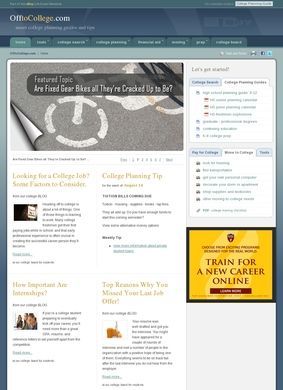
Buried in the navigation of OfftoCollege.com is a feature called the Textbook Navigator, and it does more to explain the site than any tagline could. It is aimed squarely at the student who has already accepted the sticker price of tuition and is now staring at a four hundred dollar pile of required reading, looking for rentals and discounts. That money-conscious, practical angle runs through most of what College Planning Center offers. College Planning Center is the brand name OfftoCollege.com uses for itself, and it pitches the site as a free "online guidance counselor" for high school seniors, current undergraduates, and anyone heading into graduate or continuing education.
Planning tools for application and finances
The content follows the obvious milestones of getting to and through college. For seniors there are search guides, step-by-step checklists, and forms meant to keep the application year from turning into chaos. Graduate students get their own planning track. Financial aid gets the most attention: FAFSA completion walkthroughs sit next to material on scholarships, grants, and student loans. That grouping makes sense. Anyone who has tried to fill out the FAFSA without help knows how badly a plain-language walkthrough is needed, and placing it beside scholarship and loan information means a student can work through the money questions in one place.
Budgeting and logistics resources
Beyond textbooks, College Planning Center extends into the day-to-day logistics that tend to catch students off guard. Budgeting calculators, a Job Center pointing toward internships and campus employment, a downloadable PDF moving checklist, and guidance on what to actually buy before move-in day are all in the mix. None of these are original in isolation, but bundling them is sensible. A student does not naturally separate a budget plan, a summer job search, and a dorm packing list into three different research projects, so having them together saves time.
The editorial side comes from the College Journal, which runs articles sorted into careers, academics, college news, money management, college living, and travel. That spread is broad, arguably broader than a focused planning tool needs, and it reads like an attempt to keep people on the site between the big deadlines. A Success module covers planning, discipline, and time management, which is the softest part of the offering. Registration and login exist, meaning College Planning Center wants returning users who can track progress across visits not treating the site as a one-time reference stop.
Taken together, the breadth is the strongest argument for the site. A high school senior could plausibly use College Planning Center to map out an application timeline, work through the FAFSA, price textbooks, and pack for move-in without bouncing between five different websites. Whether the depth matches the breadth is harder to judge from the outside, but the surface presentation points to the planning checklists and the FAFSA material as where the real effort went.
Contact information missing from site
The contact page at the expected URL appears to carry lorem ipsum placeholder text rather than working contact information. Lorem ipsum is the filler designers drop in before real copy is written, and finding it live on a published page means that section was never finished. No phone number, no physical address, and no direct email appear on the homepage or the support page either. For a resource asking students to register accounts and trust its FAFSA and loan guidance, an unfinished contact page is a real problem. A student who hits a broken link, a confusing form, or an out-of-date scholarship deadline has no obvious way to flag it or ask a question.
The "online guidance counselor" framing sharpens the concern, because a counselor you cannot reach is not much of a counselor. A gap like that separates an actively maintained resource from one that was built, launched, and then left. It also raises a practical question about the currency of time-sensitive material like FAFSA deadlines and scholarship windows, where content that is a year out of date is unhelpful at best and actively misleading at worst.
One clarification on the name: a separate brick-and-mortar operation called College Planning Center, based in Tustin, California, appears on the Better Business Bureau and is reportedly out of business. That is a different entity from OfftoCollege.com. Anyone searching the name and landing on the BBB listing for the California office is looking at an unrelated company, not the website reviewed here.
A search for third-party ratings or user reviews of College Planning Center and OfftoCollege.com came up empty. There were no notable platform ratings or aggregated opinions to factor in. That absence is not a verdict by itself for a free resource that may simply fly under most reviewers' radar, but combined with the placeholder contact page, there is no external signal to offset the maintenance concern. College Planning Center has to be judged almost entirely on what it puts in front of you.
Verify deadlines with official sources
The concept is genuinely useful and the menu of tools addresses things students actually struggle with: the FAFSA walkthrough, the textbook savings angle, the budgeting calculators, and the application checklists all have real value. The reservations are about upkeep and accountability. Used with those caveats in mind, College Planning Center works best as a starting point and a structural guide rather than a primary authority.
Lean on it for the evergreen material like how the FAFSA works and where to find cheaper textbooks, and verify anything with a deadline against the official source before acting on it. If the people behind the site finish the contact page and show the content is being kept current, the case for College Planning Center gets substantially stronger. On the evidence available, it is a useful skeleton with some unresolved questions about who is minding it.