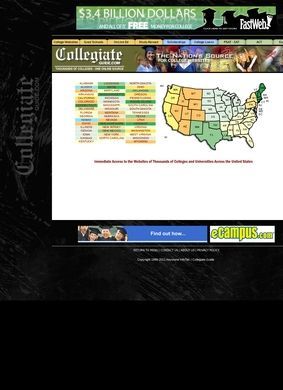
Colleges and Universities is a U.S. college search portal at collegiateguide.com, in operation since 1999 and run by Senior Class Graduation Products, LLC. The pitch is straightforward: a single launch point connecting prospective students to the official websites of more than 3,000 universities, colleges, and trade schools across the country. That focus on high school seniors and applicants trying to narrow down where to enroll shapes nearly everything on the page, and the parts are worth taking one at a time.
Searchable directory of college websites
The backbone of Colleges and Universities is a searchable directory that links out to individual institution sites. This makes it a referral hub rather than a content destination, which was a reasonable design choice for the era it was built in and is arguably still useful today. A student who already has a shortlist can jump straight to the source instead of wading through a paywalled ranking service. The trade-off is that all depth lives on the schools' own sites; Colleges and Universities points the way without trying to reproduce admissions data, tuition figures, or program details in-house. Anyone expecting a comparison engine with filters for cost, acceptance rate, or major will not find that here.
Honor societies and academic information
Around that core directory sit a few smaller sections. Colleges and Universities offers information on honor and academic societies, a collection of fun facts about colleges, and a "Class of 2025 Information" area aimed at current seniors. The honor society material has a practical reason to exist, since it ties directly into the merchandise side of the operation. The fun-facts section is harder to place; it reads more like light filler than a tool a student would return to, but it does no harm sitting alongside the rest.
Graduation apparel and regalia
The commerce half of Colleges and Universities is more developed than the name alone would imply. The site sells a range of college-related goods: apparel, Greek life clothing, custom college products, and graduation regalia such as honor cords and stoles. The honor cords and stoles connect logically to the academic-society content, so the merchandise is not bolted on at random. A graduating senior reading about which societies confer which colors can then buy the corresponding regalia in the same place.
Still, the dual identity does affect how Colleges and Universities should be read. When a directory also runs a shop, a visitor is right to keep the two functions mentally separate. The outbound links to college websites are neutral and useful regardless of whether anyone buys a stole. The retail pages serve the graduation-products business that operates the whole thing. Neither undermines the other, but a student should know going in that part of what they are looking at is a storefront, not impartial guidance.
From news feeds to current campus coverage
Content freshness is handled partly by embedding outside feeds. Colleges and Universities pulls aggregated news from US News on the education beat and from Sports Illustrated for NCAA coverage. That keeps something current on the page without requiring a staff writer, and it suits the audience: prospective students often care about both campus academics and college athletics. The flip side is that this content is borrowed, so its quality rides on those external publishers rather than on anything Colleges and Universities produces itself.
On structural housekeeping, the site does the basics. There is a privacy notice and a sitemap, both reassuring to see on a property that has been online for as long as this one. A sitemap in particular shows that Colleges and Universities is built to be crawled and navigated in full, which fits its purpose as a jumping-off point to thousands of destinations.
Contact information and customer support
Where Colleges and Universities is less forthcoming is in how it presents the company behind it. There is an "About Us" link, but the accessible pages do not surface a phone number, an email, or a mailing address, and no direct contact route turned up in the content that loads. For a directory whose main job is sending traffic elsewhere, that is a smaller problem than it would be for a service business taking bookings.
A student does not really need to reach Colleges and Universities to use the directory; they need it to reach the schools. The contact gap becomes more relevant on the retail side, where a buyer might reasonably want a way to ask about an order, sizing, or a return. Anyone planning to purchase regalia would do well to confirm there is a working support channel before paying, because the landing page does not put one forward.
On outside reputation, there is not much to report, and it is better to say that plainly. A search for third-party reviews of collegiateguide.com or the company behind Colleges and Universities did not return meaningful commentary. What surfaced instead were reviews of the colleges themselves, hosted on GradReports, StudentsReview, Niche, Unigo, and Princeton Review. Those evaluate the institutions a student might pick, not the portal that links to them. Colleges and Universities arrives without a public track record of user feedback, which is common for referral sites of this type but still leaves a visitor judging it on the merits of the page alone.
Taken together, Colleges and Universities suits a fairly specific moment in a student's timeline. Someone in their senior year who wants a clean, ad-light list of school websites, plus a quick read on honor societies and a place to order graduation gear, will get genuine use out of it. Someone hunting for rankings, side-by-side data, or in-depth admissions advice should treat Colleges and Universities as a starting point and go to the schools and the dedicated review sites for the substance. The age of the operation works both ways: a property online since 1999 has real staying power, though parts of the presentation feel built to an earlier web.
The strongest link in the whole setup is the alignment between the academic-society content and the regalia for sale, because each gives the other a reason to exist on the same domain. The directory itself is the broadest feature but also the most commoditized; a list of links to 3,000 college sites is something a search engine now handles on its own. The lasting value of Colleges and Universities lies in being a curated, single-purpose entry point that has kept its lights on for a quarter of a century while pairing that directory with a graduation-products shop aimed squarely at the students using it.