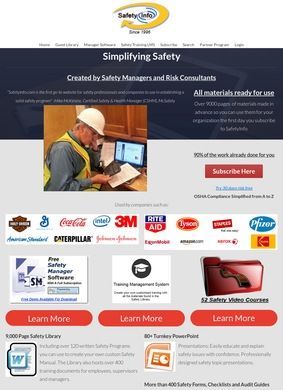
At $389 standalone or bundled into a full subscription, the Safety Manager Software tells you something about how SafetyInfo is structured. This is not a blog with downloadable checklists. It is a paid membership library aimed at people who keep workplaces compliant with OSHA and who would otherwise be building every program and form from scratch.
Library size and topic coverage
The numbers it puts forward are the main pitch, and they are specific enough to take seriously. Over 9,000 pages of material, more than 120 written safety programs, 400-plus training documents, 80-plus PowerPoint presentations, and another 400-plus forms, checklists, and audit guides. For a safety manager who has ever sat down to write a lockout/tagout program or a fall protection plan from a blank page, that library is the whole value proposition. The topic spread backs it up: forklift operation, electrical safety, ergonomics, emergency management, fall protection, and a long run of other hazard areas that tend to land on a single overworked person's desk.
Bundling programs with training materials
What I find more telling than any one number is that the catalog is built around the actual artifacts a compliance program produces. A written program paired with the training deck, the quiz, the sign-off form, and the audit guide is how that program survives an inspection.
Extra tools beyond the document library
There are training videos, fact sheets, and posters in the mix, plus lighter touches like safety crosswords that read as filler for toolbox-talk variety. The toolset rounds it out: beyond the Safety Manager Software, SafetyInfo offers a Sign and Label Maker and a set of safety calculators, which turn the site from a document repository into something closer to a working desk for the job. Those extra tools are minor next to the document library, but they cover small jobs a safety manager would otherwise hand off to separate software, and they sit in the same place as the reference material.
Company history and target audience
Operating since 1996 is not a small claim for a web resource, and it lines up with how the material is organized: deep, categorized, and clearly accreted over many years and not spun up to chase a trend. SafetyInfo knows its audience. Safety professionals, plant and operations managers, and companies that need defensible, OSHA-ready documentation are the people who will get their money's worth. A small business owner who needs one hazard communication sheet will find the membership model heavy for that need, and the site does not pretend otherwise.
Checking membership pricing details
The "tens of thousands of companies" line is the kind of self-reported figure that is impossible to check from the outside, so I would weigh it lightly. The 1996 start date and the sheer depth of the catalog do more to build trust than that sentence does. Membership pricing sits behind the sign-up flow on SafetyInfo, which is standard for this kind of library, though it does mean a prospective member has to commit before seeing the full shelf.
Contact information and physical presence
On the practical side, SafetyInfo is easy to reach. There is a physical address in Birmingham, Alabama, a direct phone line, and a contact form, which together point to a real company behind the subscription and not an anonymous paywall. For a service people pay for year after year, a street address and a published phone number give a subscriber somewhere to turn when a renewal stalls or a document question comes up, and that is no small thing for a paid library.
Reviews across major platforms
Outside reputation adds little. A search turns up a single listing on smart.reviews with an algorithmic trust score of 3.3 out of 5, and nothing on Google, Trustpilot, BBB, or Yelp. That is a very short list for a site that has been online since the late nineties. It does not read as a red flag so much as a reflection of the audience: corporate safety departments renew quietly and rarely leave public reviews, and a B2B compliance tool simply does not generate the chatter a consumer product would.
Assessing the smart.reviews score
That lone score came from a rating engine, not from a paying member, so it tells a prospective subscriber little that the empty profiles on the other platforms do not already say. Still, anyone deciding whether to subscribe will not find a body of customer feedback to lean on, and that is worth knowing going in.
The most reliable evidence is internal rather than external. SafetyInfo's catalog is large, specific, and maps onto the real paperwork that keeps a compliance program running. The site asks you to take the depth on faith until you are inside, but the visible part holds together well enough. Weighing the breadth of the library and the software bundle against the membership cost and the absence of a public review record is what a prospective member has to settle, and the published material gives enough to make that call.