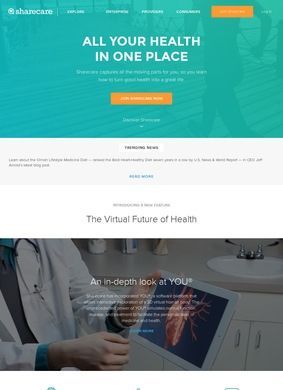
A digital health company that went public through a SPAC merger in 2021 sits behind this consumer health site, which is an odd origin story for something that looks, on the surface, like a stack of articles about diabetes and heart disease. Share Care: Expert Health Information is the public face of Sharecare, an Atlanta-based business founded in 2010 that built a large machine selling population health products to employers and insurers, then put a free library and a set of self-service tools in front of regular people. Knowing that backstory changes how you read the rest of the page.
Consumer tools and editorial content
The consumer side is the part most visitors will touch first. AskMD works as a symptom checker and question-and-answer tool, Find a Doctor and Find a Caregiver handle the search side, Sharecare Rx points toward prescription savings, and Sharecare Windows acts as a personal health dashboard. None of these are exotic ideas on their own, and plenty of sites offer a version of each. What makes Share Care: Expert Health Information different is having them gathered in one place alongside editorial material instead of scattered across separate apps.
Condition education centers and pharma partnerships
That editorial material covers a lot of ground. The site runs condition education centers across more than 50 health topics, with the brief listing cancer, diabetes, mental health, heart disease, MS, psoriasis, Crohn's, ADHD and more. Some of those sit inside what the company calls Condition Headquarters, guides co-developed with pharmaceutical and life-sciences partners. I want to flag that arrangement plainly, because a reader deserves to know that some of the deepest guides on a given disease were built with a drug-industry partner in the room. It does not make the information wrong, and Share Care: Expert Health Information does publish an editorial policy, a press center and a blog, which is more disclosure than many health sites bother with. It does mean a careful reader should treat a branded condition guide differently from a plain article.
B2B services for employers and payers
Behind the consumer tools is a sizeable B2B operation, and the site does not hide it. CareLinx handles home care staffing and matching. There are digital therapeutics, health advocacy services, and population health management products aimed at employers and payers. The customer list named on the site runs well past individuals: employers, health plans, public-sector bodies, brokers and consultants, providers, and life sciences companies all get their own pitch.
Professional tools for clinicians
For clinicians, the company points to Dx Dialogues and CareView, the latter a patient-data tool still marked "coming soon." That label is worth noting, since it tells you the professional side is a work in progress rather than a finished suite. The leadership page lists the executive team, and the site keeps a section on health equity resources, which reads as a genuine editorial priority rather than a throwaway page.
From free content to institutional sales
All of this explains the economics. The free articles and tools exist because the company sells health management to organizations, and Share Care: Expert Health Information is essentially the shop window for a much larger commercial engine. A "Contact us" link lives in the About section of the navigation, so a route exists, but the homepage shows no phone number and no address up front. You have to click through to reach anything, which is a minor friction for a company of this size and one you might expect them to handle more openly given how much of their model depends on institutional trust.
Employee reviews dominate public feedback
Outside opinion is harder to read than usual here, because most of what turns up is about working there, not using it. Trustpilot carries 52 reviews with mixed sentiment and no clear aggregate rating in the snippet. The bulk of the feedback is employee-facing: Glassdoor shows 924 reviews at 3.1 out of 5, Indeed adds 442 reviews, and Comparably has more, again mixed. No consumer star ratings surfaced on Google or Yelp. So the consumer reputation picture is limited, and the employer-side signal is average at best. A health brand this established with so little consumer review volume likely reaches most users through employer benefits portals or search results: they land on a page, read it, and leave without ever rating it.
This is a substantial, well-resourced site with real tools and a deep content library, carrying two honest caveats: some flagship guides are built with pharma partners, and public reputation rests mostly on employee reviews. Neither sinks it. Both should shape how you use it. The free information on Share Care: Expert Health Information is a reasonable starting point for understanding a condition, and the search tools can save time. Just check whether the guide you are reading is a standard article or a Condition Headquarters page, and weigh the source accordingly.
HR and benefits managers evaluating population health vendors will want to ask Sharecare specifically how CareLinx staffing and the advocacy services are priced and measured. Patients who landed on Share Care: Expert Health Information while researching a diagnosis can use the condition centers and AskMD freely, but the pharma-partnered guides deserve a second read against a source with no commercial stake in the topic. Share Care: Expert Health Information publishes enough about its structure and partnerships that an informed reader can calibrate. That transparency, partial as it is, puts it ahead of sites that bury the same conflicts in fine print.