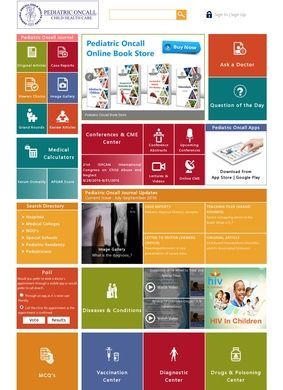
Where does a pediatrician turn when a child presents an unfamiliar rash, and the textbook is on a shelf two floors away? Pediatric Oncall answers that with a single web platform built around one specialty: the medicine of children. The Mumbai-based site keeps an A-to-Z disease database, a drug index with child-specific dosing, a set of clinical calculators, and structured guidance on vaccines and nutrition. It reads as a working tool for people who treat kids, with parents allowed in as a second audience.
Drug index and clinical calculators
The drug index is the part most likely to get repeat use. Pediatric prescribing turns on weight-based and age-based dosing that differs from adult references, and a resource that bakes that in saves the kind of mental arithmetic that goes wrong at the wrong moment. Pair it with the calculators and you have the two things a busy clinic actually reaches for between patients. The disease database fills out the rest, indexed by condition so it works as a quick lookup as much as a study aid.
Education materials and peer-reviewed journal
Past the reference material, the site leans hard into education. There are CME materials, a video library, Grand Rounds teaching files, spot-diagnosis cases, and a recurring Question of the Week. That spread suggests the people behind it think about training as much as point-of-care lookup, and the teaching files in particular are the sort of thing residents pass around.
Sitting alongside that is the Pediatric Oncall Journal, described as peer-reviewed and refreshed with each issue. A peer-reviewed publication run under the same roof as the clinical database is a real signal of seriousness, since it implies editorial process and outside scrutiny rather than a single author posting notes. The organization also puts out printed books on pediatric subjects and keeps a running list of medical conferences, which rounds the offering into something closer to a small publishing operation than a static reference site.
An "Ask a Doctor" consultation service is offered too. For parents that is the headline feature; for clinicians it is more of a side door. The mix of professional reference, formal teaching, journal, and a public Q-and-A channel is unusual to find bundled together on a single site, and it does create a slight tension over who the primary reader is, though the depth of the clinical sections makes the professional tilt clear enough. Pediatric Oncall plainly aims its core material at people with medical training first.
Mobile apps for different user needs
Pediatric Oncall does not stop at the browser. It ships a cluster of mobile apps, each carved off a function of the main site: a flagship Pediatric Oncall app, plus separate Medical Calculators, Drug Center, Vaccine Reminder, Parenting, and Journal apps. Splitting them out is a defensible call, since a parent wanting vaccine reminders and a doctor wanting dosing tables are not after the same thing, and a leaner single-purpose download often beats one heavy app that tries to be everything.
The numbers behind those apps give an outside read on whether people stick with them. The main Pediatric Oncall Android app has crossed 100,000 downloads and averages 4.4 stars across more than 2,700 ratings, which is a solid score on a base large enough to mean something. The iOS version sits at 4.1 stars, though only from 63 reviews, a thinner sample that means less as evidence. Those figures are the strongest third-party evidence here, because app-store ratings are harder to stage than testimonials and they come from people who installed the thing and kept using it.
Beyond the stores, the reputation trail is shorter. The Facebook page shows 49 reviews with 78 percent recommending, a positive lean on a small count. There is no large pile of independent ratings to lean on past that, so the app scores end up doing most of the credibility work, and they do it reasonably well.
Contact information and social presence
Contact is where Pediatric Oncall is least forthcoming. The homepage does not put a phone number, postal address, or direct email up front. A feedback form is present, and an email, feedback@pediatriconcall.com, surfaces on the Facebook page, while links to Facebook, Twitter, YouTube, and Instagram are reachable from the site. A street address, Francis Road, Vile Parle (West), Mumbai 400056, turns up in third-party listings instead of on the site itself. For a clinical-information platform that is a minor knock: a reader who wants to know who stands behind the dosing tables has to dig a little, and a clearer contact and editorial page would close that gap. The active social accounts and the working feedback route mean the door is not shut, just not held wide open.
Staying focused on pediatrics alone
One thing worth noting is the consistency of focus. Plenty of medical sites widen their net until pediatrics is one tab among many, and the offering thins out as a result. Pediatric Oncall stays inside its lane, and the database, drug index, calculators, journal, and teaching files all serve the same specialty rather than pulling in different directions. That coherence is part of why the apps can be split cleanly along function lines without any of them feeling like an afterthought. It also explains the volume of teaching content, since a site this committed to one field tends to attract contributors from inside it.
For a working pediatrician or a medical student, the value of Pediatric Oncall is easy to see: a dosing reference and calculator set you can keep on a phone, a disease index for fast lookup, and a teaching library for the slower hours. For a parent, the Ask a Doctor channel and the parenting and vaccine-reminder apps are the natural entry points, with the caveat that this is a reference and consultation service, not a substitute for an in-person visit. The journal and the conference listings sit at the academic end and matter most to people already inside the field.
What Pediatric Oncall delivers is breadth held together by a narrow subject. A clinician can answer a dosing question, brush up on a condition, read a peer-reviewed case, and pass a teaching file to a junior without leaving the same set of resources. The contact opacity and the unevenness between a strong Android base and a small iOS sample are the rough edges. The drug index with built-in pediatric dosing remains the piece most likely to keep someone coming back.