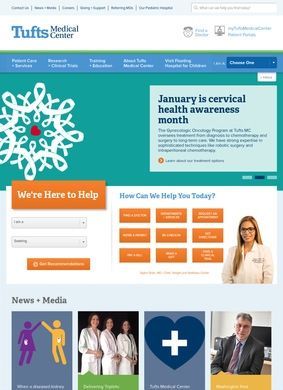
Through a single app called myTuftsMed, a patient can request an appointment, pay a bill, and pull up test results without phoning anyone, and that portal is the hinge the whole online experience turns on at Tufts Medical Center. The web and mobile versions handle the routine transactions most people actually need from a hospital site, which is more than a lot of health systems get right.
The listing sits under the wider Tufts Medicine banner, the regional system that runs the flagship hospital along with several others, so a visitor is really looking at two things at once: a large health network and Tufts Medical Center at its centre.
Care across a regional system
The hospitals under one system
Tufts Medicine operates Tufts Medical Center in Boston together with Lowell General Hospital, MelroseWakefield Hospital, and a dedicated behavioral-health hospital, plus home-care and visiting-nurse services and a hospice and palliative-care arm. That spread means the network can follow a patient from a hospital bed to recovery at home, a real advantage for anyone managing a long illness or an aging parent who needs care in stages.
The system treats adults and children alike, described on its own pages as covering everything from routine check-ups to the most involved treatments. For a family that would rather keep every record inside one organisation, the breadth is a practical argument on its own, and it is the sort of continuity a standalone clinic cannot promise. A referral inside the same system usually means the next doctor can already see the chart, which spares a patient the tedious work of carrying results between unconnected offices.
The list also includes a dedicated behavioral-health hospital and a hospice and palliative-care arm, two services a general hospital often farms out. Keeping mental-health care and end-of-life care inside the same system is the kind of completeness that only shows its value at the hardest moments, when a family is least able to go shopping for a new provider.
Specialty and everyday care
Clinical depth is where a hospital like this justifies itself, and Tufts Medical Center names its strengths plainly. The specialties include cardiovascular care, neurology and neurosurgery, cancer care, obstetrics and gynecology, and gastroenterology. Those sit alongside primary care, general specialty care, virtual visits, urgent care, and emergency medicine, with both adult and pediatric patients covered.
That is a wide clinical map, and it lines up with where Tufts Medical Center draws its outside recognition, particularly in heart care. A person weighing a hospital for one specific condition will find the relevant service named on the site instead of buried under vague marketing, which is more than some large systems manage. Virtual visits and urgent care fill the space between a scheduled appointment and a full emergency, so the everyday complaints that do not warrant an ER trip still have somewhere to go.
Primary care sits at the base of all of it, the routine relationship most people actually keep with a health system, and the site puts adult and pediatric care under the same banner so a household is not split between two organisations. A parent scheduling a child's check-up and their own follow-up can, in principle, handle both in one place, which is a small mercy for anyone juggling a family calendar.
How outside raters see it
The third-party record leans strongly positive on the clinical side. U.S. News & World Report rates Tufts Medical Center "High Performing" in Cardiology and in Heart & Vascular Surgery, and across twelve adult procedures and conditions. It also lands among the Best Regional Hospitals for the Boston area. The Leapfrog Group has handed the hospital an "A" Hospital Safety Grade, and Healthgrades has recognised it for patient experience. Those are the ratings that count most when the question is whether a hospital is safe and good at what it does, because they measure outcomes and process, not bedside charm.
Patient-voice reviews run more mixed, as they tend to for any big-city hospital. A Yelp listing for Tufts Medical Center's Boston location gathers 269 reviews with a real spread of opinion, including specific praise for the heart-transplant team. A pointed compliment aimed at a named program tends to mean more than a vague five stars.
On the employer side, and reported only for completeness, Glassdoor gives Tufts Medical Center 3.4 out of 5 across more than 831 staff reviews, with 47% saying they would recommend working there, and Indeed carries 567 reviews; a Fitch credit rating of BBB- on the organisation's bonds also turns up, though that gauges financial standing, not care. Neither the staff scores nor the credit grade says anything direct about a patient's day.
Read together, the record splits cleanly. The institutional ratings, the safety grade, and the clinical rankings speak to competence, and they are strong. The patient reviews speak to experience, and they land in the ordinary range a large urban hospital usually occupies, with the wait times and billing gripes that come with size. Someone choosing a hospital for a serious procedure should weight the first set heavily; someone choosing for convenience and bedside feel should read the second closely before deciding.
Booking and reaching the front desk
Day-to-day contact at Tufts Medical Center runs through the myTuftsMed portal and a set of web tools: online appointment requests, a "Find a doctor" search, a "Find a location" lookup, and online bill pay. For someone comfortable online, that covers most errands without a phone call, and the mobile app makes it portable enough to handle from a waiting room or a kitchen table.
The Tufts Medical Center tools themselves are the standard set a modern hospital offers, and they do what they promise: search for a physician by name or specialty, pin down which of the system's locations is nearest, request a time, and settle a bill, all without a receptionist. For the tech-comfortable majority that is genuinely convenient, and it removes the phone tag that scheduling used to require.
The gap is a direct human line. A mailing address is published, but no general phone number or email surfaced on the homepage, so a patient who wants to speak to a person, or who simply prefers the phone, has to dig past the portal to find one. For a health system this large, routing nearly everything through an app is efficient, and it quietly disadvantages anyone not at ease with one. An older patient without a smartphone is exactly the person a hospital cannot afford to lose in the menus.
Booking care for an elderly relative works best treated as a portal-first task from the start: call the specific department before the first visit, ask about phone access to scheduling, and confirm the practical details the website keeps behind a login. The clinical credentials here are strong enough to justify that extra step; the online front desk simply asks more of the patients least equipped to navigate it.