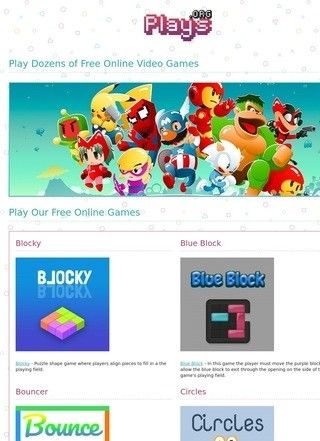
The person arriving at Plays.org is usually a parent looking for something their child can use on a school Chromebook without hitting a paywall, or an adult who wants five minutes of solitaire without creating an account. The pitch is built around three absences: no mandatory sign-up, no advertising, and no trial-version cutoffs. For a free-play platform that charges nothing and sells nothing, those are the right promises to lead with. The harder question is whether the execution holds.
Game genres and licensed titles
The range is genuinely wide: arcade, puzzle, solitaire, mahjong, card, board, racing, sports, shooting, strategy, simulation, and pinball. Licensed collections built around Star Wars, Batman, Spider-Man, TMNT, and Adventure Time sit alongside an educational section that third-party reviewers specifically cite as a reason parents direct children here. The site describes its audience as everyone from age 8 to 80, and the catalogue roughly supports that claim, with cartoon titles on one end and classic card games on the other.
Site navigation and pop-out feature
Navigation is handled through category pages, a "New" feed, a "Random" button, and curated groupings called Player Favorites and Team Favorites. There is also a set of Exclusive Games described as titles not hosted elsewhere. Each game carries an instructions panel covering controls and objectives, which is a small but practical detail. A full-screen pop-out is available, and the site notes this as useful for younger children who concentrate better without peripheral distractions.
Cross-device HTML5 support
All of this runs on HTML5. A school Chromebook, an aging Android phone, and a desktop load the same game without plugin installs or version mismatches. Plays.org offers free registration that unlocks favourites lists and sharing, but casual visitors can play without creating anything.
External reviews of the ad-free experience
Blog coverage from rhyskeller.com, withlovetiff.co.uk, myhelpfulhints.co.uk, and myfixituplife.com is positive, and the ad-free experience is the detail those reviewers return to most often. No Trustpilot, Google, Yelp, Facebook, or BBB profile surfaces an aggregate score. That is not unusual for a platform where users play without transacting and have no particular reason to write structured reviews in those systems.
Google Safe Browsing verification
More relevant for this kind of service: Plays.org passed the Google Safe Browsing check, a specific and independently run test that matters more for a children's platform than a star average from a commerce-review site. Four named blogs corroborate the core ad-free claim. That combination is not nothing.
Contact options and social channels
The contact surface is sparse. No phone number or address is listed. What exists is a per-game feedback link, an email route in the footer for suggesting new titles, and social accounts on Facebook, Instagram, Twitter, and Pinterest. About Us and privacy pages are present. For a service that charges nothing, the low contact footprint is not surprising, but anyone expecting a quick human response will need to go to the social channels and hope someone is watching.
Questioning the catalogue's breadth
The deeper skepticism about Plays.org is not the contact page or the star-rating gap. It is the breadth claim. "Thousands of titles" covering a dozen genres for users from 8 to 80 is the kind of scope that often produces a shallow library: many games, few that are genuinely worth returning to. The site cannot be dismissed on this point, but it also cannot be trusted on it without spending time in the catalogue itself. The licensed properties suggest real content agreements; the Google Safe Browsing pass and the four corroborating reviews suggest the site is what it says it is. What remains open is whether the depth matches the breadth, and that is something the site's own claims cannot settle.
Who should use Plays.org?
Plays.org is defensible as a starting point for parents and casual players who need a no-cost, no-account, ad-free option with a clean safety record. It is less defensible as a destination for someone who wants a curated, high-quality library and does not want to dig through hundreds of titles to find what is worth keeping. The listing makes a coherent case. Whether that case is enough depends on how much curation matters to the person asking.