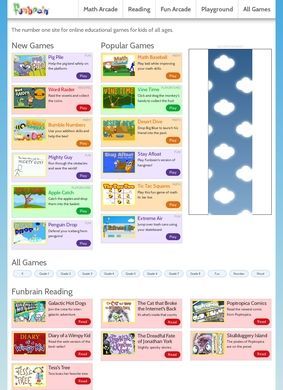
Open FunBrain.com and the first thing you meet is a wall of clickable games sorted by grade, with a Diary of a Wimpy Kid reading link sitting a few rows down. That mix tells you most of what the site is about before you read a word of explanation. It is a free learning destination aimed at children roughly between kindergarten and eighth grade, ages five through thirteen or so, and it has been doing this particular job long enough that the layout feels lived-in rather than experimental.
Games, reading library and videos
The catalog splits into three honest categories. There are the games, more than a hundred of them, covering math practice, reading, and basic literacy skills, sorted so a parent or a child can land on something age-appropriate without much hunting. There is a reading library that leans on recognizable children's book series, the Wimpy Kid books being the obvious draw. And there are educational videos for kids who would rather watch than click through a puzzle. The grade-and-subject structure is the spine of the whole thing, and it does the job: pick a level, pick a skill, get content built for that combination.
Behind the Poptropica connection
What FunBrain.com does not hide is its relationship to Poptropica, the adventure game from the same stable. Sandbox Networks owns both, and the site nudges visitors toward Poptropica membership for the premium tier. The base experience stays free and ad-supported, with the paid content sitting on the Poptropica side of the fence. That arrangement is reasonable on paper, though it means the free version comes wrapped in advertising, and that is the part of the picture outside reviewers keep flagging.
Ratings from parents and educators
The reputation trail is wider than you might expect for a site that mostly serves kids. Common Sense Media carries parent and kid feedback, eight reviews from parents and twenty-nine from children, though no single star average came through clearly. Common Sense Education has an educator write-up that treats FunBrain.com as a solid free resource with books and games attached. SmartCustomer lists eighteen reviews averaging 3.9 stars, the Educational App Store has looked at it, and Education World ran an editorial review some time back. That is a real spread of independent eyes, not a handful of stray comments.
Comparing ad load against learning value
The recurring complaint across those sources is the advertising. Several reviewers describe the ad load as heavy enough to interrupt the experience, and a related thread of commentary questions whether the site tilts more toward entertainment than genuine instruction. Both criticisms are fair to surface. A 3.9 average is decent, not glowing, and it squares with the impression of a useful free tool that asks young users to wade through promotional clutter to reach the good parts. Anyone weighing FunBrain.com for a classroom should factor that in, because ad density is the single most consistent knock against it.
None of that sinks the offering. The educational substance is genuinely there, the grade sorting is practical, and the price of zero covers a lot of forgiveness. But the value depends on whether the adult supervising the screen is comfortable with the ad environment and treats the games as supplements to teaching, not replacements for it.
Checking contact details and support routes
On the practical side of trust, FunBrain.com is light on the basics a cautious user looks for. The homepage and about page surface no phone number, no email address, and no street address, and a clearly labeled contact route did not turn up during browsing. For a children's platform owned by an established media company, that absence is more an inconvenience than a red flag, since the corporate parent is identifiable and the brand has a long track record. Still, a parent or teacher wanting to ask a direct question or report a problem will need to chase the answer through Poptropica or the parent company rather than a simple form on the page.
It is also worth being clear about who this is built for. The primary audience is the child at the keyboard; the secondary audience is the adult standing behind them. FunBrain.com names parents and teachers as users it wants to serve, with resources pointed at home learning and the classroom, but the design energy clearly goes into the kid-facing games and reading. Teachers looking for lesson planning depth or progress tracking will find the site less capable than a dedicated curriculum tool. What they get instead is a stock of ready-to-use practice activities that need no setup and cost nothing, which is a different kind of usefulness.
Set against comparable free options, FunBrain.com holds a respectable position. Longevity counts for something here: a site that has stayed current with recognizable book tie-ins and a steady game library has earned a level of confidence that a newer entry has not. If you found FunBrain.com through a business directory or a teacher recommendation, you would land in a place that is well-established and straightforward to use. The free-plus-Poptropica-upsell model is transparent enough that nobody should feel ambushed at the paywall. The honest caveat stays the same one outside reviewers raise: the ads are intrusive, and the line between learning and play sometimes blurs in favor of play.
From homework help to classroom use
A parent of a grade-school child who wants free math or reading practice and does not mind sitting nearby to navigate the advertising will find FunBrain.com worth bookmarking. Start with the grade selector, point a child at the math games or the Wimpy Kid library, and watch a session or two before letting it run unsupervised. Teachers curious whether it fits a lesson should try a single activity at the relevant grade level, gauge how the ad interruptions land with their class, and decide from there whether FunBrain.com belongs in the rotation or stays a home-only suggestion. The published record gives enough to work from: solid catalog, real reviews spread across multiple platforms, transparent ownership, and a persistent ad problem that the 3.9 average already accounts for.