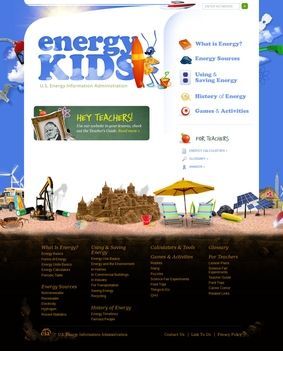
EIA Energy Kids is the U.S. Energy Information Administration's educational website for K-12 students and teachers, sitting at eia.gov/kids as a public branch of the federal agency that compiles the country's energy statistics. The content is split into five topic areas, and each one pulls from the same data the agency uses in its official reporting, which is the quiet advantage running underneath everything here. A student reading about coal production or solar capacity is, in effect, reading numbers that trace back to the Department of Energy's own books.
What EIA Energy Kids sets out to do is narrow and well defined: take the agency's serious energy data and translate it into something a school-age reader can use without an adult interpreting every line. That goal shows in how the material is laid out, and it is worth walking through what the site actually puts in front of a visitor.
Five topic areas of energy data
The first area, "What Is Energy?", handles the fundamentals: the forms energy takes, how it is measured, the units involved, and a periodic table of elements for context. This is the groundwork, and it is pitched at a level a curious ten-year-old can follow without a teacher hovering. From there the site widens out considerably.
From sources to consumption and history
"Energy Sources" is the heaviest section and the most useful. It walks through nonrenewable fuels (coal, oil, natural gas, nuclear) and renewable ones (solar, wind, hydropower, geothermal, biomass), then covers how electricity is actually generated and where hydrogen fuel fits. What lifts it above a generic explainer is the links to current statistical data. A child who wants to know how much wind power the country produces is one click from the real figure, kept current by the agency itself. Few children's resources can offer that, because few are run by the body that collects the data in the first place.
"Using & Saving Energy" turns from where energy comes from to where it goes: homes, commercial buildings, industry, and transportation, with sections on environmental impact and conservation. The framing is practical, the kind of material that fits a unit on household energy use or a discussion about why a building's heating bill behaves the way it does. A child can take a conservation point from this section straight home and test it against the family's own habits, which is about the best thing a lesson can do.
"History of Energy" rounds out the factual half with timelines and profiles of people who shaped how energy is produced and used. It gives the numbers a human spine, and it keeps the story from reading as a flat catalogue of fuels. Read in order, the five areas build on one another: definitions, then sources, then consumption, then the history behind it all, with the games waiting at the end as a reward. That sequence is not an accident, and it is part of why teachers find EIA Energy Kids easy to slot into a syllabus.
Games activities and energy ant
The lighter end of the site lives in "Games & Activities", which carries riddles, puzzles, quizzes, and guides for science fair experiments. None of this is filler. The science fair material in particular gives a child a structured starting point for a real project, with the agency's data sitting one tab away to back up whatever claim the experiment ends up making. Threaded through the whole site is "Energy Ant," an animated mascot that softens the tone for younger readers. It is a small touch, but it does the job of making a government statistics portal feel like somewhere a third-grader is allowed to be. Plenty of agency websites forget that a child is reading; EIA Energy Kids does not.
Resources for teachers
Teachers get their own corner, and it is more substantial than the usual token gesture. The educator section holds lesson plans, experiment guides, a downloadable teacher's guide, field trip resources, and information about careers in energy. That last item is worth pausing on, because it quietly extends the site's reach from a homework helper into something a high schooler weighing a future in the field might consult. A glossary of energy terminology covers the vocabulary gaps that come up when younger readers hit a word like "photovoltaic" or "turbine" for the first time.
Behind the data a federal agency
One characteristic shapes how much weight to put on all of this: the publisher. Because EIA Energy Kids comes from a federal statistical agency, the explanations carry an authority that a commercial education site or an ad-funded blog cannot match. When EIA Energy Kids states a certain share of U.S. electricity comes from natural gas, that figure is not a guess borrowed from a secondary source; it is the agency reporting on its own measurement.
The agency's job is to measure and report energy data accurately, and that discipline shows in how the children's material is written. Definitions are careful, the renewable and nonrenewable sources get balanced treatment without a political tilt, and the statistics are the genuine national figures rather than rounded approximations borrowed from somewhere else. For a parent or teacher who has grown wary of where school-project facts come from, that provenance settles a lot of doubt before the reading even starts.
Design limits and learning focus
There are limits worth naming honestly. The design is functional more than flashy, and a child raised on slick interactive apps may find the presentation plain next to a polished commercial product. The games are educational tools first and entertainment second, so they hold attention through curiosity rather than spectacle. None of this undercuts the value, but it sets expectations: EIA Energy Kids rewards a reader who has come to learn something specific, and it is less suited to idle browsing for its own sake.
Free access compared to DOE pages
What holds everything together is range paired with zero cost. A single site moves a student from "what is a joule" through "how does a coal plant make electricity" to "what jobs exist in the wind industry," and none of it requires a login, a fee, or an email address. EIA Energy Kids is free and publicly accessible, which is not a trivial point when schools are patching together curricula on limited budgets.
The natural comparison is the U.S. Department of Energy's own STEM and student pages, which cover similar ground and share the federal pedigree. That broader DOE material leans toward research programs, national labs, and policy framing, written for readers who can already handle dense prose. EIA Energy Kids keeps the same factual rigor while pitching the language and the interactives at children. The DOE pages suit older students who already have the basics; EIA Energy Kids is where those basics get built.