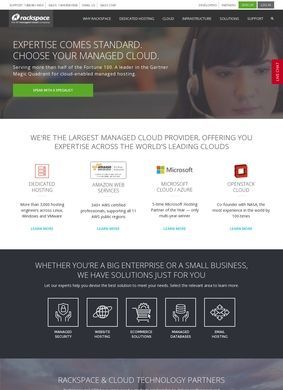
Mid-market companies carrying workloads across AWS, Azure and Google Cloud usually reach a point where the cloud bill stops making sense, the security posture feels patchy, and no one internally has the bandwidth to run all three platforms well. That is the spot Rackspace US, Inc steps into. The company positions itself as the team that operates the cloud you already chose, across whichever providers you happen to use, and increasingly as the layer that gets governed AI into production. For a directory category labelled web hosting, that is a more enterprise proposition than the name suggests, and it pays to understand what is on offer before assuming it competes with shared hosting plans.
Enterprise AI Cloud bundles governed infrastructure
The headline product now is Enterprise AI Cloud, which is where a lot of the recent positioning sits. It bundles governed private cloud infrastructure with AI inference and what Rackspace US, Inc describes as production agent environments. That framing matters because plenty of vendors sell you raw compute and leave the governance to you. The pitch here goes the other way: private infrastructure with controls built in, aimed at organisations that cannot drop sensitive data into a public model and walk away. Whether the execution lives up to the marketing is a separate question, but the intent is clear, and it lines up with where regulated industries are nervously heading.
From migration to modernization services
Strip away the AI framing and the core of Rackspace US, Inc is professional services, which is the part that has carried the company for years. The catalogue is wide. Cloud consulting and migration cover the move itself. Managed cloud operations handle the day-to-day running once you are there. Cloud optimization means trimming spend that nobody noticed creeping up, alongside platform engineering and automation for teams that want their infrastructure defined in code. Data and analytics modernization, application modernization, and modern workplace solutions fill out the list. The overall picture is a company that wants to own the whole lifecycle of a workload: from the decision to move it through to years of quiet maintenance afterwards. Cybersecurity and threat response sits in that same catalogue and deserves a separate mention.
Cybersecurity and threat response capabilities
A managed provider that runs your infrastructure and also watches it for threats has an efficiency argument. It also concentrates a lot of responsibility in one vendor, which is a trade-off any buyer should think through. The brief does not detail how threat response works in practice, so the honest read is that this is a stated capability worth probing in a sales conversation, not a proven differentiator on the strength of a feature list alone.
Data center footprint across regions
Numbers are where Rackspace US, Inc makes its case for being a serious operator. The company points to 39 global data centers, which gives it a physical footprint most managed-services firms cannot match and matters for clients with data residency rules or latency concerns tied to specific regions. Geographic spread of that kind is genuinely hard to assemble, and it separates a company that owns infrastructure from one that resells someone else's.
Certified workforce across three clouds
On the human side, Rackspace US, Inc cites more than 2,200 certified experts holding over 10,000 technical certifications. Certifications are an imperfect proxy for skill, and any large services firm can stack them up, but the multi-cloud claim becomes more credible when there are enough people to hold deep credentials across AWS, Azure and Google Cloud simultaneously. Running one of those platforms well is hard. Running all three to a standard a regulated enterprise will accept is a different order of difficulty, and headcount with breadth is the only credible way to do it.
Partnership roster spanning infrastructure and AI
The partnership roster fills in the rest of the picture. Names like AMD, VMware, Dell Technologies and Rubrik point to the infrastructure and resilience side, while Palantir and Uniphore point toward the data and AI direction Rackspace US, Inc is pursuing. These are alliances that give a managed provider early access and joint engineering rather than just a logo to display. They are also the sort of relationships that shift over time, so a prospective client should confirm which ones are deep and which are nominal for their particular use case.
Industry coverage across regulated sectors
Industry coverage is broad to the point of being almost a complete sweep: healthcare, financial services, oil and gas, government and education, manufacturing, retail, automotive, media and entertainment, and technology or SaaS. A vertical list this long can read as a company trying to be everything to everyone, which is a fair concern. The more defensible reading is that managed cloud operations translate across sectors once the compliance overlay is handled, and the regulated verticals on that list (healthcare, finance, government) are precisely the ones that pay for governed infrastructure instead of building it in-house. Rackspace US, Inc is publicly traded, which adds a layer the typical hosting entry lacks.
Behind the public company structure
Quarterly reporting and the governance structure around it offer some reassurance for an enterprise buyer who wants a vendor that will still exist in five years. The flip side is well known: public companies face margin pressure, and a managed-services business competing against the hyperscalers it also depends on lives in a structurally awkward position. The investor relations portal exists for those who want to read that story through the actual financials.
Review scores and reputation signals
Outside reputation is limited enough to be honest about. Rackspace US, Inc has a presence across review platforms including Google and Trustpilot, where the aggregate picture is mixed: scores in the 3 to 3.5 range across several hundred reviews, with complaints clustering around support responsiveness during escalations and billing transparency. For an enterprise-facing business this is not unusual. Buyers at that level rarely rely on public review scores, but the pattern is worth knowing. A prospective client should ask specific reference questions: which industries, which cloud platforms, and which scale of migration. General satisfaction scores across a broad user base do not answer those questions.
Rackspace US, Inc also runs a support portal for day-to-day users, a careers section for those evaluating Rackspace US, Inc as an employer, and investor relations resources for anyone weighing it as a financial stake.
What lingers after reading through all of this is the gap between breadth and proof. Rackspace US, Inc presents an unusually complete spread of capabilities, from migration through to AI agents in production, backed by real data centers and a credentialed workforce. The harder thing to judge from the outside is where that breadth turns into genuine depth and where it stays a line on a services menu.
The Enterprise AI Cloud story in particular is recent enough that its track record is still forming, and a company asking regulated enterprises to trust it with governed AI is making a promise that only production deployments can validate. The capability list answers what Rackspace US, Inc can do. What it cannot settle is whether, on the specific workload a given buyer cares most about, Rackspace US, Inc delivers the depth its scale implies. That uncertainty does not disappear from a feature page. It resolves only against a concrete project scope, a named reference client in the same vertical, and a support model spelled out in writing.