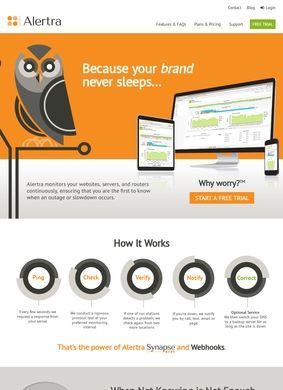
Despite sitting in a web hosting category, Alertra does not host a single website. It watches them. The service exists to tell a business the moment one of its sites, servers, or routers stops responding, and it does that from a spread of independent monitoring nodes scattered across different networks instead of one machine in one place. That geographic spread is worth understanding first, because a check that only runs from a single location can be fooled by a local routing hiccup into reporting an outage that real visitors never saw.
How the monitoring works
The checking engine runs around the clock and is built on something Alertra calls SYNapse technology. Whatever the branding, the practical behaviour is plain enough: it pings your endpoints continuously, notices when one goes dark or starts crawling, and then raises an alarm. Slowdown detection sits alongside the binary up-or-down test. A page that loads in twelve seconds is failing its visitors even though it technically resolves, so Alertra treats a crawling-but-live site and a fully downed one as two distinct problems, each requiring its own alert. For a site that takes orders on every page load, the slow-but-up state can be the costlier of the two, since visitors give up quietly instead of hitting an error they would think to report.
Slowdown detection and alerts
Where Alertra gets specific is in how it reaches you when something breaks. Notifications go out by phone call, SMS, and email, and there are hooks into third-party tools so an alert can land wherever a team already lives. The phone-call option is the one I find genuinely useful, since an email about a downed server at three in the morning is an email nobody reads until breakfast, while a ringing phone is hard to sleep through.
Notification channels
There is an iOS app that carries the same idea into your pocket: live status and push notifications, so a webmaster away from a desk can still see whether everything is green. Cyber security monitoring is folded into the offering as well, which pushes the remit past pure availability into whether something is wrong in a way that uptime alone would not catch. A free trial lets you put the alerting through its paces before spending anything, which is the sensible way to evaluate Alertra, whose entire value is whether it actually wakes you up at the right moment. The feature set is plainly aimed at businesses and webmasters who cannot afford to learn about a dead server from an angry customer.
Mobile app and security monitoring
The Alertra site itself is laid out the way you would hope for a technical product. How It Works, Features, and Pricing are all reachable, there is a Cyber Security section, and the Support area carries articles alongside a blog. Account holders log in through a separate portal at app.alertra.com, which keeps the marketing site and the working dashboard cleanly apart.
Third-party reviews
Third-party opinion on Alertra in this niche is reasonably easy to find, and it leans positive without being overwhelming. Knoji lists 35 reviews averaging 4.2 out of 5, which is a solid score from a sample large enough to be meaningful. G2 carries multiple verified reviews, Capterra has it listed with feedback, and Revain notes positive sentiment, while Slashdot adds user reviews of its own. The iOS App Store shows a perfect 5 out of 5, though only across two ratings, so that figure should be read as a footnote rather than evidence. No Trustpilot, Yelp, or BBB presence turned up, which is unremarkable for a back-end developer tool that customers reach through software directories rather than consumer review sites.
Contact options
Contact options on the homepage are minimal: a Contact Us form is linked, so there is a route in, but no phone number and no physical address appear, and a direct email is not surfaced. For a service whose whole promise is reaching you fast when your infrastructure fails, the absence of a visible direct line is a slightly odd note. The form covers the ordinary case, yet a company built around urgent communication might reasonably be expected to be more reachable itself. A vendor that goes quiet when its own customers need to reach it sits a little awkwardly next to the rest of its message.
Alertra is a focused, mature monitoring tool that knows exactly what it does and does not pretend to do more. The redundant checking nodes, the multi-channel alerts with real telephone calls in the mix, and the steady spread of decent third-party ratings all point the same direction. The understated contact options are the main caveat, and the free trial removes most of the risk in finding out whether the alerting suits how a given team works.