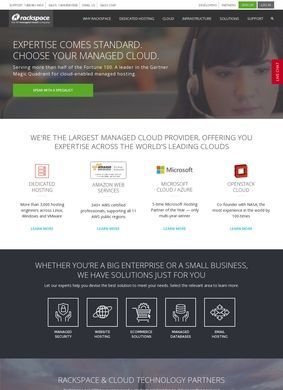
Twenty-five years in, Rackspace has quietly reinvented itself around a single bet: that the hard part of enterprise AI is not the models but the plumbing underneath them. The current pitch, "Where enterprise AI runs and outcomes scale," sits at the top of the site, and the substance behind it is more interesting than the slogan. There is a Governed AI Private Cloud, a Forward Deployed Engineering program that drops actual engineers into a client's production AI work, and a partner ecosystem meant to stitch third-party tools into that setup. A company that started life renting out managed servers now talks mostly about regulated AI workloads. That shift tells you where Rackspace thinks the money is going.
Infrastructure and staffing credentials
The infrastructure claims are concrete, and they read like the kind of numbers a company says out loud only because it can stand behind them. Thirty-nine data centers spread across the globe. More than 2,200 certified technical staff carrying over 10,000 certifications between them, with 600-plus specifically tied to AI platforms. The advertised uptime is 99.999 percent, which is the five-nines figure that enterprise buyers actually check against. None of this is dressed up much. The site lays out the headcount and the certification count and lets a reader draw the obvious conclusion, which is that for Rackspace the depth of expertise is the product as much as the hardware. A firm willing to publish ten thousand certifications is inviting a buyer to check the math.
Global data centers and certified expertise
Strip away the AI framing and what remains is a broad, traditional managed-services catalog, and it is worth walking through because it explains who Rackspace is really built to serve. This is the part of the company that predates the AI pivot, and it remains the spine of what Rackspace does. Cloud consulting, migration and modernization, managed cloud operations, optimization, platform engineering and automation, data and analytics, cybersecurity and resiliency, application modernization, and a modern-work bucket covering email and productivity. These are the services a large organization buys when it has decided not to staff all of this internally. The list is long without feeling padded, since each item maps to a distinct stage of running cloud infrastructure at scale.
Managed services across cloud operations
What I find telling is the choice of industries the company puts forward. The emphasis falls heavily on regulated sectors: healthcare, financial services, oil and gas, public utilities, plus government and education on the public-sector side. Then a wider enterprise spread covering manufacturing, retail, automotive, media and entertainment, and technology or SaaS firms. The regulated-industry focus is the meaningful signal here. Compliance-bound buyers do not pick a hosting partner on price, and a vendor that leads with healthcare and financial services is positioning itself for exactly the contracts where governance and auditability matter more than a cheap monthly rate.
Industries with compliance requirements
That governance angle ties back to the Governed AI Private Cloud, and the two pieces fit together logically. A bank or a hospital system experimenting with AI cannot simply push data into a public model and hope for the best. The private-cloud framing, paired with embedded engineers through the Forward Deployed Engineering program, is a direct answer to that anxiety. Rackspace is selling control and supervision as much as raw compute, and for the audience it names, that is the right thing to be selling. The embedded-engineer model in particular is a real differentiator, since it means Rackspace staff sit inside the client's production work instead of handing over a console and a manual.
Governed AI Private Cloud deployment
The site does not confine itself to a single property either. Beyond the main marketing presence there is a separate support portal, an investor relations site reflecting its status as a public company, and a careers portal. If you arrive at Rackspace through a business directory and click through expecting a basic vendor page, the split structure can feel surprising. A buyer looking for ticket-based support, a shareholder reading filings, and a candidate hunting for a job all have somewhere purpose-built to land, instead of one overloaded homepage trying to do every job at once.
Forward Deployed Engineering program
For all that coherence, the offering is dense enough to be genuinely hard to evaluate from the outside. Reading through the service list and the AI vocabulary, a prospective client gets a clear picture of breadth but a much fuzzier picture of fit. The catalog answers what Rackspace can do; it is far quieter on what an actual engagement costs, how long a migration runs, or where the lines sit between a self-serve product and a fully managed contract that needs a sales conversation. That is normal for enterprise services, where pricing lives behind a quote, yet it does leave the homepage doing a lot of persuading and very little committing.
How clear is pricing and engagement scope?
There is also a quieter tension worth naming. The company has spent a quarter-century building a reputation in managed hosting and cloud operations, and the new material leans so hard into AI that the older, steadier business almost recedes into the background. For a buyer who simply wants reliable managed cloud operations or a clean migration off aging infrastructure, the AI-first homepage may read as more aspirational than the work they need done, and that buyer may not immediately register that Rackspace still does the unglamorous part well. The capabilities are clearly still there in the service list. The framing just points somewhere else.
Balancing AI innovation with core operations
The numbers, the certifications, the data-center footprint, the regulated-industry track record: all of it points to a serious operator that has earned the right to talk about enterprise AI without it sounding like a land grab. Rackspace has the receipts to back the new positioning. The five-nines uptime and the certification counts are the sort of thing a vendor publishes because buyers will hold them to it. Where it gets harder to read is at the point of decision. The site builds a convincing case that the company can run almost anything at scale, but it leaves a prospective client guessing at the one thing that usually decides these contracts, which is whether the engagement that fits their specific workload, budget, and timeline is the same engagement the homepage is so confidently advertising.
Business address
Rackspace
1 Fanatical Place, City of Windcrest,
San Antonio,
Texas
78218
United States
Contact details
Phone: 1-800-961-2888