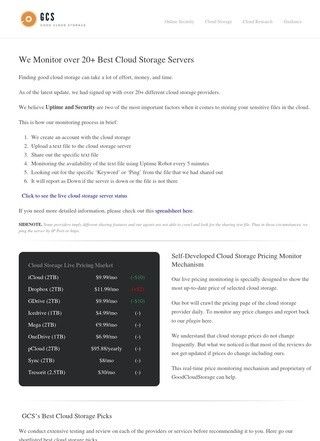
Ninja QuickSend, a drag-and-drop secure file transfer widget, sits right on the homepage alongside an IP address checker, a password generator, and a file transfer calculator. None of that is a cloud storage service. GoodCloudStorage sells nothing of its own. It is an independent review and education site that points readers toward Google Drive, Dropbox, OneDrive, pCloud, Sync.com, Icedrive, MEGA, and Wasabi, then tries to explain which one fits a given person's needs and budget.
Scope beyond web hosting
That framing matters because the category label here, web hosting, undersells the actual scope. Hosting in the literal sense is a small slice of the coverage. The bulk reads as consumer and small-business storage advice: head-to-head comparisons of the big providers, a recurring NAS versus cloud thread for people weighing a physical box at home against a monthly subscription, roundups of lifetime cloud storage deals, and secure storage guides for readers who care about where their files physically sit and who can access them.
Niche guides for specific professions
GoodCloudStorage narrows further than the usual generic listicle in places. There are pages on cloud solutions for law firms, where retention and confidentiality rules change the calculation, and recommendations specifically for photographers, who care about raw-file volume and versioning in ways a casual user never will. Password manager reviews and productivity guides round it out, which fits the broader digital-security angle the whole place leans on.
Target audience for purchasing decisions
The stated audience is individuals, remote workers, and small business owners trying to make a purchasing decision without reading twelve provider pricing pages themselves. That audience mapping holds across most of the content, even where GoodCloudStorage goes into territory most comparison sites skip entirely.
Monitoring tools and data freshness
One smaller feature worth calling out is the uptime monitoring section. Tracking whether the services GoodCloudStorage recommends are actually staying online gives the advice a reference point that does not depend on the writer's mood that week. Whether the monitoring is genuinely live and current or a static snapshot is an open question, and that distinction decides how useful it really is. I lingered on this longer than the rest, because a monitoring tool that quietly goes stale is worse than no tool, and there was no obvious way to confirm freshness from the surface of the site.
Lifetime deal coverage gaps
The same question hangs over the lifetime-deal coverage. Those offers expire, and pages about them age quickly unless someone keeps pruning. There is no visible indicator of how often any of this gets refreshed, which is a real gap for a site whose credibility rests on currency.
Contact information placement
On the question of who runs GoodCloudStorage and how you reach them, the answer is muted. There is no phone number and no street address on the homepage, and no email is surfaced where a first-time visitor would land. A contact route exists on the About Us page, so this is not a dead end, but the placement asks the reader to go looking. For a site whose entire pitch is trustworthy guidance on a security-sensitive purchase, putting the human behind it one click deep is a mild own-goal. It does not sink the project, but it shaves something off the first impression.
Trustpilot profile and review depth
Reputation is harder to pin down than I would like. A Trustpilot profile for GoodCloudStorage is live, which is more than many small review outfits bother with, but the exact review count and aggregate score were not retrievable at the time of writing, so no number will be offered here. One user comment that did surface praised the content as helpful while flagging the research depth as amateur. That is a fair-minded piece of feedback to sit with, because it captures the likely tradeoff. The breadth is real and the writing is approachable, but a reader who needs rigorous, deeply technical benchmarking may find the analysis lighter than they hoped. No ratings turned up on Google, Yelp, the BBB, or anywhere else, so the public track record rests almost entirely on that single Trustpilot footprint.
Provider selection and utility features
GoodCloudStorage knows its lane. The provider list it covers, pCloud, Sync.com, Icedrive, Wasabi, and the rest, is the right set of names for someone shopping in this space, and the free utilities are practical rather than decorative. A password generator and an IP checker are small things, but they are the small things a security-minded visitor will actually use, and bundling them with the reviews keeps people on the site for reasons beyond a single comparison table.
Verification limits for verdicts
The weak spots are also clear. The depth ceiling the Trustpilot commenter named is the central one. A comparison site lives or dies on whether its verdicts can be confirmed elsewhere, and a reputation built on one platform with an unverifiable score gives a cautious reader little external confirmation. The verdict lands lukewarm rather than glowing. For a remote worker or a small-business owner who wants a readable starting point, a sense of how Dropbox stacks against pCloud, what NAS actually buys you, or whether a lifetime plan is worth the gamble, GoodCloudStorage is a reasonable first stop and the free tools are a genuine bonus.
For anyone making a high-stakes or compliance-driven decision, especially the law-firm audience the site courts, it works better as a primer than as the final word. Confirm the specifics against the providers themselves, and the time spent on GoodCloudStorage pays off. Lean on it as gospel and the amateur-depth caveat is the one to remember.



Business address
Good Cloud Storage