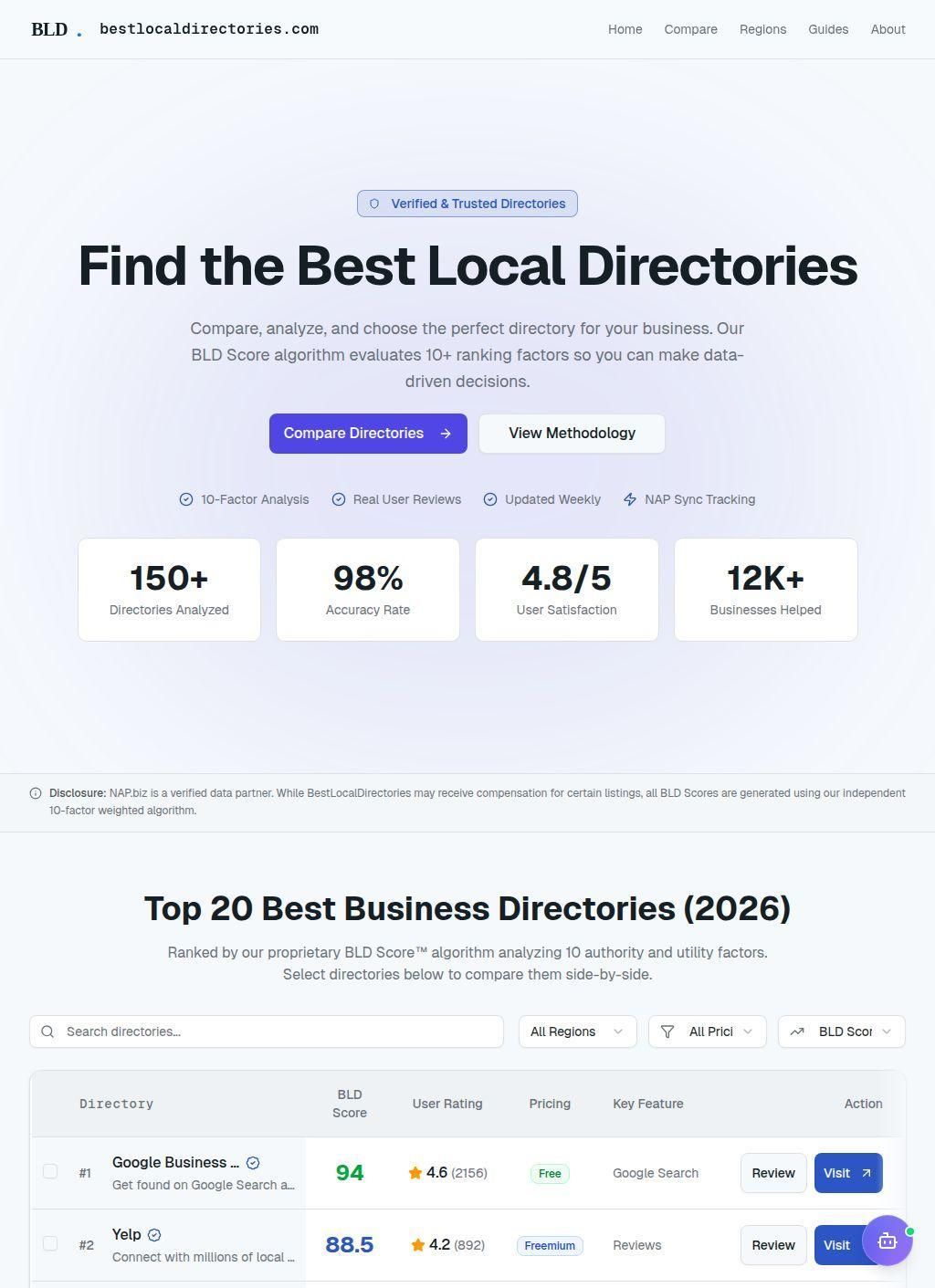
Best Local Directories is a comparison and ranking site that scores online directories for businesses trying to figure out where their listings are worth placing. The premise is narrow and useful: instead of guessing which of the hundreds of citation sites deserve attention, you get a graded list. Best Local Directories claims to evaluate more than 150 directories and runs them through a 10-factor system it calls the BLD Score, weighing things like SEO value, citation quality, and NAP integrity (name, address, phone consistency, which is the unglamorous backbone of local search). That framing tells you who this is for before you read another line.
How the BLD Score evaluates directories
The headline feature is a Top 20 ranking. Google Business Profile sits at number one with a stated 94 out of 100, which is the kind of result that reassures and worries at the same time. Reassures, because anyone who has done local SEO would put Google at the top too. Worries, because if the answer to "where should I list my business" is the most obvious platform on the internet, the value of the other 149 entries has to carry the rest of the proposition. To its credit, Best Local Directories does not stop at the leaderboard. Alongside the ranked list, there is a side-by-side comparison tool that lets you put directories against each other on the same criteria, which is more practical than a static leaderboard.
Top 20 ranking and comparison tools
Where Best Local Directories gets more interesting is the segmentation. It groups directories into industry clusters for verticals such as SaaS, legal services, and home services, on the sensible logic that a plumber and a software company do not need the same citation strategy. There are regional sections too, covering directories specific to the UK, Canada, and Australia, a useful correction given how much local-SEO advice quietly assumes a US-only audience. A contractor in Manchester or a clinic in Brisbane gets pointed at sources that actually apply to them. That kind of tailoring is harder to assemble than a generic global list, and its presence suggests someone thought about the real shape of the problem.
Industry and regional segmentation
On top of the rankings, Best Local Directories publishes guides on local SEO, citation building, and entity-based SEO. Entity-based SEO is a more current angle than the usual "submit your business to 50 sites" advice, dealing with how search engines understand a business as a defined entity across the web, so its inclusion hints that the editorial side is keeping pace with how the field has shifted. A newsletter promising weekly directory insights rounds out the content offering. Whether weekly is a realistic cadence for genuinely new findings, or whether it becomes recycled filler, is the sort of thing only time on the list would reveal.
Guides on local SEO and entity-based strategies
The claim that invites the most doubt is the one the whole Best Local Directories pitch rests on: BLD Scores are said to be updated weekly. Weekly re-scoring of 150-plus directories across ten factors each is a serious amount of work if done by hand, and if done by an algorithm running on autopilot it raises the question of what actually changes week to week. Directory authority does not move that fast. The honest version of this claim might be that the underlying data refreshes weekly while most scores hold steady, but the page presents the frequency as a selling point without showing the receipts. There is no visible changelog, no "last updated" stamp on individual entries that a visitor can use to check the promise. For a service whose entire pitch is rigor and freshness, that gap is conspicuous.
Weekly updates lack visible verification
A data partnership with NAP.biz, a citation management platform, is featured prominently across the site. This cuts two ways. On the useful side, a tie to a working citation tool lends the scoring some operational grounding, since NAP.biz presumably sees real listing data. On the skeptical side, a prominent commercial partner sitting next to an "independent" ranking always invites the question of whether the rankings and the partner's interests ever point in the same direction. Nothing in what is visible proves bias, and plenty of legitimate review sites carry partnerships. But a ranking platform lives or dies on perceived neutrality, and Best Local Directories would be stronger if it spelled out how the partnership does or does not touch the scoring.
Partnership with NAP.biz raises transparency questions
Reaching the people behind the site is where the polish slips. There is a contact page linked in the footer, so a route exists, but the homepage shows no phone number and no physical address. You have to go looking. For a business that judges other directories partly on NAP integrity, the irony writes itself: Best Local Directories preaches consistent, visible name-address-phone data and does not put much of its own out front. A contact form is a perfectly normal way to handle inquiries, and a missing public email is no real fault. What is missing is any signal about who is behind the scoring. A ranking is only as trustworthy as the people or method producing it, and the site keeps that firmly in the background.
Contact information and scoring authority hidden
That feeds into the larger uncertainty. A search for outside verification of Best Local Directories turns up nothing. No Trustpilot profile, no Google reviews, no BBB or Yelp presence that references this specific site. For most small businesses that absence would be unremarkable. For a platform whose entire value proposition is that it independently judges the reputation and quality of other sites, the lack of any reputation of its own is a strange place to be. The tool exists to help you trust a directory; there is no comparable third-party signal telling you whether to trust the tool.
No third-party reviews or external verification
So the offering is genuinely thoughtful. The clustering by industry, the regional breakouts, the comparison tool, and the move toward entity-based SEO all read like the work of someone who understands the field, well beyond affiliate pages spun up overnight. A business auditing its directory presence could get real direction here in an afternoon. What stays unresolved is the foundation under it: a weekly-update claim with no visible proof, a featured commercial partner with an unexplained relationship to the scoring, and a scoring authority that stays anonymous behind a footer link. Best Local Directories asks you to take its judgment of everyone else on faith, while offering very little for you to judge it by, and that is the doubt worth settling before treating its rankings as anything more than a well-organized starting point.