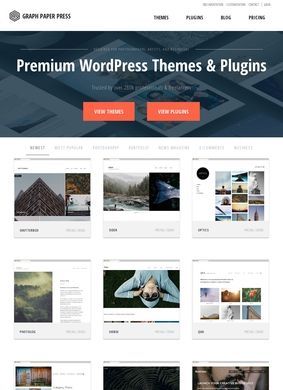
A photographer who has just finished a season of shoots faces a familiar wall: the images are ready, the clients are waiting, and the website still looks like a default template fighting against full-bleed photos. That gap between having good work and showing it well is the exact problem Graph Paper Press has built its whole catalogue around. The studio designs and sells WordPress themes and plugins aimed squarely at photographers, artists, and other creatives who need their pictures to carry the page instead of fighting the layout.
WordPress themes for photographers
The themes are the centre of it. Named releases like Summer Weddings, _vs, and Exposure are built for portfolios, photography sites, and magazine-style layouts, which tells you the team has a clear picture of who is buying and why. The selling points are practical ones: mobile optimisation, attention to SEO, accessibility compliance, and performance, with Graph Paper Press pointing to perfect performance scores on its own builds. Those are the things that quietly decide whether a portfolio loads fast enough to hold a visitor or sends them clicking away, so it is reassuring that they lead with speed and structure instead of just screenshots of pretty homepages.
Performance and mobile optimization
Beyond the themes, the plugin side fills in the parts that turn a gallery into a working shop. There is e-commerce functionality and print-on-demand integration, which is worth noting for a photographer who wants to sell prints without bolting together three unrelated tools and praying they cooperate. For someone whose business depends on selling the images rather than just displaying them, that integration is doing real work.
E-commerce and print integration
Graph Paper Press frames itself as the leading WordPress resource for photographers and creatives and cites a user base somewhere north of 280,000. Numbers like that are hard to confirm from the outside, but the longevity behind them is more telling. The studio traces back to 2004, when a developer named Thad started it as a side project building sites for nonprofits and small businesses. Two decades is a long time for a niche software shop to keep shipping, and that survival says more than any user count.
Twenty years of development history
Pricing is laid out in three tiers and easy to compare. Basic runs $99 a year and covers themes only, with priority support and advanced customisation. Professional is $299 a year and adds the plugins plus the e-commerce and print-on-demand tools. Then there is a Lifetime plan at $399 as a one-time payment, which bundles every current and future product. A 100 percent money-back guarantee applies to all of them.
Three pricing tiers with guarantees
That Lifetime option is the interesting one. For a working photographer who expects to lean on these tools for years, $399 once against $299 every year is the kind of math that pays for itself fast, and the inclusion of future products removes the worry of being stranded on an old release. The annual plans suit someone testing the waters or running a single project; the one-time plan reads like it is built for the loyal user Graph Paper Press has spent twenty years cultivating. Supporting all of this is a documentation library, a blog with tutorials, and priority customer support, which is the unglamorous infrastructure that decides whether a non-developer can get unstuck at midnight.
Lifetime plan value for long-term users
The third-party review record for Graph Paper Press is harder to read than the claimed user base of 280,000 would suggest. WPMU Dev published an editorial review of the themes, and ThemeGrade keeps a review page, though neither attaches a clear numeric score in what is publicly visible. A coupon aggregator shows a 4.3 out of 5, but that rests on just five user ratings, which is not enough to draw conclusions from.
Limited independent review presence
One deal site lists zero reviews and a flat rating. No verified reviews turned up on Google, Trustpilot, Yelp, or BBB. For a company with that kind of claimed reach and two decades of history, that quiet footprint is a little surprising, and a careful buyer should factor it in. The editorial write-up from an established WordPress publication is a more reliable data point than a handful of aggregator stars ever could be.
Contact methods and support access
Graph Paper Press is reachable through a contact form, and the homepage links to Twitter and Facebook plus routes into support and documentation. There is no phone number or physical address visible from the front door. For a fully digital product company like Graph Paper Press that runs on support tickets and documentation, that is a reasonable setup and not a red flag, though buyers who want to speak to someone before paying will need to go through the form.
Product focus on creative professionals
What Graph Paper Press gets right is focus. It is not trying to be a theme marketplace for every type of site; it serves photographers and creatives, and the entire product line, from the magazine layouts to the print-on-demand plugins, bends toward that audience. The pricing is transparent, the guarantee lowers the risk of trying it, and the long history gives some confidence that support and updates will still be there next year. The honest caveat is the limited independent review trail, which means a prospective buyer is partly trusting the company's own framing and the editorial coverage rather than a broad base of customer verdicts. That is a reasonable position for a product with a clear money-back guarantee behind it, but it is worth going in with open eyes.