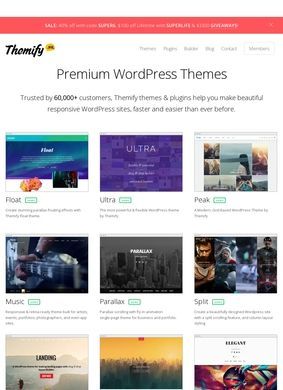
Buy once, build anywhere: the whole pitch of Themify Me rests on a single flat membership fee that opens every theme and plugin the shop sells, with no per-site cap. That structure shapes who it suits and who it does not. A solo developer juggling a dozen client builds gets far more out of one payment than a person setting up a single blog, and the site does not pretend otherwise. It is a developer-and-designer store first, a hobbyist store second.
How the membership model works
The catalog splits cleanly into themes and the tools that power them. On the theme side, the headline product is Ultra, billed as an all-in-one theme that ships with pre-built demo imports you can pull in and edit, with attention paid to PageSpeed scores and search visibility. For a theme shop that is worth saying plainly, because plenty of feature-heavy WordPress themes load slowly enough to undo the design work they were bought for. Themify Me at least puts speed and SEO in the sales copy as deliberate goals, and the demo-import approach means a new user is not staring at a blank canvas on day one.
Ultra theme with demo imports
The audience is people comfortable inside WordPress: individual developers, designers handing finished sites to clients, and site owners willing to learn a page builder. Nothing about the store is aimed at someone who wants a one-click website with no involvement, and Themify Me does not dress itself up that way, which is to its credit. The themes assume you will customise them, the plugins assume you want control, and the pricing assumes you will use the library more than once.
Builder plugin and add-ons
The tooling is what brings most buyers back to Themify Me. The Themify Builder is a drag-and-drop page builder that runs as a standalone plugin, so it works on top of any WordPress theme and is not locked to the company's own designs. That portability is a real selling point, since a buyer can keep the editing workflow they have learned even after switching themes down the line. Builder Pro, priced at sixty-nine dollars, stacks more than twenty-four addons on top of the free core, including a WooCommerce addon aimed at people who want to restyle store and product pages without dropping into code.
Custom content types and layout packs
Around that core sit the other plugins: Post Type Builder for spinning up custom content types, plus a long shelf of Builder addons such as pricing tables and ready-made layout packs that drop into a page and save an hour of fiddling. The collection is wide enough that a working developer will find duplicates of tools they currently pay several vendors for, which feeds straight back into the single-membership argument. A developer can also buy into just the Themify Me Builder and ignore the themes entirely, which is an honest way to sell a page builder and a sign the company trusts its plugin to stand on its own.
Evaluating value for your use case
The club model deserves the hardest scrutiny of anything here. One membership grants every theme, every plugin, and unlimited installs, which is generous on paper and genuinely good value if you build sites for a living. For someone who needs one theme for one project, paying for the entire library is overkill, and the cheaper route is buying a single product outright where that option exists. Pricing is quoted in US dollars, so buyers elsewhere should factor in conversion and any card fees their bank tacks on.
A thirty-day exchange-and-refund policy backs the purchase, which softens the risk of committing to a Themify Me membership sight unseen. The base Builder and a free Base theme give you a real sense of the workflow before any payment. That free path is the smartest way to test the store. Try the free Builder on a throwaway install first, decide whether the editing experience suits you, then weigh the membership against how many sites you actually plan to build this year.
The blog rounds out what Themify Me offers, with WordPress tips and product-update posts. It is not the reason anyone lands here, but a company that keeps talking to its users instead of going quiet after the sale builds a kind of confidence that a glossy homepage cannot. For a store whose whole relationship with a customer is digital, that steady stream of writing does real reassurance work. It also doubles as informal documentation when you hit a snag mid-build.
Trust signals from ratings and reviews
On reputation, Themify Me comes out well across the platforms that track it. Trustpilot carries a five-star average across roughly eighty-seven reviews. A third-party aggregator (Tenere) shows 4.6 out of 5 drawn from a much larger pool of about 1,837 user ratings, and that volume is what gives the score real credibility. On WordPress.org itself, the Themify Base theme sits at 4.6 from a modest ten reviews.
Scamadviser flags the site as legitimate and safe, which is the bare-minimum reassurance a buyer wants before entering card details on a store with no storefront to walk into. Editorial coverage adds another layer: WPBeginner and SavvyTheme have both published detailed, favorable write-ups, and those are read by exactly the WordPress audience the shop is courting. A single glowing testimonial is easy to discount, but a five-star Trustpilot score, a 4.6 across nearly two thousand aggregator ratings, an independent safety check, and named editorial coverage all pointing the same direction give a buyer a reasonable basis to trust Themify Me.
Support through email only
Reaching the company is the one place where Themify Me asks for a little patience. The site lists no phone number and no street address, and the homepage keeps its support route fairly quiet. A support page does exist, and the pricing and FAQ area points to email as the way to reach a human. Support and refund requests run through email, where you hand over your user ID and the details of your problem, which is a reasonable system for a company tracking purchases by account. For a digital product sold worldwide, email-only support is the norm and not a real mark against Themify Me, though anyone who likes a phone line for billing questions should know going in that there is not one.
Two things keep Themify Me from being an unqualified recommendation. The flat-membership pricing genuinely rewards volume and genuinely punishes the one-off buyer, so the value verdict depends entirely on how much you build. And the quiet contact setup, while normal for the category, means your first real test of the company's responsiveness happens after you have already paid, not before.
Weighed together, Themify Me reads as a long-running, well-regarded WordPress shop that knows its audience and prices for it. The Builder is a credible standalone product, the Ultra theme has a clear reason to exist, the free tier and refund policy lower the stakes of trying it, and the outside ratings line up with the company's own confidence. Heavy site-builders get a strong deal here; casual users probably do not, and that gap is the only real caveat worth carrying into a purchase decision.