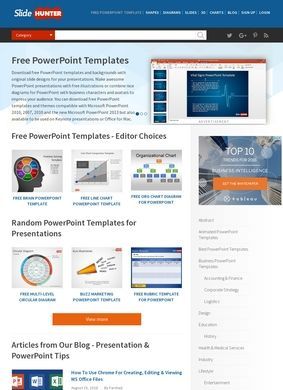
Imagine the deck is due in the morning, the SWOT slide still looks like a wall of bullet points, and there is no time to build a clean four-quadrant graphic from scratch. That is the exact moment Slide Hunter justifies its existence. It is a free library of PowerPoint templates, and the catalog is large enough that the SWOT problem above has several ready answers, alongside Venn diagrams, process flows, and the matrix layouts that consulting-style presentations lean on. You download, you edit, you move on.
Over 6,700 templates for business diagrams
The headline number on the Slide Hunter site is more than 6,748 templates, and the breadth behind that figure is what makes it useful, since a big catalog of near-identical files would help nobody. Business diagrams are well represented, but so are the planning visuals people actually hunt for under deadline: Gantt charts, zigzag roadmaps, 30-60-90 day plans, and timelines that can be reshaped without fighting PowerPoint's native tools. There are brain diagrams, decision-making frameworks, 3D elements, and thematic backgrounds for people who want a finished look without hiring a designer. Everything is described as fully editable, which is the one attribute that really counts in a template; a locked or fiddly file is worse than starting from nothing.
Works across PowerPoint, Google Slides, Keynote
Compatibility is the other practical strength of Slide Hunter. The templates are pitched as working across PowerPoint, Google Slides, Keynote, and the wider Microsoft Office set, so a team scattered across different software is not forced back onto one program. For an organization where one person drafts in Keynote and another finalizes in PowerPoint, that flexibility removes a step that usually causes formatting headaches. The site is also clear about what it is not: it states plainly that it has no affiliation with Microsoft Corporation, which is a small piece of honesty that many template farms skip.
How-to guides for presentation design
Beyond the files themselves, Slide Hunter has a blog of how-to guides covering presentation design technique. That is a sensible addition for the audience this serves, since the people downloading a process-flow template are often the same people unsure how to use it well. It pushes the site past being a pure download depot and toward something a regular presenter might return to. How deep or current that writing runs is harder to judge from the outside, and a guide library only earns repeat visits if it is maintained, but its presence works in the site's favour.
Advertising revenue funds the free service
The business model is visible and worth understanding before you trust the place with your time. Slide Hunter runs an "Advertise Here" page and a "Write for Us" page, which tells you it lives on advertising revenue and outside contributors. That is a common and legitimate way to keep a resource free, though it does mean a visitor should expect ad placements and should read contributed posts with the same mild caution any contributor-driven site deserves. The free price has to come from somewhere, and here it comes from ads, stated openly.
Contact through form only, no phone support
On contact, the picture is functional without being generous. There is a proper contact page, plus About Us, Privacy Policy, and the advertising and contributor pages all reachable from the Slide Hunter footer, so the basic structure of an accountable operation is in place. No phone number or physical address appears anywhere obvious, and reaching anyone runs through the contact form alone. For a free template library that is not unusual or alarming, but anyone hoping to resolve a licensing question or a download problem quickly should know that a form is the only door, and forms move at the operator's pace.
Outside opinion on Slide Hunter is sparse, and that is the honest weak spot in any assessment of it. Trustpilot carries a single review, which describes a good support exchange with a staff member named Julian (pleasant, but a sample of one). Complete-Reviews.com lists one review at 3.69 out of five, which is middling and again barely a sample. The trust-scanning services lean positive: ScamAdviser rates the domain legitimate and safe, and a Web of Trust scorecard exists for it, both of which speak to safe browsing rather than template quality. An editorial writeup on TechOzens called Slide Hunter one of the best free PowerPoint template providers, which is a real endorsement but a single editorial voice. No Google, Yelp, Facebook, or BBB data turned up at all.
So the credibility rests less on crowd verdicts and more on what Slide Hunter demonstrably is. The 6,748-template count is something a visitor can verify by browsing, the editability claim is the right one to make, and the cross-platform reach answers a genuine pain for mixed teams. Slide Hunter turns the panic of a half-built diagram slide into a five-minute fix. The independence statement and the transparent ad model both read as the work of an operator who is not trying to mislead anyone about what they run.
With almost no independent reviewer base to vouch for consistency across thousands of files, a first-time visitor is largely taking the site's own word on quality control. That is not a reason to avoid Slide Hunter altogether (the price being zero lowers the cost of disappointment to almost nothing), but it is a reason to grab a template, see whether it bends to your content without breaking, and judge the library from there rather than assuming every file in a 6,000-plus catalog is as polished as the featured pieces. A library sustained by ad revenue and volunteer writers lives or dies on whether those files stay current and free of the licensing surprises that bite template users later, and on that question the public record on Slide Hunter simply has not filled in yet.