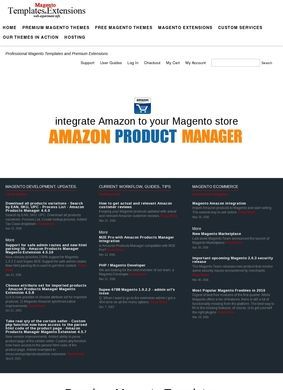
Arriving at Magento Templates expecting a theme shop is a reasonable mistake, and the site does nothing to head it off. The name points one direction; the product points another. What sits behind the homepage is a data extraction platform, specifically a parallelized scraping engine built for high-volume queries, described as capable of handling millions of requests a day. That is a different product category entirely, and getting that straight is necessary before anything else in this review.
Data extraction platform, not theme shop
The company describes itself as an international software and consulting firm founded in 2009. That history puts Magento Templates in a different bracket from the typical scraping tool that appears for a year, ships a few updates, and disappears. In automated data collection, longevity counts for a lot: scraping tools live and die on how well they adapt as target sites change their structure, implement blocks, and adjust rate limits. A firm still operating after fifteen-plus years has handled those cycles repeatedly, and that is the most concrete positive in the public-facing brief.
Amazon extraction module for e-commerce
The core product is a general-purpose web data extraction engine, but the more specific offering is an Amazon Data Extraction Tool that pulls product-level fields including prices, descriptions, reviews, and images directly from Amazon listings. Amazon is one of the harder targets to scrape reliably because the marketplace actively defends against automated access, so maintaining a purpose-built module for it reflects genuine investment. E-commerce businesses tracking competitor pricing, analysts pulling catalog data, and review aggregators are the obvious users for Magento Templates in this configuration.
B2B audience and subscription pricing
The platform's described audience is B2B and technical: data scientists who need feedstock for models, e-commerce companies monitoring product catalogs, and larger enterprises requiring web data at volume. The presence of account and cart management on the site points toward a SaaS subscription or a licensed download arrangement, though the brief does not clarify which, and no published pricing appears anywhere on the page. For a technical buyer evaluating Magento Templates, the absence of a pricing tier is an early friction point that a competitor's site would typically resolve on the first scroll.
Free guides for Magento development
A visitor clicking through from a business directory listing under "Magento Templates" will reasonably wonder why the name and the product do not match. The site maintains an /articles section covering eCommerce and Magento development resources, user guides, and related reading. That documentation is a genuine resource for someone researching Magento builds. What Magento Templates does not carry, going by the available brief, is a catalog of Magento themes or storefront templates ready to purchase and install. The listing category has drifted from what the product is, and the honest thing to do is say so plainly.
If the goal is buying a ready-made Magento skin, this is the wrong destination. If the goal is gathering product or pricing data to feed a store's merchandising decisions, or learning the development side through the guide library, then Magento Templates lines up far better than the name prepares you for. The /articles content is a modest point in its favor: free guides suggest a team willing to explain its domain and wall nothing behind a sales form, and for a data-engineering crowd that material doubles as a way to assess whether the people behind the tool know their subject.
A named specialist, Eugene, is listed on the site with the title Data Expert. Putting a real name and role on a B2B platform is a visible trust cue. It adds a human anchor to what could otherwise read as a faceless product page, and in a market where many scraping operations are entirely anonymous, the detail stands out. Magento Templates does not oversell this; the name appears without a biography or contact link, which keeps it honest.
Why external reviews are missing?
This is where Magento Templates gets harder to evaluate. A search for outside reviews turned up almost nothing of substance: a LinkedIn stub, a scatter of unrelated results, and no consumer-facing score anywhere. No Google rating, no Trustpilot presence, no BBB file surfaced. That outcome is not automatically damning. Plenty of capable B2B data vendors sell quietly to technical buyers and never accumulate the review trail you would find around a retail brand. But it does mean an independent buyer has almost no external point of reference, and for a product that asks for trust with data pipelines and likely recurring payment, the gap is worth naming honestly.
Contact options lack geographic detail
Contact options are similarly pared back. There is a /support page, which gives users a defined channel for help, but the landing page shows no phone number and no physical address, routing everything through that section. For a firm billing itself as international with consulting services, the absence of any geographic anchor or direct line is a genuine shortfall. Businesses routinely drop public email addresses to avoid spam, and that missing detail alone is no concern. The harder question is whether a buyer can confirm they are dealing with a real, locatable company through the published page, and right now the answer is no.
None of that collapses the offering. The product story is specific, the company history is long, and the technical positioning of Magento Templates is consistent throughout the site. What is missing is the external scaffolding that lets a stranger verify the story without engaging directly: a visible review trail, a geographic presence, a phone line. A buyer comfortable running a trial and judging the engine on its own output will weigh those gaps lightly. One who needs external reassurance before spending anything will find Magento Templates harder to assess on the public page alone.
Compared against a well-documented competitor like Bright Data, the difference in visible trust infrastructure is obvious. Bright Data carries a heavy public review trail, transparent pricing tiers, and a large compliance and proxy operation behind it. Magento Templates counters with a longer continuous history and a focused Amazon extraction module, but asks the buyer to take more on faith. For a technical user willing to run a trial and let the engine's output be the proof, this entry is worth investigating. Where the published record is limited, the founding date and the Amazon-specific tooling are the two details that keep the platform plausible.