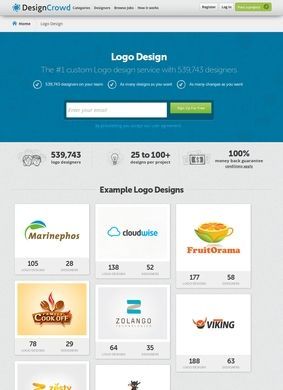
Post a project on Design Crowd and the promise arrives as a specific number: 25 to more than 100 logo concepts from freelance designers, most landing within hours, drawn from a pool the site counts at 1,333,304 people. A client writes a creative brief, names a budget, and opens the job to a worldwide crowd who upload finished drafts on spec. The buyer picks a winner and pays out. That single mechanic, competitive bidding applied to graphic design, is what Design Crowd is built around.
The company bills itself as the number one custom logo design service, and logos are plainly where the volume sits.
The buyers are mostly small businesses and startups that need a mark quickly and cannot justify a design studio's day rate. That audience is exactly who Design Crowd courts, and the whole interface is tuned to move them from an empty brief to a finished file with as little friction as possible.
From a creative brief to a winning logo
The workflow is easy to describe, and that plainness is part of the sell. Someone who needs a logo posts the brief with a description of the business, the style they lean toward, and the prize on offer. Designers around the world read it and submit concepts, each competing for that one payout. The buyer sifts the entries, asks for tweaks on the ones showing promise, and awards a winner.
Design Crowd puts its running tally at 534,811 completed projects and more than 100,000 businesses served, figures meant to signal that a great many jobs have already moved through this pipeline.
The draw is volume and choice. Instead of betting everything on one designer's taste, a buyer sees dozens of directions at once and keeps whichever fits. The catch is baked into the same design: most of those dozens get turned down, and the designers who lose spent real hours working unpaid. That is the standing criticism of every spec-work marketplace, and Design Crowd runs on exactly that model.
The process does not stop at the first batch. A buyer can leave feedback, request revisions, and watch new versions come back, so the eventual winner has usually been nudged closer to what the client pictured. That exchange is thinner than a one-on-one engagement with a hired designer, but it is a step above a blind pick from a stock gallery.
To help buyers judge who they are dealing with, the platform runs a designer star-rating system, explained in its own help articles alongside a set of FAQs and a blog.
Where the money-back guarantee sits
Design Crowd advertises a money-back guarantee with stated conditions attached, and on paper that lowers the risk of posting a project and disliking everything that comes back. The conditions decide whether the guarantee is worth anything. A guarantee framed around specific eligibility rules is a different animal from a no-questions refund, and the outside reviews further down suggest the refund route is exactly where a share of the friction shows up.
Guarantees like this tend to hinge on definitions: what counts as a failed project, how long a buyer has to claim, and whether spending the prize forfeits the refund. None of that is knowable from the headline alone, and it is the fine print that decides whether the promise is genuine protection or a comfort blanket. Anyone weighing a paid project would do well to read those terms before writing the brief, not after the concepts arrive.
The wider catalogue beyond logos
Logos are the headline, but the catalogue reaches across most of what a small business might need drawn up. Logo and identity work extends into business cards, stationery, and letterheads. There is a graphic design bucket for infographics, vector art, icons, and 3D. Web design covers WordPress, landing pages, and store builds on Shopify or Wix.
Print design takes flyers, brochures, posters, restaurant menus. Product and merchandise stretches to t-shirts, packaging, and apparel; art and illustration handles book covers, mascots, and character design; digital marketing fills in banners, newsletters, and social media content. The same contest format applies to all of it: post a brief, collect concepts, choose one.
Whether that breadth helps depends entirely on the buyer. A startup that wants a logo, a business card, and a simple landing page in one sitting will find the range convenient and the single account tidy. A project needing sustained back-and-forth with one designer fits the model far less well, since the crowd submits and moves on instead of staying to iterate the way a hired studio would. Design Crowd is built for breadth and speed, and it is honest about that being the trade.
For a founder assembling a brand over a weekend, the appeal is obvious: one login, one workflow, and a logo, a card, and a web page all sourced the same way. Established companies with a design team already in place have less reason to be here, since the platform's strength is getting a serviceable result fast, not partnering over the long haul.
Reaching Design Crowd directly takes a little digging. The interface pushes the post a project button at every turn, and the plainer contact routes sit lower down: a contact form and the help centre in the footer, with no phone number or postal address surfaced up front. For a self-service platform that is normal, and the form covers most needs, but buyers who like to speak to a person before parting with money will notice what is missing.
What the outside scores say
Here the picture turns uncomfortable for Design Crowd. Trustpilot carries 3,253 reviews for the company's own domain, a large volume that at least confirms heavy real traffic, though the headline star figure was not visible in the snippet examined. Away from Trustpilot the numbers are blunt. SmartCustomer records 1.7 out of 5 across 95 reviews and notes most customers came away dissatisfied. ResellerRatings sits at a flat 1.00 stars from 30 reviews. Those are not middling scores that could swing either way. They are low.
The complaints share a shape. A reviewer on G2 flagged poor quality and trouble securing a refund. Over on Reddit's design community, a user posting what they called an honest review described the finished product as minimal and said the platform nudges paid upgrades and add-ons at nearly every step. No single account settles anything, but several independent sources drifting the same direction is harder to wave away than one angry post. For Design Crowd, whose entire pitch is the quality and quantity of concepts, quality complaints cut close to the bone.
The split between a heavily reviewed Trustpilot page and rock-bottom averages on the smaller sites is itself telling. A platform this busy will always produce some unhappy customers, but a 1.00 average, even across only 30 reviews, is not the pattern of an occasional off day. It reads as a gap between what a buyer expects from a hundred submitted concepts and what a meaningful share of them feel they actually received once the money changed hands.
Employee sentiment against customer verdicts
One cheerful set of numbers deserves a clear caveat. Glassdoor shows Design Crowd at 4.3 out of 5 for culture, with strong work-life-balance marks and 84 percent of staff saying they would recommend it as a place to work. That reads well. It also measures something apart from what a buyer cares about: how employees feel about their jobs, not how customers feel about the logos they paid for.
Set the two side by side and the gap becomes the story. A company people seem to enjoy working for is delivering a service a meaningful share of paying customers rate poorly, and Design Crowd has to own both halves of that.
The arithmetic a prospective Design Crowd buyer actually faces is concrete: more than a million designers on tap, over half a million finished projects claimed, a money-back guarantee hedged with conditions, and a set of third-party scores running from a busy Trustpilot page down to one-star tallies on the smaller review sites. Concepts arrive fast and in bulk. What happens after that, on quality and on getting money back, is where the reviews split apart.