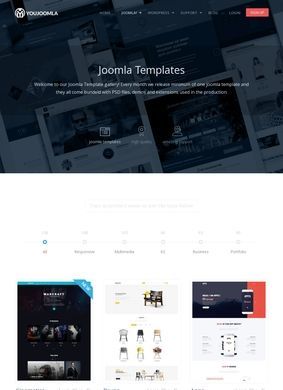
One hundred and fifty-one Joomla templates sit on this single landing page, which tells you immediately what kind of operation You!Joomla is: a high-volume design shop that has been turning out themes for the Joomla content management system long enough to fill a catalogue that deep. The categories cover responsive layouts, corporate sites, portfolios, magazine and blog formats, and e-commerce storefronts. A designer looking for a Joomla starting frame is unlikely to come up empty here, whether the job is a clean brochure site or a content-heavy publication.
Template catalogue and the yjsg framework
What holds the catalogue together is the company's own engine, the Yjsg Framework, which You!Joomla also markets as the Templates Framework. Every template is built on it, and the framework is sold separately as well. Buy a You!Joomla template and you are buying into its framework too; the way the templates handle layout options, responsiveness, and configuration all run through that shared layer. For a developer who plans to maintain a site for years, that is a real consideration: the framework becomes part of the stack, something you cannot easily swap out later. The upside is consistency across products. The downside is the usual one with any proprietary base, your site inherits the maintainer's release pace and priorities, for better or worse.
Beyond joomla plans and support tools
The offering does not stop at Joomla. You!Joomla also sells WordPress themes and a line of Joomla extensions, positioning itself as a broader content management toolkit vendor than the templates page alone suggests. Access is structured around subscription plans, split into developer and standard tiers, the developer level aimed at people building multiple client sites and the standard level at someone with a single project. Single-purchase options have existed in the past, so a buyer who wants one template without an ongoing commitment may need to check what is currently available; the model leans toward memberships now.
Support is where You!Joomla puts a noticeable amount of structure. There is a vBulletin-powered community forum, a knowledgebase, a FAQ section, a ticket-submission system, and per-product documentation that the site describes as detailed. That is a fuller support apparatus than many template shops bother to assemble, and the forum in particular points to a userbase large enough to sustain peer-to-peer help. A GitHub repository is linked for developers too. A public repository, a ticketing queue, and documentation together reward a technical buyer and ask a little patience of a casual one. The forum keeps the record visible; open activity there is the closest thing to an outside indicator of ongoing use.
A few things on the page deserve a clear eye. The copyright notice reads 2023, which raises a fair question about how current the catalogue and the framework are. Joomla itself moves forward, and a buyer wants to know the templates track recent core releases and current security practice. You!Joomla is also explicit that it is not affiliated with or endorsed by the Joomla! Project or Open Source Matters, a standard and honest disclaimer that keeps the relationship straight: this is an independent commercial vendor working in the Joomla ecosystem, not an official arm of it. Stating that plainly is to the company's credit.
Reading the site's contact options
On contact, the picture is functional but lean. A contact page is reachable through the site navigation, but the templates landing page carries no phone number and no street address. Support is funneled mainly through the ticket system and the forums, which suits a software business that handles most issues in writing and wants a tracked record of each request. Most people buying a template would use those channels anyway, and both are present. A buyer who prefers to speak to someone before purchasing will not find an easy route to that conversation.
Checking outside reputation signals
Outside reputation is the hardest part to read. A search turns up no listings on the independent review platforms a buyer would normally consult: no Trustpilot, no Google business reviews, no G2, Capterra, or BBB entries tied to youjoomla.com. What does surface is You!Joomla's own customer testimonials page, full of positive quotes praising the templates and the support, and a third-party aggregator page that summarizes user sentiment favorably but is not itself an independent review venue. Testimonials a company curates on its own site carry some value as evidence of intent. They are not the same as verified, unfiltered feedback from a neutral platform, and that gap leaves a buyer leaning on the forum as the only other data point.
One more data point sharpens the doubt. SimilarWeb ranks You!Joomla somewhere around the 4.5-millionth position globally, which is low traffic for a vendor that has been around long enough to publish 151 templates and run an active forum. That number is not damning on its own; niche developer tools serve small, loyal audiences and never chase mass traffic, and a Joomla template shop is a niche within a niche. But paired with a 2023 copyright and no independent review trail, it leaves a buyer relying more on the product's own presentation than on outside corroboration.
So what is the honest weighing of You!Joomla? The product side is substantial and concrete: a deep catalogue, the Yjsg Framework sold both bundled and standalone, extensions and WordPress themes alongside, and a support stack with documentation, forums, a knowledgebase, and tickets that few small shops match. For a developer comfortable inside the Joomla world and willing to commit to the framework, the offering is serious. The GitHub link especially points to a real engineering operation rather than a static catalogue left to age.
The unresolved part is whether You!Joomla is still moving at the pace a long-term Joomla site needs. A 2023 copyright, no independent reviews, traffic that ranks deep in the millions, and support that has no phone or address behind it: none of those is fatal in isolation, and together they may simply describe a quiet, established niche tool. Or they may describe a catalogue that is coasting. The framework's recent release activity in that linked repository is the one concrete check a buyer can do before subscribing. On the strength of this listing alone, that is the check You!Joomla most needs to pass.