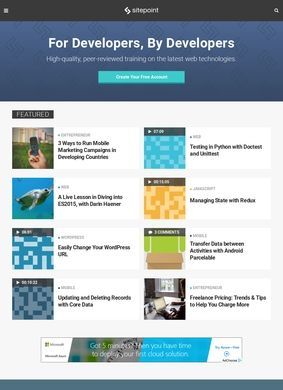
Someone teaching themselves front-end development hits the same wall every self-taught coder hits: the free tutorials run out, the advice contradicts itself, and there is no clear path from copying snippets to building something real. SitePoint has spent years positioning itself as the answer to exactly that, an online publisher and education platform aimed squarely at web developers who want structure instead of a hundred open browser tabs.
The pitch behind a paid platform like this is simple. Free material is everywhere, but it is unsorted, uneven in quality and often out of date, and sifting it eats the time a learner would rather spend coding. A subscription that curates courses, books and tutorials into one place is selling exactly that saved effort, a single vetted source in place of the open web's clutter. Whether the price is worth it depends entirely on how good the curation is, which is where independent verdicts start to matter.
A caveat has to come first. The public SitePoint site refused to load on repeated attempts, returning an access-denied response, and a fallback fetch failed as well. That kind of block is common on sites that screen out automated traffic, so an ordinary visitor with a normal browser may well reach it without trouble. What it does mean is that the picture below rests on independent reviews and rating platforms more than on a first-hand walk through the pages.
Inside the SitePoint Premium subscription
The core product is a subscription called SitePoint Premium. Independent listings describe it consistently: coding courses, books and tutorials covering web design and development, bundled behind a single subscription.
Courses, books and tutorials
The three formats do different jobs. Courses give the guided, start-to-finish path a beginner needs; books go deeper on one topic for someone who already knows the basics; and tutorials handle the quick, specific how-do-I question that sends most developers to a search engine. That breadth of format is the platform's clearest strength on paper.
Covering all three under one SitePoint login is the practical case for paying, since it swaps a scattered pile of sources for one library. For a working developer the tutorials alone can carry a subscription, since they answer the narrow, urgent questions that stall a project, while the courses and books serve the slower work of learning a subject properly. PCMag, reviewing the offering, called the material information-packed, which fits a publisher that has served this audience for years.
Low cost, lighter on practice
The same PCMag review is where the honest weakness shows. It praised SitePoint for its low-cost courses, then marked it down for lacking the interactivity and hands-on tools that rival platforms build in, things like quizzes and in-browser practice. For a certain learner that gap is decisive. Reading a clear explanation is not the same as being made to write code and have it checked, and platforms built around exercises tend to make lessons stick harder.
Learning style decides the rest: a reader who absorbs concepts from prose and then experiments on their own projects will barely notice the missing quizzes, while a learner who needs a system to check their work and keep them moving will feel the absence quickly. The price is friendly. The trade is less practice.
How it rates across the platforms
Pull the scores together and a split appears. The SitePoint Premium subscription rates well where its actual buyers leave feedback: G2 gives it 4.5 out of 5 across 11 reviews, with 81 percent of those at five stars, and AppSumo users score it higher still, 4.86 out of 5 from seven verified buyers.
These are the platforms where people pay for the product and then report back, which makes them the most useful signals in the pile.
A split between the product and the brand
The wider brand fares differently. On Sitejabber, SitePoint holds 3.3 stars from just three reviews, and its Trustpilot page carries only around nine contributions with no headline rating in view. Glassdoor adds three employee reviews of the company as an employer, again with no aggregate showing. Small samples cut both ways. A 4.86 average from seven buyers is genuinely strong, but seven is few enough that a couple of unhappy users would drag it down sharply, so the score reads better as a signal than as a settled verdict.
The same caution applies to the low Sitejabber figure: three reviews cannot condemn a platform any more than they can crown it. Taken together, the numbers suggest that people who buy the SitePoint Premium subscription and rate it tend to be satisfied, while the thinner general listings are too small and too mixed to prove much either way. The safer read is the product scores, since they come from verified users of the thing being sold.
One consequence of the loading problem is that the usual transparency check on SitePoint could not run. With the pages closed to inspection, there was no way to confirm a contact page, a phone line or an address, the basic checks any business directory profile would normally rely on, so that box stays unticked here, though the failure looks like automated blocking, not an absent business. It also means the loading failure should not be read as a red flag on its own, since large, active sites routinely turn away the automated tools used to inspect them.
SitePoint is a reasonable bet for a budget-minded self-taught developer who learns well from reading and wants one stocked library instead of chasing scattered free tutorials. The practical route in is to open the site in a normal browser, check what the Premium subscription includes and whether a trial is on offer, and run a course or two through it, paying attention to how recently the material was updated, since web tooling moves fast and stale content is the main risk with any developer library.
The gap shows up fastest for someone who learns by doing: without quizzes or live code checks built in, that kind of learner gets less out of SitePoint than the platforms built around hands-on practice, and the reviews say as much, so the material is worth testing hard before any money changes hands.