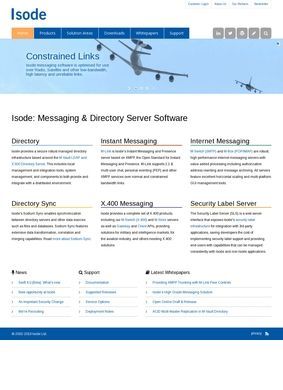
Isode is one of a small set of UK firms that sell secure messaging and directory software to defence and government customers. Founded in 2002 and based in Hampton, Middlesex, the company builds client and server products for environments where the choice of communication protocol is not optional, it is mandated by an alliance or a regulator, and has been for decades.
Messaging protocols for mandated standards
The catalogue starts with messaging. Isode supports X.400, the older heavyweight standard still entrenched in military and aviation systems, alongside ACP127 military messaging, plain Internet messaging, and dedicated military clients. Next to that sits a full XMPP stack: instant messaging servers, gateways, clients, and libraries. The combination reflects the customer base. These are organisations that cannot simply adopt whatever consumer app is fashionable, because their interoperability requirements are set by NATO standards bodies and national regulators, not by what the market prefers this year. They need software that speaks the right protocols correctly and keeps doing so over a procurement lifecycle that can run a decade or more. Isode is built around that assumption.
Directory services and provisioning
Directory services form the second pillar. Isode offers high-performance LDAP and X.500 directory products with provisioning, the unglamorous plumbing that tells a large messaging deployment who each user is and what they are allowed to access. In environments where accounts and permissions change constantly and errors have security consequences, provisioning accuracy is not a nice-to-have. A vendor that treats directory as a headline product, not a bundled afterthought, has a real place in that world, and Isode positions it accordingly.
HF radio and cross-domain security
The more specialised end of the range is HF radio communication software for degraded-connectivity environments, meaning messaging built on the assumption that the link will be slow, intermittent, or under electronic interference. That is the daily reality for naval and field units in many deployment scenarios, and very few software companies work in it at all. Paired with that are Cross Domain Guards: XMPP boundary protection and XML data diode controls, the components that let a high-security network exchange information with a lower-classified one without leaking in the wrong direction. Developer APIs round it out for teams that need to integrate these capabilities into their own systems.
The markets named on the site line up with the products in a way that reads as honest, not aspirational. Military deployments, including NATO, sit at the centre, with civil aviation, government, and EDI alongside. Each of those sectors runs on slow procurement cycles, mandatory certification, and formal vendor evaluation. Getting through those processes once is hard; doing it across multiple product lines over more than twenty years is a different order of difficulty. Isode has done it, and the still-active product range is the most direct evidence available.
Technical documentation and evaluation support
One part of the Isode site worth attention is the depth of published technical material. Isode publishes more than a hundred whitepapers, and that volume is not decoration. Whitepapers at that scale are written by engineers who know the protocols in detail and expect readers who will notice any handwaving. For an integrator deciding whether a product fits a particular network topology, that library does real work before any sales conversation starts. Product evaluations are offered so a team can test against its own requirements rather than relying on a datasheet. A customer support portal backs the products after purchase.
Contact with Isode runs through a structured form instead of a published phone number or direct email address, which will suit buyers who arrive through formal evaluation processes anyway. A physical address in Hampton, Middlesex appears on the site, and for procurement processes that require a verifiable corporate base, that detail is useful. The support portal covers post-purchase needs. Overall the Isode site is functional, not polished: it is aimed at engineers and procurement officers who know what they are looking for, not at casual visitors trying to understand the field.
Outside reputation is sparse in the public record, and it is worth being plain about why. A search turns up roughly seven or eight employee reviews on Glassdoor, which speak to working conditions rather than product quality. No customer-facing ratings appeared on Google, Trustpilot, Yelp, or comparable platforms. This is normal for a B2B vendor of this kind. Defence and government buyers do not leave star ratings online, and the people who depend on X.400 or HF messaging evaluate products through formal trials and references, not public review pages. The absence reflects the market, not the quality of the work. A prospective buyer has to lean on the technical documentation, the offered evaluations, and direct references instead of aggregated public sentiment.
For an organisation that needs standards-compliant secure messaging or directory software and operates in defence, government, or aviation, Isode presents as a credible, long-established specialist with a coherent product line and unusually deep documentation. The narrowness of the focus is intentional: this is software for hard, non-negotiable requirements, sold to buyers who arrive knowing exactly what they need. A general-purpose buyer looking for everyday team collaboration will not find a fit here and should not expect one.
Comparing Isode with mainstream alternatives
The natural comparison is Microsoft, whose Exchange and Teams stack dominates ordinary enterprise messaging. For a standard corporate environment, that is the safer, better-supported choice with a vast partner ecosystem. The trouble is that Microsoft does not seriously address X.400, ACP127, HF radio messaging, or cross-domain guards, the exact protocols a NATO or civil-aviation deployment is obligated to support. That gap is where Isode operates, and for buyers whose requirements sit inside it, the comparison is short. If the requirement is mainstream collaboration, look elsewhere; if it is military-grade interoperability over difficult links, Isode has spent more than two decades building for precisely those conditions.