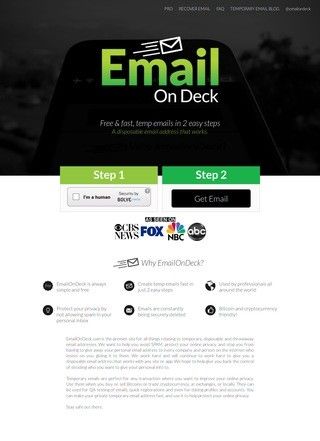
EmailOnDeck is a free disposable email service that hands you a working throwaway inbox without asking you to register an account. The whole flow takes two steps: you land on the site, a temporary address is generated, and you start receiving mail. There is no password to set, no profile to fill in, and nothing to confirm before the inbox is usable. For a tool whose entire reason to exist is speed and detachment from your real identity, that low friction is the right design choice.
How does EmailOnDeck work?
The use cases EmailOnDeck points at are specific and sensible. People reach for a temporary address to dodge spam on a one-off signup, to register for a site they expect to abandon, to test software during QA, or to keep a real inbox out of cryptocurrency and dating registrations where the volume of follow-up mail can get heavy. EmailOnDeck fits all of those because the address is meant to be used and forgotten. Messages are deleted automatically, and the connection runs over SSL/TLS, so the data in transit is encrypted even if the address itself is deliberately ephemeral.
One thing that separates EmailOnDeck from barebones free competitors is reach. The interface supports ten languages, including French, Spanish, German, Portuguese, Turkish, Russian, Indonesian, Traditional Chinese, and Arabic alongside English. That investment in a multilingual interface points to an international user base rather than an English-only utility. The site also reports more than 202 million temporary emails processed since 2015, which, if accurate, means EmailOnDeck has been running steadily for the best part of a decade. Longevity counts in this category because disposable-mail domains come and go quickly, and many get blocked by the very sites users want to register on.
Multilingual interface and longevity
Beyond the core inbox generator, EmailOnDeck carries a small set of supporting sections. There is a blog, an FAQ, and a glossary that explains the terminology around temporary email, which is a useful touch for newcomers who do not know the difference between a forwarding alias and a self-destructing inbox. An email recovery tool is also offered, aimed at people who generated an address, used it for a registration, and then lost access before retrieving an important message. That recovery feature turns out to be a point of friction, and the review platforms make that point clearly enough.
Supporting tools and features
The browser tooling is a genuine convenience. A Chrome extension and a Firefox add-on let you spin up an EmailOnDeck address from the toolbar instead of visiting the site each time, which is exactly how a regular user of this kind of tool would want it to work. If you find yourself reaching for a burner inbox several times a week, having EmailOnDeck one click away in the browser changes the calculus on whether the service stays in your workflow. It is a smarter integration than most free generators bother to build.
Browser extensions for quick access
There is also a paid Pro tier. What it includes and what it costs are not laid out on the homepage, and that opacity is worth flagging. A free base product with an undefined premium upgrade leaves a prospective Pro buyer guessing, and the kind of gap tends to surface in user complaints rather than in the marketing. EmailOnDeck does not explain Pro in any way that lets you evaluate it before paying.
Pro tier lacks public details
On contact and transparency, EmailOnDeck is notably bare. There is no phone number, no physical address, and no direct contact email visible on the homepage or in the general site overview. Terms and FAQ pages are present, but a clear route to reach a human is either absent or buried. For a free anonymous-by-design tool, some of that reticence is understandable, since the operators presumably want to keep their own footprint small. Even so, the absence of any visible support channel is a real limitation if a paying Pro customer ever needs help, and it is fair to weigh that when deciding whether to upgrade.
The third-party picture is mixed and leans negative at low volume. Trustpilot carries around six reviews with no aggregate score shown and feedback that runs both ways. PissedConsumer lists four reviews averaging roughly 1.2 stars, which is poor. Sitejabber has a single two-star review whose complaint centers on being upsold the paid recovery feature, and that aligns with the friction point already noted: the recovery tool appears to push users toward the Pro tier at the moment they are most motivated to pay.
Comparably scores product quality at about 3.2 out of 5, somewhere in the middle. The one reassuring data point comes from Scamadviser, which assessed EmailOnDeck as likely legitimate. SaaSWorthy lists EmailOnDeck with a product description but no visible rating, and the Chrome and Firefox stores carry user reviews whose counts were not pulled. None of these sample sizes is large enough to draw firm conclusions from, so weight them accordingly.
EmailOnDeck does not appear in any business directory of verified software tools with an independent rating, which is not unusual for a utility of this type, but it does mean there is no external aggregator to cross-reference the platform scores against.
Putting the pieces together, EmailOnDeck delivers well on its central promise. A no-signup, two-step inbox with auto-deletion and encrypted transport is precisely what someone needs for a throwaway registration. The multilingual interface and the browser extensions make EmailOnDeck more polished than the average barebones generator, and the track record since 2015 lends it credibility that newer entrants cannot claim. Free, single-use, low-stakes registration work is where EmailOnDeck is clearly worth using.
The caveats sit almost entirely on the paid side and on support. The Pro tier is undefined publicly, the most common complaint involves being pushed into paying for email recovery, and there is no obvious way to reach anyone if a transaction goes wrong. Low review volumes across several platforms, with at least one rating sitting near the bottom, mean the external reputation adds little reassurance. EmailOnDeck as a free tool is a reasonable pick. The Pro upgrade is another matter entirely: the information needed to evaluate it is not publicly available, and the review platforms suggest the upsell experience has frustrated more than a few people who found themselves there.