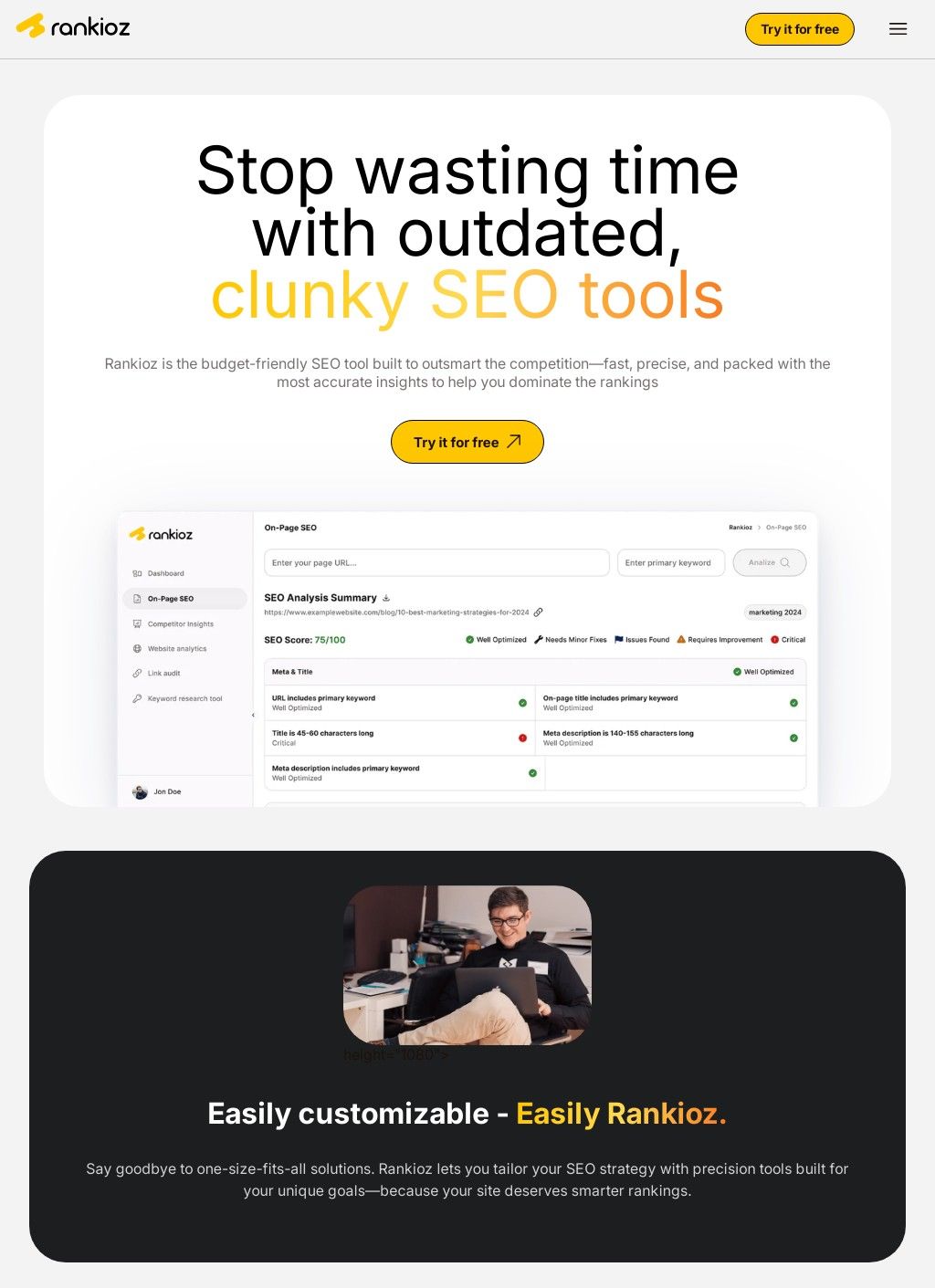
One thousand keywords a month is the number Rankioz puts at the center of its pitch, and it is worth pausing on what that ceiling represents in practice. At a flat $30 per seat, per month, Rankioz bundles AI-driven competitor analysis, Google-API-sourced keyword research, on-page URL checks, rank tracking with email alerts, an unlimited link checker, and a WordPress plugin for bulk meta edits. That breadth under a single price is either a deliberate philosophy or the natural state of a product that has not yet had to slice its user base into revenue segments. Probably both. There is no bronze-silver-gold ladder here, no feature locked behind an enterprise tier, no "contact sales" wall.
Keyword research with Google API data
Rankioz pulls volume figures through Google's own API rather than reselling modelled estimates. The practical difference is not small: third-party keyword databases frequently diverge from actual search behaviour by a wide margin, and content briefs built on inferred counts can quietly point a campaign in the wrong direction. The 1,000-keyword monthly cap is generous for a solo freelancer; an agency carrying twenty accounts will exhaust it mid-month. At that scale, Rankioz's per-seat billing model starts to accumulate costs in ways the flat-rate framing does not foreground. Worth knowing before the trial ends.
Scaling limits for agencies and freelancers
The headline feature reads the top ten Google results for a target query, extracts H1-through-H3 structure, meta data, and content gaps, and returns the breakdown in roughly a minute. Manually replicating that across ten pages eats an afternoon. Rankioz caps competitor analyses at 100 a month. On-page checks cover up to 100 URLs and flag missing keywords, weak structure, and meta issues. Rank tracking carries adjustable sensitivity with email alerts, which handles the monitoring side without requiring a separate subscription.
Competitor analysis and on-page checks
The WordPress plugin, called Action Tool, handles bulk meta edits. Applying changes one post at a time is the exact kind of tedium that causes site owners to abandon SEO housekeeping after a few edits, and bulk handling removes that specific friction. The unlimited link checker is the other constraint-free feature: link rot accumulates faster than anyone checks, and an uncapped tool is the only kind that gets used routinely instead of deferred indefinitely.
WordPress plugin for bulk meta edits
Rankioz also runs a blog covering on-page and off-page tactics, backlink work, and content marketing, giving the free tier of the site a reason to exist beyond product promotion. The named target users span digital marketers, SEO consultants, agencies, content marketers, SaaS founders, and small business owners. That is a wide spread, and tools aimed at everyone tend to disappoint most of them. Rankioz sidesteps the worst version of that problem by keeping the feature set narrowed to tasks those users repeat weekly, with no obvious dashboard padding or analytics-for-analytics-sake filler.
Blog content and target user segments
The monthly caps function differently depending on workflow. A freelancer running keyword research on a handful of clients will stay inside 1,000 keywords and 100 competitor lookups without difficulty. A busier agency will not. The seven-day free trial is the right place to stress-test whether the limits fit a specific workload: run an actual keyword set through Rankioz, fire a real competitor query, and judge the output against whatever the current process costs in time or money. The Google-sourced volume data and the competitor breakdown are the two features most worth examining, since they are the claimed differentiators and the places where quality gaps would surface first.
Testing monthly caps against your workflow
Tekpon scores Rankioz at 4.4 out of 5 based on aggregated user sentiment. SaaSGenius gives it a 91 percent Genius rating. SoftwareFinder carries one review at five stars. GoodFirms lists the product without reviews yet. G2 shows reviews, though no specific total was published. A founder post on Reddit's r/DigitalMarketing asking for early feedback drew a modest thread and a handful of upvotes. This is the footprint of a tool in its first wave of adoption, not an established platform with years of organic accumulation.
User ratings across review platforms
A 4.4 across a small base is useful context but not the same as a four-star average across thousands of paying customers. Each platform entry is consistent in direction, which is worth noting: there are no scattered negative outliers pulling the score down. But with most platforms showing single-digit or zero reviews, the scores justify running the trial; they do not substitute for it.
Limited contact options and support channels
Contact visibility is the one area where Rankioz falls noticeably short. No phone number, no physical address, and no obvious route to reach the company appear on the homepage or the blog. Support runs through email backed by a knowledge base. That setup is common for lean SaaS products, but the absence of any visible contact detail on the main landing page is a genuine point against the tool for buyers who need to know someone answers before they subscribe. In a category where even small competitors list at least an email address publicly, the gap stands out and does not reflect well.
Evaluating the trial before committing
Rankioz fits a specific profile well: one predictable fee, weekly SEO tasks covered in a single interface, keyword data pulled directly from Google instead of from a third-party approximation layer. The contact opacity and the shallow review history are the two honest demerits. Neither disqualifies the product for a buyer willing to use the trial seriously, but the decision rests squarely on the trial output. The site itself does not provide enough third-party evidence to shortcut that step.
Business address
Rankioz
Stojana Matića 034 stan 24,
BEOGRAD-ČUKARICA,
11030
Serbia
Contact details
Phone: 0640532078