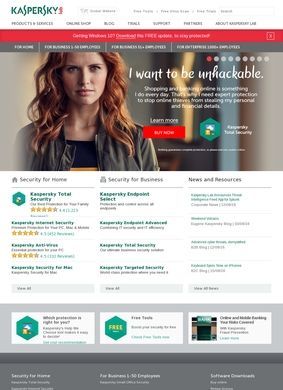
A laptop slows to a crawl, a browser warns about a payment page, a parent worries about what a child is downloading after school. These are the ordinary moments that push someone toward security software, and Kaspersky has built its consumer line around exactly that kind of everyday trouble. The home products split into three tiers: Standard, Plus, and Premium. The difference between them is concrete enough to compare on a single page. Standard carries twelve features, Plus seventeen, and Premium twenty-four, so a shopper can see what the extra money buys instead of guessing at vague "advanced protection" labels. Real-time antivirus sits at the base of all three, with online payment protection, performance tuning, a VPN, a password manager, and parental controls layered on as the tier climbs.
Protection across every device
What pulls the Kaspersky catalog together is how far it reaches across devices. Protection covers Windows, Mac, Android, iOS, and Linux, which means a household running a mix of hardware can stay inside one ecosystem rather than stitching together separate tools. The parental side runs under the Safe Kids name, and the top tier folds in expert virus removal, the sort of human help worth having when an infection has already dug in and a scan alone is not closing the loop. For families, gamers, and older users who want something they can install and mostly forget, the structure is legible. You pick a tier, you know the device count, and the feature list is the contract.
Business security tiers
The business catalog is where Kaspersky shows its actual depth, and it goes well past a rebadged consumer scanner. Small Office Security handles the low end, aimed at firms that need solid coverage without a dedicated security team. Above that sit Next EDR for endpoint detection and response, Next XDR, and the managed variants MXDR Optimum and Managed Detection and Response, where Kaspersky analysts watch the network so an in-house staff does not have to run a round-the-clock operation. Threat Intelligence services and Hybrid Cloud Security round out the enterprise shelf. The naming gets dense, as security vocabulary tends to, but the progression makes sense: a buyer can start small and move up the same vendor's stack as the organization grows and its threat surface widens.
Threat research and training programs
One genuinely useful thing about the Kaspersky site is that it is more than a storefront. SecureList, the company's threat research publication, posts the kind of material that security professionals read regardless of which products they buy: malware breakdowns, campaign tracking, and technical writeups. The blog runs daily content for a less specialized audience, and Kaspersky Academy offers product training and certification for people who want to formalize their skills. There is also a broader resource library. This research output is part of why the Kaspersky name has standing in the field. A company that publishes original analysis of live threats is showing its work rather than just selling a subscription, and that distinction counts for a lot when you are deciding whose detection engine to trust.
Global reach with support portals
The reach is considerable in scale terms. Kaspersky has operated since 1997 and distributes in more than 200 countries, with the head office in Moscow and regional offices spread internationally. Support is split into separate portals for home and business users, which is the right call given how different those two audiences are: a parent troubleshooting Safe Kids and an administrator deploying EDR across hundreds of endpoints have almost nothing in common. Forcing them through one help channel would serve neither. That kind of operational clarity, where Kaspersky has thought about who is asking the question before routing the answer, tends to track with a product that has been refined over many release cycles.
Geopolitical trust concerns
The one thing a prospective buyer cannot ignore is the geopolitical context, and it sits entirely outside the feature list. Kaspersky's Russian headquarters has drawn government scrutiny in several countries, and some public-sector bodies and regulators have restricted or banned Kaspersky software on official systems over supply-chain trust concerns. None of that reflects on the technical quality of the detection, which has rated well in independent lab testing for years, but it is a factor any careful reader should weigh, especially anyone buying for an organization with its own compliance rules. For a home user in a country without such restrictions, the calculus is simpler; for a government contractor, it may rule the product out entirely. The honest position is that this is a strong toolset carrying a real political asterisk, and pretending otherwise would do the reader a disservice.
Stack the catalog up and the picture is coherent. Consumers get a clean three-tier ladder with transparent feature counts and broad device coverage. Small businesses get a true entry point, and enterprises get a full detection-and-response stack with managed options and a research arm feeding it. The training and publishing wings mean Kaspersky functions as a reference point in the field, not purely a vendor, and that gives the listing more substance than a company that simply ships a binary and an invoice. Someone arriving with a single infected PC and someone arriving with a fleet of servers can both find a product that fits.
Comparing Kaspersky and Bitdefender
Set against a direct competitor like Bitdefender, the comparison comes down to that trust question more than to capability. Bitdefender offers a similar consumer ladder, comparable lab scores, and a comparable business stack, but without the headquarters baggage that has triggered formal bans on Kaspersky in certain markets. On pure features and research credibility, Kaspersky holds its own and arguably leads on the depth of its published threat intelligence.
Choosing based on procurement rules
The choice is less about whether the software works, because by most independent measures it does, and more about whether a given buyer's situation can accommodate where the company is based. For a household weighing the two, Kaspersky remains a serious, well-documented option worth shortlisting. For a buyer bound by procurement rules that flag its origin, Bitdefender or a domestically based vendor will be the cleaner path, and that is a constraint no amount of product polish can resolve.