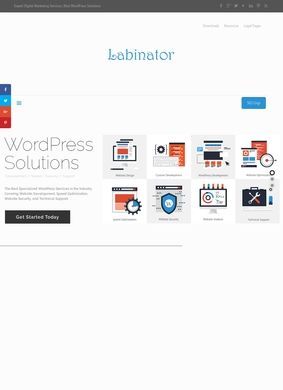
Labinator's product line starts with three WordPress themes, GrandSpace, NanoSpace, and PicoSpace, and the names alone telegraph the pitch: leaner, faster builds with less of the bloat baked into most commercial themes. Alongside those, the site sells plugins covering security, speed tuning, ongoing maintenance, and customisation. The intended customer base is people who build and run sites for other people, and that shapes almost everything about how the catalogue is put together.
Behind the white-label model
It is a white-label operation, and that detail sits at the centre of the whole proposition. The buyer Labinator is really after is a freelancer, an agency, or a company that wants to put its own badge on the work and resell it. There is a marketplace for direct purchases, plus a reseller and partnership track for anyone who wants to fold the whole catalogue into their own offering. In theory a solo site owner with one WordPress install could buy here, but the deeper machinery is aimed squarely at the developer managing a portfolio of client sites.
The framing as an AI-powered web solutions provider is worth a moment of honest scrutiny, since that label gets stuck on almost everything now. What sits underneath it at Labinator is fairly concrete: themes you can install, plugins you can switch on, and services someone performs on your behalf. The AI angle is more about how some of that work gets done than a separate product category you buy, and the page does not pretend otherwise, which is the right call.
Services beyond selling themes
The services go well past selling downloads. Labinator offers WordPress development, security hardening, speed optimisation, and technical support, all of which line up with the category this listing sits under. The one that deserves particular attention is what they call autopilot maintenance, the hands-off arrangement where someone else watches the updates, backups, and breakage while you get on with client work. For a freelancer juggling a dozen sites, that service is the most likely to justify a recurring fee, and it is sensibly paired with the security and speed work that tends to deteriorate if nobody tends it.
Broader marketing and development menu
Beyond the WordPress core, the Labinator menu widens into custom web development, turning existing websites into apps, content writing, and technical SEO auditing, a fairly broad spread for one shop. There is also a digital marketing side that extends as far as Android app promotion. On top of the themes and plugins, the catalogue lists HTML templates with accessibility features built in, worth flagging because accessibility is the sort of thing most template sellers quietly skip.
That breadth cuts two ways. A shop covering themes, plugins, app conversion, content, SEO audits, and app promotion is either genuinely full-service or spread beyond what the page honestly conveys, and the site does not fully settle which. The WordPress products read as the real anchor and the marketing services orbit around them, but a buyer should ask pointed questions about anything outside that core before putting real money into it. The technical SEO auditing is the sort of service whose value depends entirely on who does it and what methodology they apply, so it is worth pressing for specifics on what a Labinator audit actually produces, and what a finished report looks like, before paying for one.
How does labinator approach security?
For the security category this listing sits under, the relevant pieces are the hardening service and the security plugin, paired with the maintenance work that keeps a site patched over time. Security on WordPress is rarely a one-time job, and a vendor that treats it as an ongoing relationship is reading the problem correctly. Whether Labinator executes that well is something only a real engagement will show, but the structure of the offering at least matches how site security actually fails: slowly, through neglect, not in one dramatic event.
Customer reviews and ratings
On outside feedback, the picture is modest. Endorsal.io carries eleven customer reviews at a flat five out of five. FinancesOnline lists Labinator with an 8.0 out of 10 quality score and a 93 percent user satisfaction rating, though it does not say how many responses that figure rests on. On WordPress.org, the Labinator Content Types Duplicator plugin has two reviews, both five stars. There is no Trustpilot, Google, Yelp, or BBB presence to draw on. Taken together, eleven ratings and two plugin reviews is not much of a track record to weigh, and the platforms involved are ones where vendors often solicit feedback directly instead of receiving it unsolicited.
The numbers that do exist point in a positive direction, and that counts for something when a company sells trust-dependent work like security hardening. A handful of perfect scores across niche platforms is a different thing from a long and diverse public history, though, and a cautious buyer should treat the existing ratings as a first data point rather than a settled verdict. Asking Labinator directly for case studies or references from clients in a similar situation would fill in what the public record cannot.
Reaching labinator through contact channels
Reaching Labinator runs through a form linked straight from the main navigation. No phone number or street address appears up front; both wait behind the contact link. That is a reasonable arrangement for a digital products company that fields most inquiries by form, and the route to get in touch is clearly marked even if the specifics take one extra click. A blog and a testimonials section round out the site, the supporting furniture a vendor typically deploys to show ongoing activity and satisfied customers. Those testimonials are self-published, so they sit alongside the third-party scores as useful context rather than independent confirmation.
Who should choose labinator
A buyer who manages WordPress sites for a living and wants a white-label source for themes, plugins, and maintenance will find Labinator worth investigating, particularly for the autopilot upkeep and the security and speed services that tie the products together. The accessibility-ready HTML templates are a genuine differentiator.
The hesitation is the same that applies to any shop with a wide menu and a limited public review record: the offering reads well, but the proof rests on a small pool of ratings from platforms with limited independent standing. Testing Labinator on a single project or one plugin first, watching how support and maintenance actually perform before expanding the relationship, is the sensible approach. As a specialist resource for WordPress builders it earns reasonable trust; as a single source for all marketing and development, the breadth still has to be demonstrated in practice, not inferred from the catalogue.