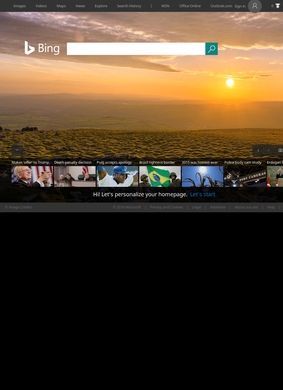
Microsoft's search engine has changed more in the past two years than in the decade before. Bing still does plain web search, but the front page now opens with an AI assistant built on OpenAI technology sitting right next to the ranked results. That is not a small UI tweak; it reshapes what kind of tool the site is and who it is aimed at.
Search verticals and visual capabilities
The search coverage is broad: general web, images, video, news, and maps. The image side goes further than a basic gallery. Bing has a visual search feature that runs reverse image lookups, so a cropped photo can become the query instead of typed words. Video and news each get their own verticals, and maps rounds out the set for local lookups without leaving the page. None of this is unusual for a major engine, but it is all there, and it works.
Microsoft Rewards points program
Two things here feel like deliberate decisions, not table stakes. One is Microsoft Rewards, a points program that pays users for running searches, with points redeemable for gift cards. A lot of people use it for that reason alone, which is a perfectly rational choice if the search quality clears the bar for daily use. The other is the rotating homepage photograph, a signature of the site for years. It is a small thing, but it gives the landing page some personality that a blank search box never had.
Integration with Microsoft products
Shopping search sits alongside the core verticals, and there is dedicated flight and travel search for fares and trips. For someone inside Microsoft's ecosystem, the integration with Microsoft 365 and the Edge browser means the engine is often the default that appears without anyone choosing it. That reach, built into the OS and browser, is probably a bigger distribution lever than any single feature announcement. The tie-in goes both directions: Bing surfaces better in Edge, and Edge pushes back to it. Whether that is good product design or just lock-in depends on your perspective, but the effect on usage numbers is obvious.
Powering search beyond bing.com
The business side is larger than the brand recognition implies. Microsoft Advertising, the platform formerly known as Bing Ads, lets companies run paid search campaigns against this inventory. The engine powers results for Yahoo Search and AOL Search, and it supplies part of what DuckDuckGo serves. Users who have never typed bing.com are in many cases reading from its index without knowing it. That syndication is a quieter form of scale than raw market share figures suggest, and it has been in place long enough to be a structural part of how search inventory gets distributed.
Developer access through APIs
Developers get API access through the Bing Search API, which exposes the same search capability for integration into outside applications. SafeSearch filtering handles content control across the global footprint. The engine runs in many countries and languages, and the localization goes deeper than translating the interface after the fact.
Conversational search with AI assistant
The AI assistant, branded as Bing Chat, is the clearest sign that Microsoft is using the engine to try things rather than maintain a settled product. Conversational search powered by OpenAI puts Bing among the first major engines to fold a large language model directly into the results for a mass audience. It changes how a query gets answered, replying in sentences instead of handing back a list. Whether that is an improvement depends entirely on the question. The usual caution about AI-generated answers applies, and Bing does nothing special to flag where the model is guessing. For factual lookups on well-documented subjects it tends to do fine; for niche or recent information the confidence can outrun the accuracy.
Market position and user adoption
The honest limitation is the one everyone knows. Bing runs in the long shadow of a competitor that holds most of the search market, and for many users it is the engine they reach for second or the one their browser defaulted to and they never bothered to change. The rewards program and the AI features are partly an answer to that: incentives and novelty meant to pull people across. Whether either holds a user past the first few sessions is not something the site itself can demonstrate.
Why customer reviews are absent
A search for third-party review platform scores turned up nothing usable: no Trustpilot profile, no aggregated star rating, no customer testimonial count. That makes sense given Microsoft runs the engine as a product, not a business that collects customer reviews. The absence is a structural feature of what Bing is, not a red flag about the product itself.
Comparing features against competitors
Measured against what the site offers, Bing is a complete and seriously resourced search engine with a few hooks the market leader does not bother with. The reverse image search, the rewards program, the syndication that quietly powers other engines, the early AI integration: each is a concrete reason a particular user might prefer it over the default. The verdict is a qualified yes. Bing is worth keeping as a second engine even for people loyal elsewhere, and the rewards points plus visual search alone justify occasional use. Whether it becomes someone's primary default is a harder argument to win, and nothing in the published feature set settles it one way or the other.