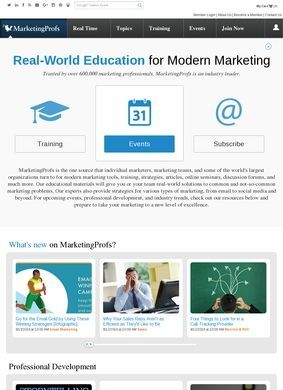
One marketing professor at the University of Southern California started this in 2000, and that academic root still shapes how the whole thing reads. Allen Weiss built Marketing Profs as a teaching operation aimed squarely at people who do B2B marketing for a living, and Marketing Profs has grown into something that claims a community north of 700,000 marketers. That number is large enough to raise an eyebrow, but the breadth of material on the site does make it plausible. This is not a blog that occasionally posts a tip sheet. It is a fairly deep library wrapped around a paid membership.
Free B2B marketing library
The free side of Marketing Profs is what most people will hit first. There is a substantial collection of articles, opinion pieces, and how-to resources, all of it narrowed to business-to-business work: content marketing, email, demand generation, branding, analytics, social, search engine marketing, and broader B2B strategy. The narrowness is the point. A general marketing publication tries to cover everything and ends up shallow on the parts that matter to someone selling to other companies.
The editorial focus at Marketing Profs stays put, which means a demand-gen specialist or a content lead is more likely to find an article that speaks to their actual problem than they would on a catch-all site. The free library is also large, not a token sampler designed to push readers toward the paywall after two clicks. Articles, opinion pieces, and resources cover the range of B2B disciplines the paid courses do, so a reader can get real use out of the site without ever entering a credit card. That generosity is itself a quiet credibility signal, since a content operation confident enough to give away this much tends to have something worth selling behind it.
PRO membership tiers
Past the free articles, the business model of Marketing Profs becomes clear. PRO subscriptions come in individual, team, and enterprise tiers, and they open up the full course catalog, the bootcamps, and a members-only Slack community. The tiering tells you who the real target is. Individual plans serve a single marketer paying their own way or expensing it, while the team and enterprise levels are pitched at organizations that want to put a whole marketing department through the same training.
Inside the members-only Slack
The members-only Slack is the part worth watching, because a working community of peers can be more valuable than the courses themselves when someone is stuck on a specific campaign problem and wants an answer from someone who has actually run one. Whether that channel is active or quiet is the kind of thing a free trial would reveal faster than any description. There is also a personal concierge service attached to Marketing Profs membership, which is an unusual touch for an education platform and points to a deliberate effort to keep subscribers from drifting away after the first month. Whether that concierge is a real human guiding your learning or a lighter-touch support function is not something the public pages settle.
Structured courses with certificates
The courses and certifications are the meat of what Marketing Profs sells. Topics run across the same B2B disciplines the free library covers, but in structured form, with certificates at the end. For a marketer who wants something to put on a LinkedIn profile or justify to a manager who approved the training budget, a certificate has professional standing that a stack of read articles does not. The catalog is paired with weekly webinars and virtual conferences, so the membership is less a static archive and more a rolling schedule of new material. Anyone trying to keep current in a field where tactics shift quickly will find that rolling schedule genuinely useful.
Annual B2B Forum conference
Then there is the B2B Forum, an annual in-person conference. Running a physical event every year is expensive and logistically heavy, and the fact that Marketing Profs sustains one tells you the brand has enough pull to fill a room. Conferences also tend to be where a company's reputation gets stress-tested in public, because attendees talk. Marketing Profs also runs an advertising and media arm on a separate subdomain, letting brands buy access to that marketer audience. That is a sensible way to monetize the traffic beyond subscriptions, though it does mean some of what reaches a reader is sponsored.
Checking customer reviews online
Here is where the picture gets harder to read. For a company this established, with this much content and a quarter-century of operation, there is surprisingly little aggregate customer feedback on the usual platforms. No notable rating turned up on Google, Trustpilot, or Yelp for Marketing Profs itself. A Trustpilot entry that surfaces under a similar name belongs to a separate Indian company, digitalmarketingprofs.in, and has nothing to do with this one, so anyone searching should be careful not to conflate the two.
How reliable are these reviews?
What does exist is scattered and partial. Glassdoor carries a handful of employer reviews, but those are written by employees about working there, not by customers about the product, so they say little about whether the courses are worth the money. Indeed shows some student reviews tied to the certifications, which is closer to useful, though no overall score came through. There is a small, mixed discussion thread about Marketing Profs on the marketing subreddit, the kind of organic back-and-forth that gives a flavor of opinion without settling anything. The Better Business Bureau lists the company out of Los Angeles but shows it as not accredited, with no rating and no visible complaint history.
None of that is damning. Plenty of B2B education brands sell to organizations through direct relationships and never accumulate the consumer-review trail that a restaurant or a retailer would. But it does leave a prospective subscriber leaning on the brand's own claims and on the visible quality of the free content, with little independent corroboration to lean against. For a purchase that can run into team or enterprise pricing, that absence is worth sitting with.
Find support and contact options
Contact at Marketing Profs is handled reasonably. There is a dedicated page at the About section with department-specific routes, so a sales question and a team-learning question go to different places instead of a single generic inbox. A phone number and an events email are findable through event pages and the BBB listing, though neither is pushed front and center on the main landing page. That is a minor friction, not a real barrier, and the structured contact options actually work in the company's favor for anyone with a specific ask.
Marketing Profs also offers a mobile app on iOS, which fits the membership model: for subscribers paying monthly for a stream of courses and webinars, being able to pick them up on a phone is a fair expectation. It is not a headline feature, but its presence indicates the platform is maintained rather than coasting.
So who is this for. A marketer working specifically in B2B, who values structured learning over scattered reading and who can either expense the membership or get genuine career mileage from the certifications, is the clear fit. Someone doing broad consumer marketing, or anyone who wants to read a few articles and move on, gets most of the value from the free Marketing Profs library without paying. The depth and focus are easy to check in the free Marketing Profs library. What stays unsettled is whether the paid tier delivers proportionally to its price, because the independent voices that would normally answer that question are, for this particular company, oddly quiet.