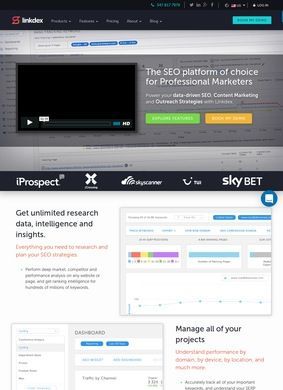
Linkdex is a UK company whose product is a cloud-based enterprise search-optimization platform aimed at corporate marketing teams rather than individual site owners. The pitch, going by the vendor listings that describe it, rests on four functions: tracking a brand's search visibility, reporting market share against competitors, measuring how published content performs, and coordinating campaigns across several channels from one place.
One caveat has to sit up front. The live site would not load during this review: a direct request returned a 503 service-unavailable error, and a second attempt through a scraping service failed with a 500 error of its own. Everything below is therefore assembled from third-party directories and review platforms that catalog the product, not from Linkdex's own pages.
What the platform is built to do
The Linkdex Enterprise SEO Platform is described as software for measuring and managing organic search at scale. Search visibility tracking watches where a brand ranks across large keyword sets over time. Market-share reporting reframes that ranking data as a slice of the total search demand in a category, which is the number a marketing director tends to care about more than any single keyword position.
Content performance reporting and multi-channel campaign management round out the set, tying what a company publishes to how it surfaces in search and letting a team run several efforts side by side. This is tooling sold to businesses with dedicated search staff, priced and packaged accordingly, though no pricing surfaced anywhere in the listings that could be confirmed.
The appeal for that kind of buyer is consolidation. Instead of stitching a rank tracker to a separate reporting deck and a third tool for campaigns, the platform is meant to fold visibility data, competitive market-share views, and content measurement into one reporting layer a team can act on. Whether the execution lives up to that promise is the part no directory page can answer, and it is the part that decides whether enterprise software is worth its yearly cost.
Search visibility and market-share reporting
Of the advertised features, these two are the clearest fit for the intended buyer. A large brand rarely wants a raw rank check; it wants to know whether it is gaining or losing ground against named rivals, and market-share reporting is built to answer exactly that.
Visibility tracking feeds it the underlying data. Without hands-on access to the platform, though, there is no way here to judge how accurate or how current that data actually is, which for a search tool is the entire proposition.
A profile assembled from listings
Because the site stayed dark, the usable evidence comes from where Linkdex is cataloged. It turns up across the enterprise software directories a buyer would normally check: G2, TrustRadius, Gartner Peer Insights, ITQlick, SpotSaaS, and FeaturedCustomers all carry a page for it. That presence at least confirms the product is real and positioned squarely in the enterprise SEO and SEM category.
What those pages do not consistently supply is depth. Several list the product without a visible rating or review count in their summaries, so the catalog entries prove existence more than they prove reception.
Contact and the unreachable site
Contact cannot be assessed at all this time. With the homepage returning a server error, no phone number, email, contact page, or business address could be viewed firsthand, and the directory listings for Linkdex did not fill that gap in any way a reviewer could verify.
For a vendor selling to enterprise buyers, an unreachable front door is a poor look, even if it proves to be nothing more than a temporary outage. A serious prospect would want the site back up before going further.
How the reviews shake out
The third-party numbers are sparse and a little contradictory. ITQlick ranks Linkdex second among 75 SEO and SEM systems it has reviewed, a strong placement, yet attaches no star score to that rank. CrowdReviews lists it with a Community Feedback Score of 4.50 out of 5, but that figure rests on just two reviews. FeaturedCustomers counts 14 customer references, of which two are written testimonials and twelve are videos.
The shape of the FeaturedCustomers entry is telling on its own. Twelve of its fourteen references are videos, a format vendors tend to commission and control, with only two plain written reviews sitting behind them. That reads as supplier-supplied proof more than independent feedback.
The rest is quieter still. The G2 page is flagged as managed by the company but carrying limited features, Serchen states plainly that the product has not been reviewed there yet, and the Gartner, TrustRadius, and SpotSaaS pages exist without a headline count in view. Put together, a high directory ranking sits oddly beside a real-user record that amounts to a handful of testimonials.
A scarce real-user record
That imbalance is the honest headline. Plenty of sites list Linkdex, and very few people are on record actually rating it, so a prospective buyer gets category placement without much lived experience to weigh against it. A 4.50 average means little at a sample of two. A rival like BrightEdge, where the product page loads and the review trail runs deeper, makes for a better-lit comparison.