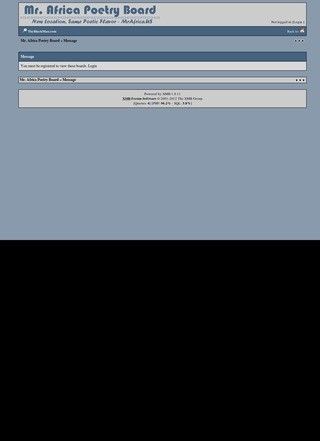
You cannot read a single poem on Mr. Africa Poetry Board without first making an account and signing in. The board content sits entirely behind a registration wall, so a visitor arriving from a link or a search result hits a login prompt before any verse, any thread, or any sense of who posts here. That choice tells you most of what you need to know about the place. It is not built to win passing traffic or to be skimmed. It expects you to commit a few minutes to joining before it shows you anything.
Registration required to view content
The software running Mr. Africa Poetry Board is XMB, version 1.9.11, an older open-source forum package that long predates the era of slick social platforms. Anyone who spent time on message boards a couple of decades ago will recognise the shape of it immediately: threaded topics, a member list, post counts, the whole familiar furniture of a classic discussion forum. There is no pretence of being a modern app. Mr. Africa Poetry Board is a community message board in the plainest sense, and it serves African American poets and readers who want a dedicated corner for sharing original work.
Poetry Lounge as the community center
At the centre of the board is a section called the Poetry Lounge, where members post their own poems and respond to each other's writing. This is the working heart of the site. The Poetry Lounge is built around original creative work, not reposted quotes or generic writing prompts, and the focus stays narrow: African American voices writing and reading verse together. A narrow focus is usually a strength in a forum, because it gives the regulars a shared reason to keep coming back, and it keeps the conversation from sprawling into everything and nothing.
Named poet pages within the network
What I find genuinely interesting is the constellation of individual poet pages tied to it. Mr. Africa Poetry Board does not stand alone; it is one node in a larger network connected to Mr. Africa, Inc., a non-profit organisation. That network includes a string of personal poet pages, each carrying a writer's name: Jlivory, LadyLyric, ShandraLove, TangelaCooke, Trin-A-Thoughtz, PoeticFreedom, LyrikallyFree, and LilPiglet. The naming alone gives you a feel for the culture here, playful, personal, rooted in pen names rather than corporate branding. These pages point to a board that is less a faceless forum and more a hub where named, recurring contributors have built their own small presences.
Connections to affiliated African American sites
The wider web of links extends to ThyBlackMan.com and to ctadams.com, described as the MrAfrica Poetry Lounge hub. So Mr. Africa Poetry Board is part of a small ecosystem of African American community sites that cross-reference one another. For someone trying to gauge whether this is a real community or an abandoned shell, those connections matter. They imply the board was set up with intent and tied deliberately into other active spaces, even if the front door gives a casual visitor very little to go on.
That said, the registration wall cuts both ways. It protects the members and keeps the content out of search-engine scrapers, which many small creative communities prefer. But it also means an outsider cannot judge how busy the Poetry Lounge currently is, how recent the last posts are, or how many writers are still active. You are asked to take it partly on faith and to join before you can assess. Whether that trade is worth it depends entirely on how much you want a poetry-specific space versus a general writing community you can browse freely.
Contact information behind the registration wall
Before logging in, Mr. Africa Poetry Board shows no phone number, no street address, and no email address. Contact information is absent from what any visitor sees first. For someone wanting to ask a question or reach an organiser without first creating an account, that is a real friction point, and it is fair to name it as one.
Email and submission routes via ctadams.com
The picture improves slightly once you look across the connected network. Associated pages do list a webmaster email and a separate address for submitting poems, both running through the ctadams.com domain. So a route to the people behind the project does exist, it just lives on the affiliate and mirror pages, not on the board itself. A visitor willing to follow those links will find a way to make contact. One who expects it front and centre on Mr. Africa Poetry Board will leave empty-handed. That gap shapes how approachable the project feels on first contact, and it is worth naming plainly.
Is there public feedback about this board?
On reputation, there is not much to report from the outside. A search turns up no third-party reviews, no star ratings, and no listings on the usual platforms where businesses accumulate public feedback. The broader Mr. Africa effort does maintain a Facebook presence, listed as MrAfrica Poetry Lounge in Mebane, North Carolina, and an Instagram account under the handle mrafricapl. Those social pages anchor the project to a real place and give it a thread of continuity, but they are not a substitute for independent reviews, and none were found.
The North Carolina connection grounds what could otherwise feel like a free-floating web project in an actual location, and it suggests there is a person or a small group behind the organisation, not a purely anonymous board. Combined with the non-profit framing and the network of named poets that orbit Mr. Africa Poetry Board, the overall impression is of a sincere, grassroots literary community rather than a commercial venture chasing clicks.
So where does that leave a prospective member? Put plainly, Mr. Africa Poetry Board is a specialised, login-gated forum for African American poets, built on dated but functional forum software, woven into a small network of poet pages and affiliated sites, and short on the public-facing indicators (visible contact, outside reviews) that usually let you size up a site at a glance. The people who will get the most out of Mr. Africa Poetry Board are writers actively looking for a community devoted to their own verse, who do not mind creating an account to see what is inside, and who value a focused, culturally specific space over the convenience of a forum they can read without joining. For everyone else, the closed front door may be enough to send them elsewhere.
The deciding factor is patience. In the end, Mr. Africa Poetry Board hands you almost nothing for free and asks you to register before it reveals whether the Poetry Lounge is humming or quiet. That is not necessarily a flaw; it is a design choice, and Mr. Africa Poetry Board is consistent about it. If you are the kind of poet who would rather belong to a small, defined community than browse a large open one, the few minutes it takes to create an account and look around is probably time well spent. If you need to see the room before you walk in, this particular door stays shut.