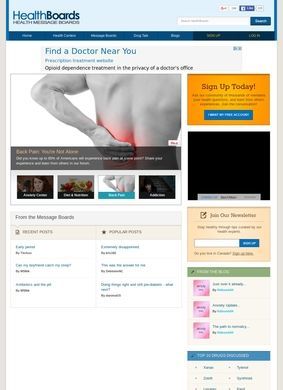
Peer health forums have a complicated reputation, and HealthBoards is a good case study in why. It has been running since before 2003, it was recognized by Consumer Reports Health WebWatch as one of the top 20 health websites in 2005, and it now sits under the ownership of MH Sub I, LLC dba Internet Brands, which also runs a string of other online communities. Few sites of its kind can claim a history that long, and longevity in the consumer health space means something. Sites that give bad advice at scale tend not to last, and HealthBoards has outlasted a large number of competitors from its era.
Message boards organized by health topic
HealthBoards offers a set of plain message boards grouped by medical topic. Acne and skin problems, back pain, addiction and recovery, diet and nutrition, mental health, and dozens of condition-specific areas all sit behind a "Find a Board" index. If you are cataloguing online health resources, the site draws inclusion on volume and history alone. You register a free account, you post your question or describe what you are dealing with, and other members reply. The model has not changed much in two decades, and that consistency is part of the appeal. People who have been coming back for years are still there, and the depth of the archive reflects that continuity.
Top discussed medications on the homepage
One feature visible on the HealthBoards homepage is a "top discussed medications" list: Xanax, Tylenol, Zoloft, Synthroid, Lexapro, Paxil, Prozac, Vicodin, Valium, and Morphine all named outright. That list is an honest indicator of what the community spends its time on, and it tells you more about the site's real audience than any mission statement would. People arrive already anxious, often about a prescription they just received or a symptom they cannot get a clear explanation for, and they want to hear from someone who has been through the same thing. The medication list makes that purpose visible rather than burying it.
Advanced search and archive depth
Beyond the boards, HealthBoards gives members Advanced Search, New Posts browsing, an FAQ, a newsletter, and the Drug Talk section that aggregates medication threads. Of those, Advanced Search is worth the most attention. The site is two decades deep at this point, and the archive is the real product. A well-aimed search will often surface a thread from six or eight years ago where someone described the same symptom in the same words, complete with replies from people who had already been through that treatment and could describe the experience in specific terms. That accumulated record is genuinely hard to find elsewhere. Clinical sites give you the approved language; HealthBoards gives you what it actually felt like.
Reviews and ratings from outside platforms
The outside reputation picture at HealthBoards is worth examining directly. Sitejabber carries 51 reviews averaging 1.4 out of 5. SmartCustomer shows the same figures: 51 reviews, 1.4 average. ComplaintsBoard logs 17 complaints at the same 1.4 average. Trustpilot has one review, which is too little to draw any conclusion from. The dominant complaint across all three platforms is moderation: members suspended without clear explanation, bans that felt disproportionate, posts removed with no reasoning given. That pattern is consistent enough to take seriously.
Weighing the negative reviews fairly
At the same time, a forum where strangers are giving each other advice about prescription drugs has real reasons to moderate firmly, and the people most likely to leave a furious one-star review are almost always the ones who were on the wrong side of a moderation call. A member who quietly got an answer to a question about Synthroid and moved on is filing a review nowhere. The low scores are documented and worth knowing going in, but they do not describe the complete picture of what HealthBoards does day to day.
Contact options and support limits
HealthBoards provides a contact link in the footer and no physical address or phone number on any standard page. For a free community forum under a corporate parent, that is a typical arrangement. The friction shows up when something goes wrong with an account, which is precisely the kind of situation the negative reviews describe most often. When a ban is the problem and a footer form is the only recourse, the gap between what a user needs and what HealthBoards provides becomes very visible. Registering with that reality already in mind is better than discovering it under pressure.
Health disclaimer and ad-supported model
HealthBoards carries a Health Disclaimer and a Consumer Health Data Notice, both of which reflect an awareness that the site is handling sensitive ground. Neither document changes what the forum fundamentally is: a peer community, not a medical authority. Advertising is accepted across the site, and a forum this focused on named medications running on an ad-supported model has drawn the kind of scrutiny the whole health-information industry has faced for years. HealthBoards is transparent about the disclaimer without making it prominent, and users should read it before treating anything they find in the boards as a substitute for professional advice.
Taken together, HealthBoards occupies a specific and useful niche. The archive is deep, the topic range is wide, and the history is long enough to give it credibility that a newer community would have to earn over time. HealthBoards is also a platform with a documented moderation complaint at the review level, limited support access, and ad funding in a space where those things draw legitimate questions.
Using the archive to research treatments
Someone newly diagnosed who wants to read about what other patients experienced with a treatment will likely find the archive worth the time. The sheer volume of historic threads on HealthBoards covers conditions and drug combinations that even good medical reference sites do not discuss in plain patient-facing language. The search function is the right place to start: run the condition or drug name through Advanced Search, read several threads across different years, and judge whether HealthBoards still has active discussion around the specific topic you are researching. If it does, the free account costs nothing to create.