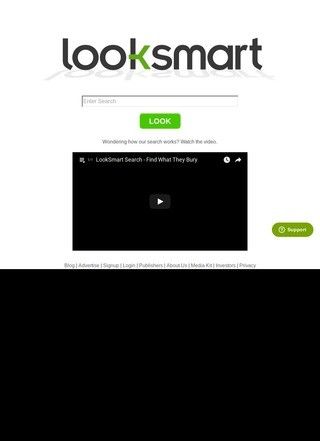
Landing on the LookSmart homepage, the first thing you see is an Advertiser Signup button and an Ad Center login, which tells you almost immediately who this site is built for. It is a search engine wrapped around an advertising business, and the front page does not pretend otherwise. There is a Media Kit available as a PDF for anyone weighing a partnership, an About Us section, and a Privacy Policy link, but the gravitational pull of the layout is toward the two account flows: one for advertisers who want to run campaigns, one for publishers who want to monetize their traffic through the network.
Advertiser and publisher network
That dual audience is the core of how LookSmart works. On the advertiser side, you register and manage pay-per-click campaigns through a dedicated portal. On the publisher side, the Ad Center handles the other end of the same machine, placing ads against search traffic and splitting the revenue. The product LookSmart sells, stripped to its mechanics, is an ad-syndication network that happens to have a search box attached. Anyone arriving expecting a consumer search destination in the mold of the big names will find that the search function exists mostly to feed the syndication engine behind it.
Search advertising syndication model
For people who have been around the web long enough, the name carries some history. LookSmart began life as one of the early curated web directories, the kind that organized the internet by hand before algorithmic search took over, and it later pivoted into the search advertising space it occupies now. A 2005 CNET editorial review captured the LookSmart search product around that transition: weak on general queries, but noticeably better at surfacing articles, which was a real niche at the time. That assessment is decades old and should be read as a snapshot of what the engine was, not a measure of what it does today.
History as web directory
Still, it is one of the few pieces of outside commentary that engages with the actual search experience instead of the company behind it. The pivot from hand-curated listings to automated pay-per-click syndication is, in a sense, the whole story of where commercial search went, and LookSmart lived through both ends of it.
Employee reviews and company stability
The third-party picture is uneven, and most of it points at the company more than the product. On Glassdoor, LookSmart carries 19 employee reviews with grim internal numbers: only 8 percent of reviewers say they would recommend working there, work-life balance sits at 3.0 out of 5, and culture and values land at 2.6. Those are employee sentiments, not customer verdicts, so they speak to the organization's health more than to whether the ad network delivers clicks. But a workforce that overwhelmingly would not recommend the place is worth noting for anyone considering a longer commercial relationship with LookSmart. Internal morale and platform performance are not the same thing, yet a partner is ultimately betting on the company's stability as much as its click numbers.
Third-party assessments
Elsewhere the readings are calmer. Scamadviser assesses the site as legitimate and safe, a useful clearance when a domain operates an ad network and asks people to sign up and feed it traffic. Smart.Reviews gives it a 3.4 and flags the same thing a careful visitor will notice within seconds: there are no contact details for the company. The Better Business Bureau lists LookSmart but does not show it as accredited, with the listing tied to San Francisco. None of these sources is glowing, and none brands it as a fraud either. Outside reviews are few, and none build a strong case in either direction. A 3.4 is a middling score that neither warns you off nor reassures you, and that ambiguity fits the rest of what is on offer.
Missing contact information
That gap on contact information deserves its own mention, because it is the clearest weakness a prospective advertiser or publisher will run into. The homepage shows no phone number, no email, and no street address, and there is no prominent contact tab to click. The BBB record preserves a historical address at 555 California Street in San Francisco and a phone number, but the listing itself comes with the caveat that this may not reflect the current operational status. For a platform that wants you to commit ad budget or wire your traffic through its network, the absence of a visible, current way to reach a human is a real friction point. Account portals handle support for signed-in users, presumably, but a stranger evaluating the service from the outside has very little to anchor a decision on.
Set against that, the signup architecture is at least honest about its intentions. LookSmart presents the commercial model openly instead of dressing it up with a consumer-facing veneer. The two entry points are labeled plainly, the Media Kit gives prospective partners a document to read, and the Privacy Policy is present where you would expect it. This is a B2B advertising tool that knows it is a B2B advertising tool, and the navigation reflects that focus instead of trying to be everything. The clarity of intent is genuinely a point in LookSmart's favor: nobody lands here confused about what is being sold.
Transparent B2B positioning
An individual searching the web is not the target audience and would be better served almost anywhere else. The real audience is advertisers shopping for a pay-per-click channel beyond the dominant platforms, and publishers looking for an additional ad partner to layer onto their sites. For both, LookSmart represents a smaller, older network with a recognizable name and a long operating history. Whether that history is an asset or just inertia depends on the performance numbers a partner can pull from the portal once they are inside, and the public-facing site offers no data to preview that. The Media Kit is the closest thing to a window, and it sits behind a download.
There is a particular irony in a company that built its early reputation on organizing and surfacing information being so sparse about itself. The product is information retrieval and ad placement, yet the storefront tells you remarkably little: no team page, no case studies anywhere up front, no published metrics, no current contact line. A visitor learns that they can sign up as an advertiser or a publisher, that a Media Kit exists, and that the company is based in San Francisco according to a record it does not itself display. The rest you have to take on the strength of the name and whatever the portals reveal after registration.
For the cautious, the sensible path is to treat LookSmart as a candidate to test rather than a destination to trust on sight. Download the Media Kit, read the Privacy Policy, and weigh the weak employee sentiment and missing contact details against the clean Scamadviser reading and the genuinely long track record. Performance data only emerges from an active account, and that is where any real verdict gets made. What the public site confirms is narrow but clear: this is a working search-advertising network with two signup doors, a downloadable kit for partners, and a homepage that says almost nothing about the people running it.