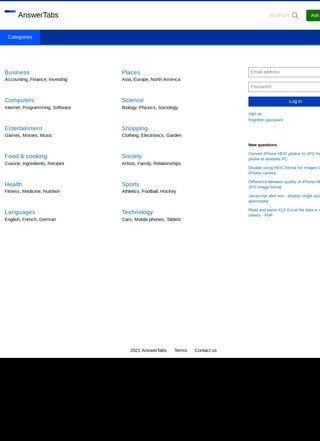
AnswerTabs divides all human curiosity into exactly twelve top-level topics, each one splitting into exactly three subtopics, giving the entire site a neat three-level hierarchy 36 categories deep. No Q&A platform does this by accident. The rigidity is a deliberate design choice, and it is the most interesting thing about the listing, because it sets a ceiling on scope that most community answer sites refuse to acknowledge.
The structure of AnswerTabs is coherent and navigable. The crowd behind it is undocumented. For a platform where the product is other people's answers, that gap leaves the utility question genuinely open, and nothing in the listing closes it. If the taxonomy and editorial content were enough on their own, the verdict would be more comfortable. They are not, and it is not.
Twelve topics and three subtopics each
The full set: Business, Computers, Entertainment, Food and Cooking, Health, Languages, Places, Science, Shopping, Society, Sports, and Technology. Each one branches into exactly three named subtopics without exception. Business covers Accounting, Finance, and Investing. Computers covers Internet, Programming, and Software. Health opens into Fitness, Medicine, and Nutrition. Sports into Athletics, Football, and Hockey. Technology into Cars, Mobile Phones, and Tablets. Society into Artists, Family, and Relationships. Languages covers English, French, and German. Food and Cooking branches into Cuisine, Ingredients, and Recipes.
The discipline holds throughout. A visitor can navigate from the homepage to a specific neighbourhood in two clicks, which is a more reliable starting point than a single search bar over an undifferentiated corpus. The consistent depth means the structure does not collapse into a flat list once you pass the landing page. That predictability is the site's clearest engineering win.
Checking what the taxonomy leaves out
The ceiling the taxonomy creates is also real. German but not Spanish. Hockey but not Soccer. Mobile Phones but not Laptops. These omissions are not oversights; the three-per-topic rule forces them. Whether the chosen three are the right three for any given visitor is the first question the structure cannot answer for itself. A visitor with questions about, say, Italian cooking or Android development hits the boundary almost immediately, redirected into the nearest approximation rather than a purpose-built category.
Editorial articles alongside user threads
AnswerTabs runs article-style pieces alongside user threads: product and brand overviews written in a contributed-editorial register, not the community-query format of the answer threads. This hybrid keeps pages from feeling empty for passive readers arriving from search, and it gives the site a body of content that does not depend on active participation to display. Visitors arriving for a quick back-and-forth may walk past these pieces entirely. The distinction between user-generated answer threads and editorial-style pieces goes unannounced on any given page, which can make the difference in quality between the two formats harder to track in practice.
Posting rules and activity metrics
Reading existing threads requires no registration. Posting a question or contributing an answer requires an account. AnswerTabs makes no claim to vetted expertise; the proposition is crowd-sourced breadth across enough topics that most everyday questions have landed somewhere in the archive. No public member count appears on the site. No monthly question volume is published. Recent activity is not displayed prominently on the homepage, and no post timestamps are surfaced in a way that lets an outside observer gauge how live the threads are.
For a platform where the entire value proposition rests on community contribution, that opacity is a meaningful problem. The taxonomy tells you where to look. It cannot tell you whether anyone is there, or whether they were there last month.
Searching for outside reviews
Google reviews: none indexed for AnswerTabs. Trustpilot: nothing. Yelp: nothing. A search for outside opinion surfaces AnswerTabs' own category pages, a Pinterest pin, and an entry on another web directory. A G2 listing exists for something called "Tabs," but that entry is for unrelated project-management software and does not apply here.
The site has been operating long enough that the continued absence of outside opinion is itself notable. This is not an automatic indictment of answer quality, because quality on any open board has to be evaluated thread by thread regardless of platform reputation. What the absence removes is any aggregate shortcut. A cautious newcomer has no community consensus to lean on, no pattern of outside reviewers reporting useful or useless answers. They either test AnswerTabs directly or they do not.
Contact page footer links
Footer links cover About, Terms, and a contact route, plus outbound links to Facebook and Twitter. No phone number on the homepage; no postal address visible anywhere. The contact form routes inquiries without exposing a public email address, which is standard for free community platforms. Two social channels give alternate routes if the form produces no response.
The taxonomy of AnswerTabs is disciplined. The editorial-plus-thread hybrid adds volume. The contact basics are present. None of that addresses whether the platform, on a given day and on a given topic, produces answers reliable enough to act on. Community platforms earn that track record through years of documented, visible activity. AnswerTabs has not documented it publicly, and the absence of any outside rating or review means there is no secondary source to check. The structure exists and is easy to use. Whether it is populated well enough to be useful is a question the listing simply does not answer.