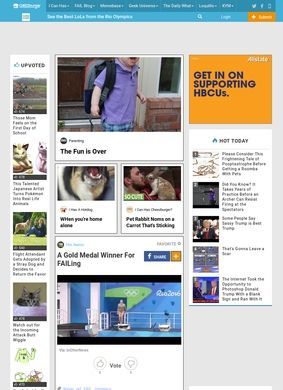
A channel called "I Can Has Cheezburger?" still sits at the top of the menu, the lolcat feed whose deliberately mangled captions gave the whole network its name back when a photo of a cat begging for a cheeseburger could genuinely define a season of the internet. That feed is now one of six under the Cheez Burger banner, and the site has grown into a stable of humor and pop-culture blogs that runs well past its feline beginnings.
Anyone who spent time online in the format's heyday will know the brand on sight. The open question is whether Cheez Burger is still a place people actually go or mostly a fond memory with a working domain attached.
Six channels under one banner
The six channels divide the territory sensibly, each aimed at a slightly different appetite. FAIL Blog collects the workplace, neighbor, and relationship disasters that make people wince and forward to a friend. Memebase covers general memes and the fandom material that moves fastest. Animal Comedy handles dogs, pets, and a steady supply of animal GIFs. Geek Universe leans into gaming, fandom, and pop-culture memes, while CheezCake takes the lifestyle, relationships, and DIY corner that reaches past pure comedy.
Put the original cat feed back on top and the Cheez Burger network has a channel for most flavors of idle browsing, which is the whole point of a portfolio built to catch different moods on different days.
What ties the channels together is a single kind of visitor: the internet-culture regular looking for a two-minute break, not a deep read. Cheez Burger is built for the idle scroll between tasks, the tab someone opens to decompress for a moment, and on that narrow measure the format still works. The images load, the categories are obvious, and a person who wants exactly ten dog GIFs and nothing more can get them and leave without friction.
It is undemanding by design, and for a humor site that is less an insult than an accurate job description, though it also sets a low ceiling on how much any one visit is really worth to a reader who has a hundred other feeds competing for the same idle minute.
A separate Hot Takes section sits alongside the meme channels and does something genuinely different: it runs opinion and commentary, from movie reviews to arguments about social-media discourse. That is a real shift in register for a brand built on captioned images, and it gives Cheez Burger a written voice rather than only a feed of reposts. Whether readers who came for cat pictures want short essays is an open question, but the section shows a site trying to be more than a meme mill.
An About Us page, a set of published Editorial Guidelines, and a newsletter signup round out the structure and hint at some ambition to run like a proper publication instead of a plain link dump.
Each channel functions as its own site with its own feed, which is both a strength and a liability. It lets a dog-video fan skip the gaming memes entirely, but it also means the Cheez Burger name stretches loosely across properties that do not always feel connected to one another. A visitor who lands on Animal Comedy straight from a search result might never register that Cheez Burger runs it at all, because the shared branding is light and each channel largely stands on its own.
For a network trying to hold a single identity, that loose federation is a genuine trade-off between per-channel focus and a coherent whole.
From lolcats to Hot Takes
The stretch from lolcats to Hot Takes is the clearest sign of how Cheez Burger has tried to age alongside its audience. The people who laughed at captioned cats when the format was new are grown now, and a lifestyle channel like CheezCake plus an opinion section reads like a deliberate attempt to follow them into adulthood instead of losing them to newer platforms.
Whether it works depends entirely on the material staying fresh, and this is exactly where the model shows strain. A humor network lives or dies on new content, and a Cheez Burger channel that recycles the same memes a competitor ran a week earlier gives a reader little reason to return instead of scrolling a feed somewhere else. The freshness problem is not hypothetical here, as the outside reviews further down make fairly plain.
How it holds up on trust
Here the picture turns noticeably sparse. The Cheez Burger landing page shows a single email address and little else, with no phone number and no mailing address anywhere obvious. An About Us page exists, but contact beyond that lone email is limited, which for a content network is neither unusual nor damning on its own. It does mean, though, that anyone with a real problem, a copyright claim or a serious business inquiry, has one slow channel to work through and no faster fallback. Cheez Burger is reachable, just barely, and strictly on its own terms.
Part of that sparseness is the nature of the business. Cheez Burger runs on user-generated and editorially selected content, a model where the crowd supplies much of the raw material and a small team sorts and repackages it. That keeps the pipeline cheap and fast, but it also makes quality uneven and originality hard to guarantee, since the same viral clip can surface on a dozen sites in the same afternoon.
It is a reasonable way to run a humor network on a budget, and it is also the structural reason the recycled-content complaint keeps resurfacing across the different channels instead of staying confined to just one.
What the review counts show
Outside feedback on Cheez Burger is both scarce and mixed. The Trustpilot page carries only seven customer reviews, a tiny sample for a site with this much name recognition, and some of that commentary knocks the content as repetitive and recycled, the precise complaint the freshness problem would predict. Glassdoor adds twelve reviews, but those come from employees, not users, and they describe long hours and limited pay growth, which says more about working at Cheez Burger than about reading it.
ScamAdviser, checking one Cheez Burger subdomain, flags the long-term domain registration as a positive trust signal, reassuring in a narrow and technical way that says nothing about whether the jokes still land. No Google, Yelp, or BBB customer rating turned up at all in this search.
That leaves Cheez Burger somewhere in the middle. As a working archive of internet humor with a name almost everyone recognizes, it still does a job, and the channel structure makes it easy to find the exact flavor of distraction a visitor wants. As a live destination worth checking every single day, the case is a good deal weaker. Seven reviews, a recurring gripe about recycled memes, a bare contact setup, and staff describing a grind behind the scenes all point to a brand living on recognition more than momentum.
For a nostalgic scroll through lolcats and fail stories, Cheez Burger delivers what it promises. For anyone expecting the cultural force it once was, the site now reads as a comfortable relic more than a returning champion. The brand is intact and the traffic funnel still functions; what the available evidence does not show is a platform with much left to prove or a great deal that is new to say.