Is Webstore a legitimate place to buy and sell, or one more marketplace name that dissolves the moment anyone looks closely? The independent scam-checkers come down firmly on the legitimate side. Scamadviser calls it "very likely not a scam," Gridinsoft hands the domain a 100 out of 100 trust score, and Scam Detector rates it "innocuous." For a site most shoppers have never heard of, that is a reassuring first answer, and it is worth having in hand before weighing anything else.
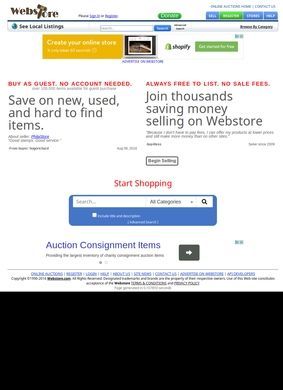
The basics are simple enough. Webstore.com is an online marketplace and auction site that positions itself against the giants, describing itself as the fastest growing free online marketplace and, in its own phrasing, the number one online auction alternative. The framing is aimed squarely at sellers who are tired of the fees and the rulebooks on the dominant platforms.
How it holds up as an eBay alternative
A pitch like that only means something if the substance is there, and here the picture turns mixed. A marketplace lives or dies on the experience of the people selling through it, and the outside commentary on Webstore points at a few real trade-offs sitting behind the free-to-list promise. Because the homepage could not be loaded during this look, the read on it leans on what third parties report, which is a limitation worth stating plainly up front.
It changes what can be said with confidence: the offer and the ratings are documented elsewhere, but the on-site experience of actually listing an item is not something this review can vouch for firsthand.
None of it suggests Webstore is a scam. It suggests a smaller operation running on thinner infrastructure than the platforms it wants to replace, which is a separate concern and a fair one to keep in mind.
What the marketplace claims to be
The self-description sets the bar high. Billing itself as the fastest growing free online marketplace and a top-ranked auction alternative, Webstore is courting sellers who want to list goods without paying for the privilege. Free listings are the central draw. For a certain kind of seller, that alone is reason enough to open an account and test the site against whatever they currently rely on, since the cost of trying it is close to nothing.
The "number one online auction alternative" line is marketing, and a claim like that means little without an independent source behind it, so it reads as ambition more than fact. Still, the free-listing model is a concrete offer a seller can evaluate on its own terms, and Webstore does put it front and center rather than burying it.
Seller support and where it ships
The caveats surface in the seller reviews. A Trustpilot account describes Webstore as a usable alternative to Amazon and eBay but flags that its support is limited compared to those platforms' policies, and that its international sales are for Canada only. Those are concrete limits, not vague grumbling.
A seller who needs strong dispute resolution or ships worldwide will run into both constraints fast, while a seller moving goods within the United States and Canada may never bump against either one. The support gap is the sharper of the two, since a marketplace that leaves sellers to sort out problem transactions on their own is asking them to accept more risk in exchange for skipping the fees. That is a trade some sellers will happily take on Webstore and others will refuse outright.
What the scam-checkers found
The trust assessments are worth a second mention because they line up so cleanly. Three separate services examined the domain and none of them raised a flag: Scamadviser's "very likely not a scam," Gridinsoft's perfect 100 out of 100, and Scam Detector's "innocuous" verdict all point in the same direction.
For anyone whose first question about an unfamiliar Webstore is simple safety, that agreement settles whether the site is real and operating in good faith. Automated trust scores have their limits, since they measure domain signals more than customer treatment, and a perfect 100 from one service should be read as "no red flags," not as a guarantee of a good sale.
Still, three independent checks landing in the same place is more reassuring than any one of them alone, and it moves the question off fraud and onto the ordinary matter of whether the service is any good.
The BBB record and the ratings gap
The Better Business Bureau file complicates the tidy scam-check picture a little. The BBB's business directory profile for Webstore.com, based in Henderson, Nevada, carries a B-minus rating, and the business is not BBB accredited. The Bureau ties that grade specifically to a failure to respond to one complaint filed against the business. It is a modest black mark, but a real one, and exactly the sort of detail a careful buyer would want to sit with before sending money.
A single unanswered complaint is a long way from a pattern of fraud, and the B-minus grade sits well above the bottom of the scale, but the gap between a clean scam-check and an imperfect BBB file is precisely where a shopper has to make a judgment the ratings cannot make for them.
The rest of the review landscape is mostly bare. A Trustpilot page for the site has drawn 22 contributors, though the aggregate star score did not show up in the search results, and TrustRadius keeps a page but says plainly that it lacks enough ratings to post an overall score.
No Yelp, Google, or Glassdoor ratings turned up. Contact details, on the other hand, are documented through the BBB, which lists a phone number, a mailing address in Henderson, and an email option for the business, so a buyer with a question has a traceable way to reach Webstore even though the homepage could not be loaded to check what it shows on its own.
Taken together, the record on Webstore pulls in two directions at once. Three trust services independently clear it, a real if limited group of sellers treats it as an Amazon and eBay alternative, and the contact trail through the BBB is on file. Against that sit a B-minus grade tied to an unanswered complaint, support the sellers themselves call limited, and a shipping map that stops at the Canadian border.