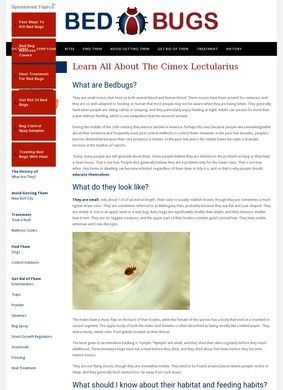
Before the panic sets in at midnight, most people reach for a search engine. BedBugs.org is clearly designed to be the page they land on: focused entirely on a single pest, written at a level that assumes no prior knowledge, and organized so that an anxious person can find what they need without wading through commercial noise. It is a narrow site, and that narrowness is largely the point. The subject demands specificity, and BedBugs.org delivers it in a form that is easier to navigate than the broad pest-control portals that try to cover every insect under one roof.
Identification across life stages
The identification content is where BedBugs.org does its steadiest work. It covers appearance at each life-cycle stage, the places these insects settle into inside a home, and how to tell an infestation from an isolated stray. That sequence is sensible: most people notice the bites before they spot the bug, and the site meets them at that point by pairing identification guidance with a section on bite symptoms and treatment. The human side of the problem gets addressed alongside the entomological detail, which is what a genuinely useful resource does. A site that explains the insect but ignores the person lying awake worrying about welts would be missing half the question.
Treatment options for DIY and professional routes
Once identification is out of the way, BedBugs.org splits its treatment coverage into two honest camps. The do-it-yourself track runs through heat methods, steamers, dusts, sprays, and mattress encasements, laying out what each approach can realistically achieve. The professional exterminator discussion sits separately, framed as the route for heavier or more persistent infestations. The site also addresses the choice between chemical and non-toxic treatments, a distinction worth understanding for households with children or pets. Nothing here is presented as a guaranteed fix. The DIY content reads as a set of methods that can work under the right conditions, and the professional track is framed accordingly. That restraint is one of the things that separates the site from the category of pest pages that exist primarily to generate service calls.
EPA regional contacts and hotline information
One section stands apart from the general reference material and is more immediately practical than the rest. BedBugs.org compiles EPA regional contact information covering all ten United States regions, organized by state and including phone numbers, mailing addresses, and email contacts. It also points visitors toward the National Pesticide Information Center hotline. For someone who has worked through the self-help options and wants to reach an official body, that compilation saves a real amount of digging. Pulling those ten regional offices into a single reference page is the kind of legwork that most pest sites skip entirely, and it lifts BedBugs.org above the level of pure informational filler.
Audience reach and content scope
The intended audience is wide without being unfocused. BedBugs.org reads primarily as a resource for homeowners and renters, but the content is written in a way that would serve property managers and hotel operators too, and a pest control professional could use it as a quick reference for materials they want to explain to a client. That breadth fits the subject. Bed bugs travel between residential and commercial spaces without any difficulty, and a resource that speaks to both sides of that line is covering the topic as it actually exists. The trade-off is that the site stays at the level of general overview. Someone with an unusual or persistent situation will find that BedBugs.org runs out of specific guidance fairly quickly and needs a specialist to carry them further.
Missing author details limit confidence
The weaker part of the picture is authorship. BedBugs.org carries no direct contact channel of its own: no site email, no phone number, no contact form that belongs to the site. The only contact details on offer point outward, to the EPA offices and to the national hotline. For a purely informational resource this is less damaging than it would be for a service provider asking for money or an appointment. But it does leave a real question unanswered: who put this together, when was it last updated, and who is responsible for the accuracy of what is on the page? A reader working through the advice has no way to follow up directly with BedBugs.org itself, and that limits how much confidence the content can carry independently.
No third-party reviews or external verification
Outside reputation for BedBugs.org as a specific entity is essentially absent. A search for third-party reviews of the site produces results that belong to other operations: a UK pest-control firm with a cluster of Trustpilot entries, a separate company on Yelp with a few dozen reviews, and various pest control providers that happen to share the same search terms. None of those review records relate to this site in any way. So there is no external confirmation of accuracy, currency, or reliability; the reader has to assess the content itself and decide how much confidence the official sources it cites can lend to the rest of the page.
Responsible referral to official agencies
That habit of forwarding to official bodies is, taken by itself, a meaningful detail. BedBugs.org routes visitors toward the EPA and toward a recognized national information center when the situation calls for professional-grade guidance. A resource that knows the edge of its own competence and hands people off to the appropriate agency is behaving more responsibly than one that tries to answer every question regardless. The pest-control space is full of sites trying to convert every visit into a service booking; the approach taken here is plainly different, and that difference shows in the tone throughout.
There are real limits worth naming. The DIY instructions on BedBugs.org read closer to an overview than to a step-by-step operational guide, so a determined self-treater may need a more detailed source once the site has pointed them in the right direction. The anonymous authorship means the claims on the page cannot be checked against a named expert or an organization with a track record. And without any third-party commentary on the site itself, there is no easy way to gauge how regularly the material is refreshed as treatment options and regulations change. These gaps do not make the site unreliable, but they do cap the role it can play.
What BedBugs.org gets right is scope and sequencing. It covers identification, symptom recognition, DIY treatment, professional options, and government contacts in an order that follows the natural progression of a bed-bug problem. The EPA regional directory is a practical addition that comparable pages rarely include. Taken on those terms, BedBugs.org is a solid starting point for someone who needs to get oriented quickly: credible enough to use as a primer, anchored to official sources that carry independent authority, and honest enough about its own limits that readers are not left thinking they have learned everything they need. Cross-reference the advice with those official sources it cites, and BedBugs.org is doing its job.