Where can a homeowner find pest advice that a qualified professional has actually signed off on, without booking a paid call-out first? That is the gap PestAdvisors.com sets out to fill. The site gives away research-based pest management guidance for free, and it makes a point of having its material authored or reviewed by licensed pest management professionals, a sharper promise than the average free pest-tip page bothers to make.
The whole thing is built around reading, not selling. There is no shop and no booking funnel getting in the way.
What the pest guides cover
The heart of the site is a library of Pest Guides, each one aimed at a single creature and the specific trouble it causes. The value here is in the coverage: a homeowner usually knows exactly what they are dealing with and wants the page about that one pest, not a general essay on bugs.
The household pests
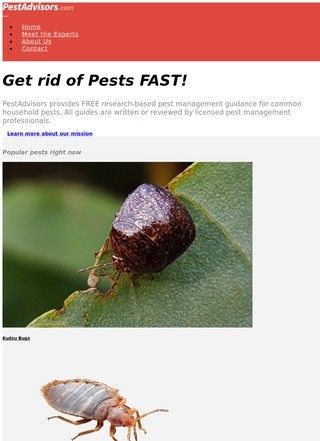
The guide list runs across the common household offenders and a few of the odder ones. Ants, bed bugs, and mosquitos are there, as anyone would expect, alongside house spiders, silverfish, crickets, earwigs, and centipedes. What stands out is the inclusion of pests that rarely get their own page elsewhere, like kudzu bugs, sowbugs and pillbugs, and thrips.
Someone who has been chasing an unfamiliar insect around the house will find that breadth genuinely useful, because the guide they need is more likely to exist here than on a site that stops at ants and roaches.
The educational articles
Beside the pest-by-pest guides sits a set of educational articles that tackle narrower questions. Instead of a broad overview, these go after specific problems, such as how the flea lifecycle works or which strategies actually get rid of an ant colony for good.
That focus is the right call. A person searching at midnight with a real infestation wants the answer to one question, and PestAdvisors.com tends to organize its writing around that question rather than around a topic in the abstract.
Who stands behind the advice
Free pest advice is everywhere, and most of it is anonymous. What separates PestAdvisors.com is that it puts named expertise behind the words. The site is candid that its content is checked by professionals, and it goes a step further by building a program around them.
The expert partner network
The site runs an Expert Network, with pages titled Meet the Experts and Become an Expert Partner, that brings in academic leaders, researchers, and active pest management professionals to review articles for accuracy and help write new guides. This is the part that gives PestAdvisors.com its credibility. It is one thing to claim professional oversight and another to name a partner program and invite qualified people into it.
For a reader trying to judge whether the advice is trustworthy, a review process staffed by working professionals and researchers is a concrete reason to take the guidance seriously.
How to ask a question
Reaching the people behind PestAdvisors.com is a plainer affair. There is a Contact page of its own, which greets visitors with a friendly line about being glad to hear from them, but it works as a form rather than a list of details. No phone number, email address, or physical address appears on the homepage itself, so anyone wanting a direct answer has to send a message through the form and wait.
For a free information site that is not trying to sell a service, that is a reasonable setup, though someone hoping to speak to a person quickly will find the route indirect. The site also keeps a Press Room for media inquiries and a partnership page for professionals who want to contribute.
There is little independent feedback to go on. A search for reviews of PestAdvisors.com turns up its own pages and a scatter of unrelated companies that share part of the name, such as a separate UK products retailer called Pest Expert that carries its own Trustpilot reviews, plus others like Pestie and a site called Pest Control Reviews.
None of those belong to this business, and no independent rating or review count attaches to PestAdvisors.com itself on the usual consumer platforms. The similar names make searching harder, and a reader has to be careful not to credit or blame this site for another company's record.
One thing PestAdvisors.com does not do is push a product. There is no store, no affiliate wall of recommended sprays, no pop-up steering a reader toward a paid exterminator. The site earns nothing visible from a visitor reading a guide, which is unusual for a free pest-information site and strips out the quiet commercial bias that colours a lot of DIY advice online. How PestAdvisors.com supports itself, whether through its expert partnerships or something off-page, is not spelled out, but the reading experience stays clean.
What a visitor is left with is concrete enough to describe plainly. Every guide traces back to licensed pest management professionals, the pest list reaches past the usual suspects into kudzu bugs and thrips, the articles answer single questions instead of circling topics, and the only way to reach the team is a contact form.