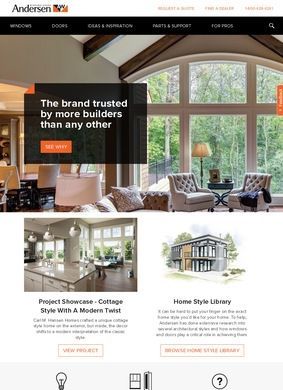
A homeowner standing in front of a drafty old window usually wants three answers fast: which product fits the opening, what it costs, and who installs it. Andersen Windows tries to settle all three before a sales call ever happens. The site is organized around numbered and lettered product families, and the moment you understand that grid, the catalog stops feeling overwhelming. The 100 Series leans on a composite material at the value end. The 200 and 400 Series cover wood-clad construction. The A-Series and E-Series push into higher performance and architectural territory with fiberglass and premium builds. Each tier is sorted by material, performance, and price, so a buyer comparing a starter rental against a custom build is not looking at the same page.
Product families by material
Doors get equal weight, which is fair given how many people arrive looking for a patio replacement and have no window need at all. The patio category alone splits into hinged, sliding, and folding designs, and Andersen Windows keeps entry doors and storm doors as their own tracks. The storm door work runs through EMCO, one of the brand's sub-lines, and the replacement-window side runs through Renewal by Andersen Windows, a full-service division that handles measurement and installation instead of leaving it to the customer. That split is worth understanding before you start clicking, because the buying path is genuinely different depending on which door you walk through.
Doors and patio options
The visualizer is the part of the catalog that does real work. Instead of guessing how a grille pattern or a dark exterior frame reads against a particular wall, a shopper can build the combination on screen and see a preview. For a purchase this permanent, that kind of tool removes a lot of second-guessing, and it is more useful than any amount of product photography.
Configuration tools
Energy performance gets its own guide, anchored to ENERGY STAR certification. The long-term cost in this category is heating and cooling, not the sticker price, so the certification matters. The pairing is sensible: pick the look in the configurator, then check whether that build actually performs in your climate. A buyer in a cold northern state and one in a hot southern one will read those numbers very differently, and the guide at least gives them the framework to do it.
Energy performance guide
Warranty information sits alongside the products, including a limited lifetime warranty on select lines. Andersen Windows is careful to say select, and reading the fine print on which series qualify is the kind of homework that separates a confident purchase from a regretted one. The installation guides round this out for the do-it-yourself crowd, though anyone routed through Renewal or a dealer will lean less on them.
Warranty coverage and installation
The "Where to Buy" tool and the showroom locator are the bridge between browsing and buying. Andersen Windows sells through authorized dealers and does not take direct orders, so these locators are not a convenience feature. They are the actual mechanism that turns a configured window into a quote. How well that experience goes depends heavily on the individual dealer the tool hands you, and Andersen Windows cannot really control what happens after the handoff.
Beyond the homeowner path, a separate Architectural section addresses commercial and large-scale projects. Andersen Windows clearly serves contractors, architects, and builders as much as it serves a single household. That breadth makes sense for a manufacturer that has been making windows and doors since 1903 and runs its operation out of Bayport, Minnesota. The professional resources are easy to reach from the main navigation, which tells you the trade audience is treated as a primary customer, not an afterthought.
Outside the site itself, Andersen Windows has accumulated reviews on platforms like Google and the Better Business Bureau where the volume is large enough to draw conclusions: complaints cluster around dealer installation quality and warranty-claim processing rather than the products themselves.
That pattern is worth noting because the site routes almost every purchase through a third party. What happens between a polished selection process and the messier reality of a custom home project (lead times, the quality of whichever local installer the locator surfaces, how the limited lifetime language plays out when a seal fails years later) is not answered on the Andersen Windows site. A shopper can leave knowing exactly which series they want and still have no firm sense of what the install will cost or how long it will take. The product grid is deep, the tools are genuinely helpful, but the one variable Andersen Windows presents least clearly is the handoff itself.