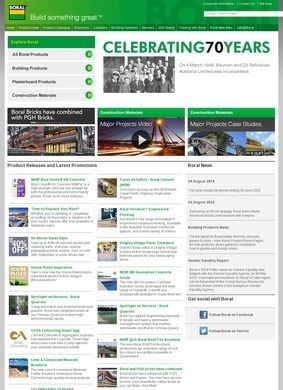
One bag of concrete from Boral can now arrive with up to 70 percent less embodied carbon than the standard mix, and that single figure tells you most of what is different about this company eight decades into its history. Boral is one of Australia's largest construction materials suppliers, and its website is built as a working reference for people who buy aggregates, cement and ready-mix by the truckload. It reads like a site made for builders, civil engineers and council procurement staff, not casual browsers.
Construction materials for professional buyers
The product spine is conventional heavy-materials fare, and the site is honest about that. You get asphalt, cement, lime, ready-mix concrete, and quarry materials such as aggregates, sand and gravel, along with packaged products for smaller jobs. Anyone who has ordered from a materials yard knows the difference between a supplier that lists a catalogue and one that explains specifications, and Boral leans toward the latter. The Environmental Product Declarations and a section called Materials Technical Services point to a company expecting questions about performance data and mix specifications, not price alone.
Specifications over price alone
Boral covers the full range from bulk asphalt and cement down to packaged bags for a tradesperson doing a single footing, which means the same supplier can serve a motorway resurfacing contract and a backyard slab. That breadth is unusual, and it is one of the few genuine reasons a buyer might consolidate orders with one materials company instead of splitting work across specialists.
Scale from motorway to backyard
Where the site genuinely separates itself is the sustainability material, and it is not treated as a footnote. The low-carbon concrete range is the headline, but the supporting content is more interesting than the usual net-zero pledge: crumbed rubber asphalt, sand recovered from recycled solar panels, and recarbonation technology that pulls carbon back into the material. There is also a circular and recycled-materials line. These are specific, named processes, not vague intentions, and that specificity is what I found persuasive.
Recycled materials and carbon reduction
A company can claim a green roadmap cheaply; reusing solar-panel glass as construction sand is a process that costs real engineering to stand behind. Boral also publishes claimed figures, up to 70 percent embodied-carbon reduction on certain mixes, where most material suppliers fall back on soft language. That gives an engineer something to test against a project specification instead of a marketing promise.
Published figures instead of pledges
The numbers Boral puts forward give a sense of why the site is structured the way it is. Around 7,500 employees and contractors, more than 14,000 customers, and roughly 8,500 suppliers describe an operation that touches a large share of Australian building activity. Eighty years of trading is a long run in a sector where margins tighten fast and demand swings with the economy. That longevity does not guarantee a good experience on any single order, but it does mean the supply chain and the technical backing are unlikely to be improvised. A firm working with 8,500 suppliers has to run logistics at a level a smaller yard never confronts, and the site quietly assumes the reader understands that delivery reliability on a deadline-driven site depends on that kind of infrastructure.
Supply chain and technical infrastructure
The audiences are clearly delineated, and the content follows them. Residential builders, commercial contractors, and civil and infrastructure project managers each have different needs, and the site recognises a fourth group that a consumer-facing brand would ignore entirely: local councils. Roadbase, asphalt and concrete for public works are a distinct buying world with their own compliance demands, and the Projects section, which collects infrastructure case studies, is where that audience can see whether Boral has done comparable work before. Case studies are easy to pad when they name only a project type, but hard to dismiss when they name actual jobs and outcomes, so a procurement reader trying to shortlist a supplier gets something concrete to work from.
Councils and public works projects
For the ordering side, the Found app is the practical hook. It lets customers place concrete orders online, which sounds minor until you remember that concrete is time-sensitive, scheduling is the whole game, and a phone-and-fax process is still common in the trade. A digital tool aimed at that pain point is sensible infrastructure, not a gimmick, and its prominence in the site's presentation points to Boral wanting repeat trade buyers to self-serve. For a contractor managing several pours a week, that kind of online ordering is the difference between a supplier who fits the workflow and one who fights it.
Online concrete ordering through Found app
The rest of the site fills out the picture a serious supplier needs to project. A Media Centre carries press releases and publications, the Sustainability area lays out the net zero roadmap alongside more granular topics like dust management, and Careers covers recruitment. None of this is unusual for a company of Boral's size, but it is all present and reasonably organised, which is more than can be said for plenty of large industrial sites that bury useful documents three clicks deep. The dust-management content is a telling example: it addresses a real complaint communities raise about quarries and concrete plants, and putting it on the public site means Boral is prepared to be held to account on it rather than keeping the topic internal.
Accountability on dust management
There is one limitation worth naming, and it is about audience fit rather than quality. This listing appears in a business directory under windows and doors, and Boral is not a windows-and-doors business in any direct sense. It is an upstream materials maker. A homeowner shopping for a replacement door will find nothing here; a builder constructing the wall that door goes into is exactly the right reader. Anyone landing here in search of finished joinery will need to look elsewhere, and the site itself is unambiguous: what Boral supplies is the material everything else is built from.
Read against what it sets out to do, the site works well. It is dense with technical and environmental documentation, it speaks plainly to professional buyers, and the recycled-materials work gives Boral a credible claim to be ahead of much of the heavy-construction field on environmental engineering. On the question of public ratings, no independent review platforms turned up a meaningful count for Boral in this context, which is typical for a B2B supplier at this scale where relationships are managed commercially and seldom posted to a review site.
The sustainability story, at least, has real substance behind the slogans, which is rarer than it should be in this sector. A civil or infrastructure buyer with a ready-mix specification should open the Projects section, pull the relevant Environmental Product Declaration and check the carbon figures against the spec, then run a test order through the Found app to see how its scheduling handles a live pour.