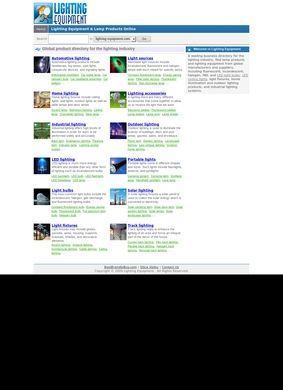
Purchasing managers who need to source two hundred LED floodlights from a verified factory, not a reseller marking up someone else's stock, usually end up with a browser full of tabs and no clear way to tell a real manufacturer from a middleman. That sourcing problem is the gap Lighting Fixture sets out to close. The site works as a global B2B hub for the lighting trade, sorting manufacturers and suppliers into product categories a buyer can actually navigate, then pointing them toward the companies that make the goods.
Product categories across lighting types
The category structure is the spine of the whole thing, and it is broad. Automotive lighting covers headlamps, fog lamps and brake lights. Home lighting splits into ceiling fixtures, wall units and table lamps. From there it runs through industrial lighting, LED, outdoor (landscape, flood and garden), portable gear like flashlights, lanterns and spotlights, plus solar, track lighting, and bulbs and fixtures. Ten major groupings in total, with specialty corners for horticulture, stage, sports and vehicle applications. A buyer who knows exactly what they want can drill straight to it; someone scoping a new product line can browse sideways and see what a category contains.
Self-populated directory plus forum
Two features push Lighting Fixture past a plain index. The Open Lighting Product Directory, or OLPD, hosted by Lighting Fixture, lets manufacturers submit their own product listings, so the catalogue grows from the supply side instead of being scraped together by a third party. There is also a Global Lighting Forum aimed at networking among people in the trade. That combination, a self-populated product directory plus a discussion space, points to a site built for repeat visits, one suppliers and buyers return to as their needs change.
Trade focus without retail clutter
The audience for Lighting Fixture is narrow on purpose. This is a trade resource for lighting manufacturers, wholesale suppliers and buyers sourcing product at volume across borders. A homeowner hunting for a single bedside lamp is not the target, and Lighting Fixture does not pretend otherwise. The framing throughout is procurement and supplier discovery, the daily work of a sourcing agent or a wholesale buyer, where the priority is the right factory well ahead of a pretty product shot.
That focus is a fair point in its favour. Plenty of lighting sites blur the line between selling to consumers and connecting businesses, which leaves trade buyers wading through retail clutter. Here the orientation is consistent, and the OLPD submission route reinforces it: the people adding listings are the manufacturers themselves, which is exactly who a buyer wants to reach directly. The forum on Lighting Fixture extends that into peer contact, where industry questions about ballasts, HID versus LED, or specialty fixtures can get answered by people who actually work in the field.
No contact information or third-party reviews
Where the site is harder to vouch for is everything around the listings. There is no contact information to be found anywhere on the site: no phone number, no mailing address, no contact page or contact tab. For a hub that asks manufacturers to submit products and trade professionals to join a forum, that absence is a real weakness. A supplier deciding whether to list, or a buyer wondering who stands behind the platform, has no obvious way to ask. It does not break the core function, since the value sits in the directory and the forum themselves, but it puts more weight on the user to verify each supplier independently.
Third-party reviews are essentially absent. A search turns up other lighting companies with similar names, LightFixturesUSA, lightinginc.com, Light Fixture Industries, Warehouse-Lighting.com, but nothing about this platform on any review site. A first-time visitor ends up judging Lighting Fixture on what the site itself shows: a thorough taxonomy and two working community tools, set against an anonymity that a cautious buyer will notice.
A buyer gets the most from Lighting Fixture by treating it as a starting map: find the category, read the listings, identify candidate manufacturers, then take due diligence off-site. The breadth of categories means most lighting needs land somewhere sensible, and the OLPD gives the catalogue a chance to stay current as suppliers add their own entries. Lighting Fixture is most useful to someone who already knows the trade and wants a wide net of suppliers in one place, less so to anyone expecting a vetted, hand-checked roster with the platform's own people a phone call away.
Weighed against something like Warehouse-Lighting.com, the trade-off is clear. Warehouse-Lighting is a direct seller with its own stock, pricing and support, which a buyer who wants to transact and get help in one place will prefer. Lighting Fixture plays a different role: it does not sell, it connects, casting a far wider supplier net across automotive, industrial, solar and the rest than any single retailer's shelf. If the goal is to discover manufacturers worldwide and compare sources, the directory model wins. If the goal is to buy now with a name to call when something goes wrong, the missing contact details make Lighting Fixture the riskier first stop, and the named alternative the safer one.
Business address
United States