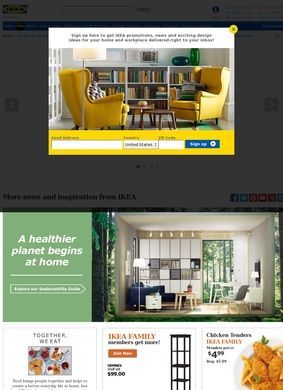
BILLY has been in production since the late 1970s and still anchors the catalog at the Ikea US storefront. That single product tells you most of what to expect from Ikea: flat-pack, low cost, a name in capital letters, and a design that has barely changed because it did not need to. The American shop is built around that idea, and the site does a reasonable job of putting the whole range in front of someone who is furnishing a first apartment or replacing a sofa they have outgrown.
Furniture range across every room
The product spread is wide in the literal sense. Sofas, beds, wardrobes, dining tables, chairs, desks and bookcases form the furniture core, and from there it branches into kitchen cabinets and appliances, bathroom fittings, storage systems, rugs and curtains and bedding, lighting, and the smaller home decor pieces that tend to end up in the cart on the way to checkout.
There is a full children's and baby section covering cribs, high chairs, toy storage and the kind of small-scale furniture that gets outgrown fast and needs to be cheap for exactly that reason. The textiles run deeper than you might expect from a furniture site, so a room can be finished down to the curtain rod and the bedside lamp in a single order. Anyone who has walked one of the physical stores will recognize the structure online, since Ikea mirrors its own showroom-to-marketplace logic of starting with inspiration and ending at the warehouse aisle. The store locator maps the 50-plus US locations for anyone who would rather see a POANG armchair in person first, and the printed catalog that was a household fixture for so long now lives here in digital form.
Named collections like Malm and Hemnes
What I find genuinely useful is how the named collections are treated as navigable lines rather than scattered SKUs. KALLAX, MALM, POANG and HEMNES each function as a sort of mini-brand within the wider Ikea range, so you can commit to one and build a room out of matching pieces over time. That continuity is the quiet reason people keep coming back: a HEMNES dresser bought now will probably still have a sibling product available when the next one is needed. Few competitors bother to guarantee that kind of backward compatibility, and over the span of furnishing a home it adds up.
Planning rooms with digital design tools
The Ikea site is more than a catalog. The Kreativ tool lets you scan a room and drop 3D furniture into it, which moves the whole exercise past guessing at measurements with a tape and a hopeful eye. For kitchens and bathrooms there are dedicated planners, and these are the rooms where the work pays off most, since a cabinet run that is two inches too long is a far more expensive mistake than a misjudged side table. The augmented-reality and 3D approach is one of the better executed versions of this idea I have used from a mass retailer.
Beyond the self-serve planners, Ikea runs a paid interior design service through IKEA Home Design, plus consultations for kitchen and bathroom projects. These sit alongside the room inspiration section, which is closer to browsing a styled set of photographs than configuring anything. The layering is sensible: free inspiration, free planning tools, then human help if the project is large enough to warrant it. Someone redoing a galley kitchen has a clear path from idea to a quoted plan without ever needing to improvise. The consultations earn their fee mostly for cabinetry work, where the cost of measuring wrong is high and the configurator only takes you so far before a second pair of eyes starts to pay for itself.
Assembly delivery service options
Assembly is handled through a TaskRabbit partnership, which is an honest acknowledgement that flat-pack furniture and a free Saturday do not always coexist peacefully. Booking a person to build the wardrobe you just bought is a practical touch, and it closes a gap that has frustrated buyers for decades. The Ikea handoff is built into the buying flow, so the assembly help surfaces at the point where it is genuinely on your mind instead of being buried three pages deep. Fulfillment covers both home delivery and in-store pickup, so the route from screen to assembled furniture is short and well signposted.
The IKEA Family program runs through the shopping experience as a loyalty layer, offering member pricing and various perks. It is free to join and clearly meant to nudge repeat visits, which makes sense given how much of the Ikea model depends on customers returning for the next room. The buy-back and resell program is the more interesting inclusion, letting people send gently used pieces back into circulation instead of to a landfill. That ties into the People and Planet Positive sustainability reporting the site hosts, and the resale option gives that messaging something concrete to stand on rather than leaving it as a page of intentions.
Commercial buyers are served separately through IKEA for Business, aimed at offices, rental properties and similar bulk needs. There is a gift registry as well, which fits the life-stage moments (a new home, a wedding) when a wholesale furniture order suddenly makes sense. Across these programs Ikea keeps the same plain pricing logic, so a business outfitting a waiting room and a couple registering for a first apartment are working from the same recognizable catalog, not separate walled gardens.
If there is a fair criticism, it is the same one that has always shadowed the brand, and the Ikea site inherits it: the breadth can overwhelm. The sheer number of collections, services and sub-programs means a first-time visitor may spend a while orienting before they find the one wardrobe they came for. The Kreativ tool and the collection-based navigation soften this, but it remains a lot of store to take in through a screen. Pages can also feel dense when every cross-sell and add-on competes for the same scroll. None of it is broken, but a clear idea of what you came for helps considerably.
Weighed against a more design-forward competitor like West Elm, the trade is clear. West Elm gives a buyer a richer-looking single piece and a tighter curated catalog, while Ikea answers a different question: how to furnish an entire space, soup to nuts, without the bill becoming frightening. For that job, with its planning tools, its resale loop and a back catalog of collections that do not vanish after a season, Ikea does what it sets out to do. Someone outfitting a real home on a real budget will get further here than almost anywhere else.