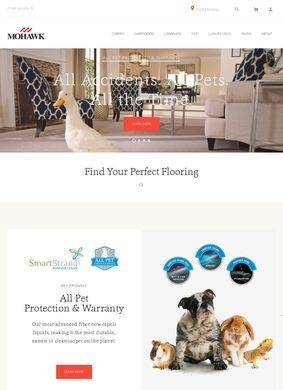
Mohawk's flooring site earns attention early because of the Visualizer tool. A shopper can upload a photo of their own living room or kitchen, or pick from a set of staged room scenes, and drop a chosen floor into the picture to see roughly how a wood tone or a tile pattern reads against existing walls and cabinetry. That sounds like a gimmick until you have spent an afternoon squinting at thumbnail swatches, at which point seeing a plank laid across a full room is the difference between guessing and deciding. The tool sits alongside a catalog that is genuinely deep, and the two work together: browse, filter, preview, then go find the product.
Product range across flooring types
The product range is the reason the site has to be this large. Mohawk is one of the largest flooring manufacturers in the United States, covering carpet, hardwood, laminate, luxury vinyl in both plank and tile form, and ceramic or porcelain tile. That is close to the entire palette of residential flooring under one roof. The shop section lets you narrow by style, by room, and by color, so someone who only wants a gray waterproof floor for a basement is not forced to wade through bedroom carpet. That filtering matters far more on a catalog this size than on a boutique line of a dozen products, and it is built in from the start rather than tacked on.
Buying through a dealer network
One thing worth understanding up front is that Mohawk does not sell to you directly. The company runs through a dealer and retail network, so the website is a research and specification tool, and the actual purchase happens at a local store. The "Find a Retailer" locator closes that loop by pointing you to nearby shops that stock Mohawk products, which keeps the online browsing from ending in a dead end. It is an honest structure for a manufacturer of this scale, and the site does not pretend otherwise by dangling an add-to-cart button it has no intention of fulfilling.
Brand collections explained
The "Our Brands" section is where the catalog stops being a flat wall of products and starts to make sense. Mohawk groups its output into sub-brands and named collections, and the descriptions get into the construction details that distinguish one laminate from another, including lines built with waterproof laminate cores. For laminate, waterproofing is the spec that historically separated it from luxury vinyl, so calling it out by collection is useful information for anyone weighing a kitchen or a mudroom floor where spills are a given.
Price tiers guide shoppers
Because the brand families carry different price positions and performance claims, this section quietly does the work of steering a visitor toward the right tier before they ever talk to a retailer. Someone furnishing a rental can land in a different collection than someone redoing a forever home, and both can arrive at the store already knowing the name of the line they want. That cuts down the showroom guesswork considerably.
From office floors to schools
Mohawk also runs a commercial arm on its own subdomain, mohawkgroup.com, aimed at architects, designers, and facility buyers. Marketed as the Mohawk Group, it carries modular and broadloom carpet, luxury vinyl tile, and resilient sheet flooring built for the wear and traffic of offices, schools, and other commercial interiors. Keeping that separate from the consumer site is sensible, given that a homeowner picking a bedroom carpet and a specifier choosing fifty thousand square feet of modular tile have almost nothing in common in how they shop.
Design tips and inspiration content
Beyond the products, the main site runs a content hub of design tips, trend guides, and inspiration articles. Flooring is a decision people make once a decade and feel anxious about, so material on how a color reads in north-facing light or which finish hides scratches has a real audience. It also gives the catalog context: a trend guide explaining why wide-plank wood is everywhere right now is more persuasive than a product page listing widths in a vacuum. Plenty of manufacturer content hubs treat the blog as an afterthought; this one does not.
Login portal for trade accounts
A login portal sits off to the side for registered users and trade accounts, which fits the dealer-driven model. Retailers and designers who work with the Mohawk line regularly get their own door, while public browsing stays open and unburdened by a sign-up wall. The separation is sensible and keeps the consumer path uncluttered. If you come across the Mohawk name in a business directory and wonder whether the site will give you enough to go on before visiting a showroom, the answer is yes. The filtering, the Visualizer, and the brand guides together do most of that groundwork.
Partnership with a nonprofit
One detail that lands differently from the usual corporate-responsibility paragraph is the partnership with Sunshine on a Ranney Day, a nonprofit that designs rooms for children with special needs. Mohawk supplies its flooring for those builds, which is a concrete use of the actual product. It reads as something the company does rather than something it merely talks about, and it is a specific worth noting on a site this size.
What ties all of this together is scale handled with some discipline. A manufacturer that makes everything from bedroom carpet to commercial sheet vinyl could easily produce a website that drowns a visitor. The structure here keeps the residential shopper, the trend reader, and the commercial specifier on separate tracks that do not bleed into each other. The filtering, the brand grouping, and the split between the consumer site and the group subdomain all point the same direction: toward letting each kind of buyer find their lane fast. Mohawk has built the catalog to be searched, and that orientation runs through the whole thing.
Heavy reliance on JavaScript means the site rewards a real browser over a quick look, and the Visualizer in particular needs the full experience to do its job. For a flooring purchase that will sit underfoot for years, that trade-off is fair. A buyer narrowing down a floor can move from a filtered Mohawk catalog to a previewed room to a local retailer without leaving the brand. The commercial buyer steps over to the group subdomain and finds a parallel set of tools built for a different scale entirely. Outside reputation data is limited. A search turns up reviews across retail and contractor forums but no aggregated rating tied to the manufacturer site itself, which is typical for a brand that operates through a dealer network. The product depth and the tools on offer are the real measure here.