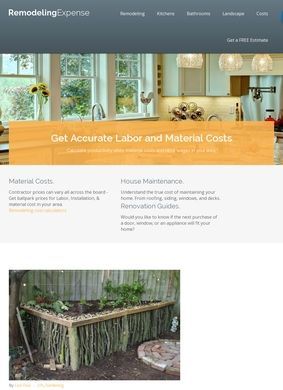
Punch in a bathroom remodel on RemodelingExpense and it quotes a national average of $5,200 to $14,800, then tells you to collect at least four estimates from BBB-rated contractors before you commit. That single number paired with that piece of advice says most of what needs to be said about what kind of site this is: it wants to anchor your expectations on price and push you toward doing the legwork yourself. The tool is the draw. Enter a ZIP code and RemodelingExpense adjusts the estimate for local labor wages, material costs, and productivity rates in your area, so a kitchen job in a high-cost metro reads differently from the same job in a rural county.
Local cost estimates by ZIP code
That ZIP-driven approach is the part worth taking seriously. A flat national figure is close to useless when you are actually budgeting, because the regional spread is enormous, and RemodelingExpense at least attempts to account for it. The calculators span hundreds of projects across kitchens, bathrooms, bedrooms, exteriors, and decks and patios, which covers the bulk of what a homeowner is likely to price out before calling anyone. A cost tool that asks where you live before it spits out a range is more trustworthy than one that does not, and this one does.
Design guides and DIY resources
Around the calculators sits a fairly broad library of supporting content. There are design idea pages on landscaping, kitchen backsplashes, stamped concrete patios, and garden bridges. DIY and repair walkthroughs cover mold removal, grout cleaning, reclaimed wood projects, and general home maintenance. RemodelingExpense also runs cost-versus-value comparisons that weigh what a renovation costs against what it returns at resale, plus material on real estate and green building. For someone in early planning, having the estimator and the how-to articles in one place is genuinely convenient. The cost-versus-value angle is the smartest piece of that mix, since the question of whether a renovation pays you back is exactly what most homeowners forget to ask until it is too late.
Accuracy limits of the calculator
No, and the site appears to understand that, which is to its credit. The recommendation to gather four estimates from vetted contractors is an admission that the calculator is a starting point rather than a contract. That framing keeps RemodelingExpense honest about what it can and cannot do. A localized algorithm narrows the range, but it cannot see your actual house, your access constraints, or the surprises behind a wall.
Business model and data sourcing
It helps to be clear about the business model, because it shapes how much weight to put on the numbers. RemodelingExpense does not sell products and does not appear to hand your details off to contractors or run a lead-generation funnel. That is a meaningful distinction. Plenty of cost sites exist mainly to harvest contact information and sell it on, with the estimate as bait. Nothing here points to that pattern, which makes the figures feel more like a reference than a hook.
Verifying data freshness
The flip side is that an informational, tool-based site lives or dies on whether its underlying data is current and well-sourced, and that is hard to verify from the outside. The methodology is described in broad terms, and the bathroom example is reasonable, but a homeowner has no easy way to check how often the wage and material inputs get refreshed. Construction prices have moved fast in recent years, and a calculator that lags the market by a season or two can quietly understate a project by thousands. RemodelingExpense gives no clear signal on the freshness of its data, so treat the output as a ballpark, not gospel.
Limited third-party verification
Outside reputation is limited. A search turns up no notable third-party reviews on Google, Trustpilot, BBB, Yelp, or anywhere comparable. The one favorable line that surfaces, calling the cost calculators "pretty darn accurate," appears to be a testimonial lifted from the site itself, so it draws on no independent source. None of that means the tool is bad. It just means you are taking its accuracy largely on faith, with no outside chorus of users to confirm or contradict the experience.
Contact transparency is middling. There is a "Contact Us" link, but the homepage shows no phone number, no physical address, and no email, so reaching anyone means clicking through to a separate page. For a site that is purely informational and asks nothing of you financially, that is a minor knock at most. No transaction to dispute, no account to manage. Still, a visible address or phone would make the operation feel more accountable, and the absence fits the slightly anonymous character of the place.
RemodelingExpense is a useful, free planning tool with a sensible core idea, a wide spread of projects, and a healthy refusal to oversell its own precision. The localized estimates and surrounding guides do real work for someone at the budgeting stage. What holds it back from a firmer endorsement is the absence of any verifiable outside reputation and the limited public contact information, both of which leave you trusting the numbers without much to check them against. Use it the way it asks to be used: as a first pass before you line up those four real quotes, not as the final word on what your project will cost. On that limited brief, RemodelingExpense does its job.