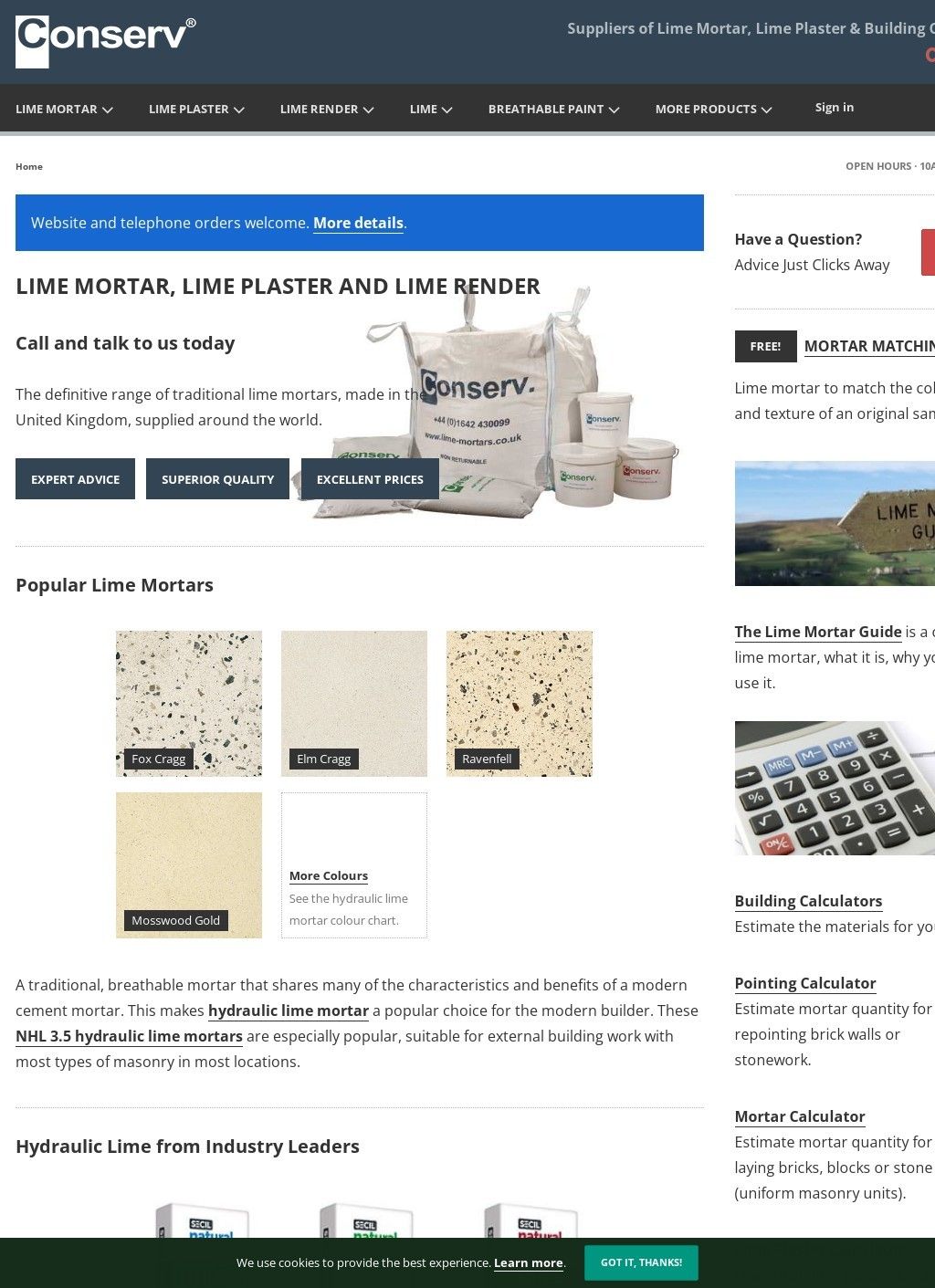
Hot-mixed lime mortars made with Buxton Quicklime, sold as Fine, Medium and Coarse Stuff, are the kind of product that tells you immediately who this supplier is for. Conserv, trading at lime-mortars.co.uk and based in North Yorkshire, sells to people repairing old buildings, and the catalogue reads like a conservation builder's shopping list with very little padding around it. There are hydraulic lime mortars in the three standard strengths (NHL 2, NHL 3.5 and NHL 5), non-hydraulic lime putty mortars, and those hot-mixed options for anyone who prefers the older method.
Mortar types for conservation repairs
What pushes it past a plain stockist is the colour-matched range. Conserv prepares mortars tuned to named UK stone types, so you see entries like Elm Cragg, Fox Cragg, Hawkstone Gold and Winchat instead of a vague "buff" or "grey". For a repair that has to disappear into an existing wall, the match is everything, and Conserv also runs a free colour-matching service if none of the stock blends fits what you are pointing into. I spent a while on that part of the site because it is the sort of thing a generic builders' merchant simply does not bother with. A mismatched repair on a stone facade is the kind of mistake that gets noticed for decades, so a supplier treating matching this seriously is doing the buyer a genuine favour.
Colour matching to UK stone types
The split between hydraulic and non-hydraulic options is handled cleanly too. The three NHL grades cover most modern conservation specs, while the lime putty mortars suit the softer, more flexible repairs that older or more decorative masonry sometimes calls for. Offering hot-mixed Coarse, Medium and Fine Stuff alongside those is a sign Conserv is reading its audience accurately, because hot-mixed lime has come back into favour among conservation practitioners who want the behaviour of historically accurate mortar. Few suppliers carry all three approaches at once, and having them side by side lets a builder pick by the building in front of them instead of by what happens to be in stock.
Plaster, render and breathable finishes
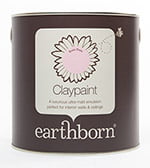
Beyond mortar, the plaster and render side is just as deliberate. Conserv carries both hydraulic and non-hydraulic base and finish coats, natural goat hair to reinforce plaster, and timber laths, which means someone re-doing a lath-and-plaster ceiling can source the whole assembly from one place. Breathable limewash comes in traditional and hydraulic forms, and for paint Conserv stocks mineral ranges from Earthborn and KEIM, two names a conservation specialist will recognise. Keeping the paint breathable is important on a lime-plastered wall, and it is reassuring that Conserv has not undermined its own materials by selling a film-forming coating that would trap moisture behind it.
Named suppliers for lime and additives
The raw materials are named rather than left generic, and that is worth noting. Natural hydraulic lime is supplied from Secil and Tarmac; the quicklime behind the hot-mixed mortars is Buxton. Pozzolanic additives, protective sheeting and masonry tools round things out. None of this is exotic on its own, but having the bases (lime, sand, hair, lath, additive) under one roof, with the source of each lime stated, saves the kind of phone-around that usually eats a restoration project's first week. A spec-conscious buyer who needs to justify materials to a conservation officer will find Conserv easier to work with for exactly that reason.
Calculators and technical guidance
Conserv also leans on its own technical material. There are downloadable guides and scientific papers, plus a set of online calculators for mortar, plaster, render, pointing and brick quantities. Calculators like these are easy to do badly, but they answer a genuine question for someone ordering by the tonne and trying not to over-buy a material with a shelf life. Conserv pairs them with an offer of expert advice, which fits a customer base that often needs to match a method to a listed building. Putting peer-reviewed papers in front of buyers is a quiet but telling choice, and the people behind Conserv clearly expect their customers to read.
Ordering by phone or online
Getting hold of Conserv takes no digging: a phone line, weekday hours of nine to five, and a full postal address at the Bolckow Industrial Estate in Middlesbrough all sit up front, which is exactly where they should be for a supplier expecting trade calls. Orders go through online or by phone, so a repeat customer skips the form and a first-timer with an awkward matching question has a number to ring. That openness counts when you are about to commit a few hundred kilos to a wall you cannot easily redo.
Limited public reviews on Trustpilot
Outside validation is limited, and it would be dishonest to dress it up. Conserv has a Trustpilot profile with only four reviews, too few to read much into. The company turns up on the BuildingArena trade directory and gets named in Mumsnet property threads as a place people have sourced lime from, which carries the unsentimental quality of word-of-mouth among renovators. No Google, Yelp or Facebook tallies surfaced. The reputation rests on the depth of the offer and the willingness to publish technical papers more than on a wall of public scores. The conservation world tends to judge by results on the wall more than by star counts, so the low review volume is not a surprise, but a fuller body of independent feedback would make the case for Conserv easier to put to a first-time buyer.
For a buyer, that mix is workable. The product knowledge Conserv puts on display is solid, the sourcing is transparent, and the contact route is open. Anyone spending heavily would do well to ring and talk through the job first, which is normal practice with lime anyway: the right NHL grade depends on the substrate, the exposure and what was there before.
Focus on conservation and traditional methods
One thing Conserv does well is stay in its lane. It does not try to be a general building supplier with a lime section bolted on; the entire catalogue circles conservation, breathability and traditional method. That focus shows in the small choices, like stocking goat hair and laths together, or naming the stone each coloured mortar is meant to match. It reads as a business run by people who understand the materials, and that impression holds across the whole site.
The honest caveat is that depth of range can mean choice paralysis for a newcomer. Someone who has never specified lime before will face NHL grades, putty versus hot-mixed, pozzolan options and several finish coats. The calculators and guides help, but they do not replace a conversation, and a supplier that publishes papers and answers the phone is better placed to walk a first-timer through the options. Conserv has built itself to do exactly that.
Comparing Conserv with Mike Wye
Set against a larger national name like Mike Wye, the Devon-based lime and natural paint supplier, Conserv competes well: a comparably serious range, named sourcing, a free matching service and clear contact details. Mike Wye carries a longer public track record and a broader spread of reviews, so a cautious buyer hunting reassurance might start there. For colour-matched mortars tied to specific British stone, hot-mixed options from Buxton quicklime, and a Northern base closer to the stone it serves, Conserv is a well-judged stop, and one I would happily point a conservation job toward.
Business address
Conserv
Lee Road, Bolckow Industrial Estate,
Middlesbrough,
Cleveland
TS6 7AR
United Kingdom
Contact details
Phone: 01642430099