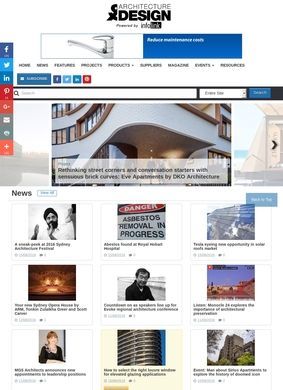
Architecture & Design Magazine is an Australian digital publication covering the built-environment industry, written for the architects, designers and construction professionals who work inside it. The homepage runs industry news, product news, sustainability pieces and a people section, so a first visit lands squarely in a working trade title, current and busy rather than archival.
The editorial split at Architecture & Design Magazine is easy to read. News covers major projects and the architectural awards circuit; product news tracks building materials and systems as they reach the market; the sustainability coverage concentrates on low-carbon construction, which is where a good deal of the Australian industry's attention sits at present.
A people section follows industry appointments, the who-went-where that matters to anyone doing business across the sector, and it is the sort of feature a reader checks without quite meaning to. The awards reporting is worth calling out on its own, since prizes drive a lot of attention in this field and a title that covers them well becomes a place people check during and after judging season.
Sustainability gets consistent room too, and framing it around low-carbon construction keeps the coverage concrete instead of vague green-building talk.
The standing features behind the news
What lifts Architecture & Design Magazine above a rolling news page is the set of standing features sitting behind the headlines. Magazine subscriptions and archives, project galleries, supplier product listings, a podcast and a professional-development stream all live here, and together they turn a news site into something closer to a reference tool an architect might come back to during a live job. A dedicated magazines section promotes the print publication itself, so the digital front and the periodical work as two halves of the same brand.
Subscriptions and archives sit in this area as well, which means Architecture & Design Magazine keeps its older material reachable instead of letting it drop off the end of a feed. A searchable back catalogue is quietly one of the more valuable things a trade title can offer someone researching a past project or product.
Project galleries and product listings
The project galleries are organised by building type, and the categories are specific: residential, commercial, education, hospitality, healthcare, sports facilities, mixed-use developments and heritage renovations. That granularity is genuinely useful. An architect chasing precedent on a healthcare fit-out or a heritage job can go straight to comparable work instead of scrolling a general feed hoping something relevant floats past.
Alongside the galleries, Architecture & Design Magazine runs product listings drawn from building-product suppliers, which is the commercial engine of a title like this and, for a specifier trying to work out what is actually available, a practical catalogue in its own right.
The honest read is that the supplier listings serve the advertisers as much as the reader, but the overlap is real: a specifier does want to know what products exist, and a supplier does want to be found, so the arrangement is not the empty filler it can be on weaker sites.
Podcasts and CPD sessions
The podcast puts industry leaders on the record in longer conversations, useful for the kind of context and back-story that never fits inside a short news item. More substantial is the CPD stream. Continuing Professional Development sessions count formally for architects, who have to log hours to keep their registration current, so hosting educational sessions gives Architecture & Design Magazine a hold on its audience that a plain news site cannot match.
A reader comes to Architecture & Design Magazine for the headlines and stays because the site also helps them meet a professional obligation they would have to satisfy somewhere anyway. That is a smart piece of positioning. Tying free reading to a paid-registration requirement builds a habit that a competitor offering only articles will struggle to break, and it explains why the account login sits so prominently on the page.
Signing up and the trust question
Getting involved with Architecture & Design Magazine runs through a newsletter signup and an account login or registration, and suppliers are pointed toward advertising options. The social channels are the usual four that a publisher of this kind keeps active: Facebook, X, LinkedIn and Instagram. What the site does not list is a phone number or a postal address, and no separate contact page or direct email address surfaced in searching.
For a digital publisher that leans on newsletters and accounts this is a soft spot more than a real failing, since readers reach it through the signup and the login, though a supplier or a reader with a specific query is left without an obvious front door to knock on.
On outside verdicts there is little to report, and it pays to be straight about it. No customer review platform, no Google, Trustpilot, Yelp, Facebook or BBB rating, carries feedback tied to Architecture & Design Magazine. Searches for reviews mostly return generic best-architecture-magazine listicles and rival Australian publications instead of any assessment of this specific site.
One automated trust checker rated an administrative subdomain as very likely legitimate, but that is a security score built from hosting and certificate signals, not a reader review, and it says nothing at all about the quality of the writing or the accuracy of the coverage.
That absence is not damning for a publisher, since readers rarely leave star ratings for a news site the way they would for a restaurant or a tradesperson, but it does mean a newcomer has to judge the work by reading it rather than by any tally of public feedback.
Set against the obvious alternative, the comparison is not a wipeout either way. A reader after Australian design coverage could go instead to ArchitectureAU, a competing title with a stronger name in critical architectural writing and long-form project criticism. Where Architecture & Design Magazine pulls ahead is breadth and everyday utility for the working professional: the supplier product listings, the type-sorted project galleries and the CPD sessions add up to a daily tool for specifying and staying current, more than a place to read essays about buildings.
Precedent images, supplier information and professional-development hours sitting in one place make Architecture & Design Magazine the more practical daily stop, even with no public reviews standing behind it to vouch for the work.