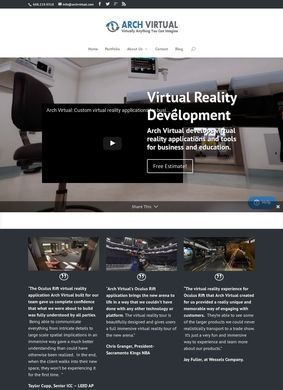
Archvirtual is a Madison, Wisconsin company that has been building custom virtual and augmented reality training since 2006, which makes it old by the standards of a field that most people only began taking seriously much later. The proprietary platform under the hood is called Acadicus, a VR training environment that ships with a library of simulation content meant to get measurable immersive lessons running quickly.
That detail says a lot about how the company operates: years of custom project work have been turned into a reusable foundation other organizations can now deploy on their own, instead of paying for every scenario to be built from scratch. The included content library does practical work for a buyer, who can evaluate the format on existing lessons before commissioning anything bespoke. That lowers the barrier for a training department wanting to test immersive instruction without a large upfront build.
VR and AR training for medical, safety, healthcare scenarios
The bulk of what the site describes falls into three areas. One is VR and AR training simulation aimed at medical, healthcare, and safety scenarios, the kind of high-stakes situations where rehearsing in a headset costs far less than rehearsing on a real patient or a live worksite. A trainee can repeat a procedure dozens of times in a simulation without consequence, and the company points to that repeatability as the practical argument for the medical and safety work.
Architectural visualization for buildings and real estate
Another is architectural visualization, walking through a building before it is built, which traces back to the company's roots and still serves real estate developers and architecture firms. The third covers interactive product demonstrations for sales and marketing, the sort of thing an equipment manufacturer might use to show how a large machine operates without shipping it to a trade show floor.
Interactive product demonstrations for equipment sales
What gives the offering some credibility is the spread of clients implied by those services. Healthcare institutions and medical education programs sit alongside industrial manufacturers and equipment makers, and that mix means Archvirtual has had to make its tools work across very different training problems. Safety drills, surgical practice, and a product walkthrough do not share much on the surface, so a platform flexible enough to handle all three has been pushed in genuinely useful directions.
Building Acadicus as a reusable platform
The Acadicus model also tells you something about the business itself: the company chose to productize rather than stay a pure services shop, which is a harder commercial bet but a more durable one if the platform holds. PitchBook lists the company as angel-backed, and it runs regional offices beyond the Madison headquarters, both of which point to something past a one-person operation. Angel funding is modest capital, not venture scale, so the picture is a small specialist firm with enough backing to keep developing Acadicus, not a startup chasing rapid growth. For a buyer, that profile usually means direct access to the people doing the work and a longer institutional memory of past projects, which is the trade Archvirtual is making against larger rivals.
Enterprise VR vendors rarely accumulate the consumer review trail that a restaurant or a plumber does. There are no ratings on Google, Trustpilot, Yelp, or the BBB, and IT-rating.com lists Archvirtual with a score of zero and no reviews at all, which reflects an empty profile more than a verdict. None of that is damning for a business that sells custom simulation work to hospitals and factories through direct relationships, but it does mean an outside party cannot lean on aggregate scores to size up quality. The evidence has to come from elsewhere, and for this kind of vendor it usually does.
A standalone app, Archvirtual HQ, sits on Steam with 80 percent positive sentiment across 21 user reviews, a small sample but a real one from people who used something the company made. Twenty-one reviews will not settle the question of whether the bespoke enterprise work is any good, but it is firsthand feedback on a shipped product, not a marketing claim, and few vendors in this category put even that much in front of a buyer. The LinkedIn presence runs to 384 followers, which reads as a quiet professional account rather than a marketing engine. Taken together these are the footprints of a specialist that wins work by reputation in its industry, not by chasing public visibility.
Direct contact and industry reputation over public ratings
Reaching the company is straightforward. A phone number and an email address both sit openly on the site, so getting to a human does not require digging through a chatbot or a web form. For buyers who expect to scope a bespoke project over a call, direct contact details count for more than any star rating, and their plain placement on the site fits the picture of a firm that works through relationships instead of a self-serve funnel.
Comparing Archvirtual to larger enterprise VR vendors
Set Archvirtual against a heavyweight like Strivr, the enterprise VR training firm that landed Walmart and other Fortune 500 names, and the difference in scale is obvious. Strivr sells polish, big-logo case studies, and a sales operation to match. What Archvirtual offers instead is a track record reaching back to 2006, a platform it owns outright in Acadicus, and a willingness to take on the narrower medical, safety, and architectural jobs that a larger competitor might treat as too small to bother with. The published evidence points to a credible and unusually seasoned operation for organizations that value a hands-on partner over a brand-name vendor.