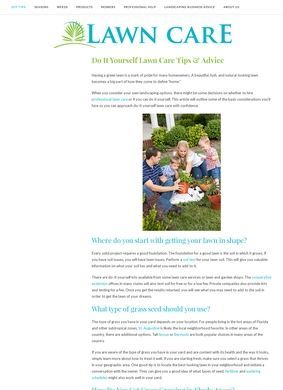
Lawncare.org sells nothing. No service to book, no quote form, no upsell waiting at the bottom of a guide. It is a reference site built around lawns, written for two distinct readers: the homeowner trying to figure out why the grass keeps thinning, and the person thinking about turning a mower and a trailer into a paying business. That second audience is the unusual part, and it shapes how the whole site reads.
Practical guides for homeowners and business operators
The bulk of the material is practical how-to writing. There are DIY sections on watering, aerating, and organic care, plus seasonal guidance broken down by spring, summer, fall, and winter. The seasonal angle is more useful than it first sounds, because lawn work is almost entirely about timing.
When you aerate, when you seed, when you stop feeding before frost, getting the timing wrong wastes more money than picking the cheaper bag of fertilizer ever will. Lawncare.org leans into that calendar logic instead of treating lawn care as one generic chore, and the section layout follows the same order. A reader can move from the watering basics to a fall feeding schedule without leaving the site, and the organic care material is a welcome inclusion for people who would rather skip synthetic chemicals on a yard where kids and pets spend time.
Seasonal timing and weed management coverage
Weeds get their own dedicated coverage, which suits the topic. Crabgrass prevention, moss control, and side-by-side comparisons of weed killers are the kind of thing people actually search for at the exact moment a problem appears in the yard. The product pages extend that further, with fertilizer recommendations and brand reviews naming the obvious heavyweights, Scotts and TruGreen among them. There is also a mowers area covering equipment comparisons and brand guides, which pairs naturally with the product write-ups since the two purchases tend to happen in the same weekend. None of this is original territory, but it is the right material for a site that wants to be the page you land on after typing a question into a search bar, and Lawncare.org has clearly built its sections around the questions homeowners actually ask.
Startup advice for lawn care entrepreneurs
The professional and business angle is where Lawncare.org separates itself from the standard pile of gardening blogs. One section covers professional help, explaining the difference between commercial and residential lawn care services for readers who would rather hire than do it themselves. Fair enough. But the more distinctive section is the landscaping business advice: startup guides, software recommendations, and marketing strategies aimed squarely at people launching their own lawn care operation. That is a real editorial decision. Most lawn sites stop at the homeowner. Lawncare.org keeps going into the part where lawn care becomes a livelihood, and the startup guides treat the unglamorous mechanics of running a small operation as seriously as they treat the grass itself.
I find that dual purpose genuinely interesting, because the two audiences rarely overlap on a single domain, and serving both means the content has to swing from "how to fix bald patches" to "which invoicing software to pick." Whether one site can do both well over the long run is an open question, and a visitor should set expectations accordingly. If you arrive wanting a quick fix for moss, the business material is noise you will scroll past. If you arrive wanting to start a company, the DIY guides are background reading at best. The breadth is a strength and a slight lack of focus at the same time.
What the site does not do is sell or book anything, and that is worth stating plainly because it changes how you should treat the recommendations. The brand reviews and product picks read as editorial guidance, so a reader should weigh them as opinion and still cross-check prices and current models elsewhere before buying. Treat Lawncare.org as a starting point for research, not a checkout.
Evaluating trust without author credentials
On the question of who stands behind the content, the site is harder to read. There is no phone number, no email address, and no physical address anywhere a visitor first arrives. A navigation link labeled About Us exists, which is the natural place to look for the people and the editorial intent, but no direct contact route surfaced beyond that. For a site that is purely informational and sells nothing, the absence of a phone line is understandable, and the missing email is a non-issue, since plenty of content sites skip it deliberately.
Still, a clearer path to reach someone, or even a visible statement of who writes the guides, would help a reader judge how much trust to place in the product comparisons. On a page steering you toward specific brands, that is a real gap in a way it would not be on a recipe blog.
A search for third-party reviews of Lawncare.org mostly turns up unrelated lawn care service companies, the local crews and franchises that share the same generic keywords, not this reference site. There is a joinchargeback.com entry for the domain, but it carries zero reviews, so it tells you nothing. No meaningful third-party ratings or commentary about Lawncare.org itself appeared in any business directory or review platform. That is not damning. A free educational resource can be perfectly solid and still never accumulate the Trustpilot footprint that a paid service collects, simply because nobody files a complaint about an article they read for free. It does mean the content has to stand on its own merits, without a chorus of outside voices vouching for it.
So the verdict comes down to what you need. For the homeowner chasing a seasonal answer, Lawncare.org is a reasonable stop: organized by the calendar, covering the common headaches, naming real products. For the would-be lawn entrepreneur, it offers something most rivals do not bother with. The catch is that you are taking the guidance on faith, with little visible authorship and no outside reviews to confirm the quality.
Comparing Lawncare.org to The Spruce
Weighed against the Lawn Care section of The Spruce, which carries clear bylines, editorial review notes, and a long track record, Lawncare.org looks lighter on the transparency that makes advice easy to trust. The Spruce also blends homeowner content with the broader home topics, where this domain stays narrow and adds the business material The Spruce ignores. For a quick how-to, either works. For someone serious about starting a lawn care company, Lawncare.org covers ground the bigger general sites simply leave out, and that focus is the better reason to bookmark it. Just go in knowing you are trusting unsigned guidance, and verify the product picks before you spend.